
As the “AI bubble theory” ravages the market, healthcare leading value stocks break through and rise
The Zhitong Finance App learned that as various pessimism about the “AI bubble” sweeps through global financial markets, global investors are re-examining large bets on technology-based stocks and bond assets that are closely linked to artificial intelligence and have vague AI monetization paths. As a result, investors have spent real money on valuable star stocks that have steady cash flow, long-term stable profit data, and historically low valuations compared to popular AI technology stocks such as Nvidia, AMD, and Micron.
In the current wave of global capital flocking to value stocks, the US stock market has long been defensive, and hedge funds tend to hedge against sharp market fluctuations. It is also a “healthcare company” that has long represented the trend of global value stocks. It can also be called the “biggest winner” in this wave of global capital rotation. According to the latest opinions of Wall Street financial giants such as Wells Fargo Bank, this year's Christmas frenzy may not arrive as scheduled as historical data suggests, so the rise that rotates to value stocks is far from over.
Value stocks (Value Stocks) generally refer to company stocks whose intrinsic value has been undervalued for a long time. They are usually characterized by low price-earnings ratio (P/E) +low net market ratio (P/B), long-term high dividend ratio, mature business lines, and relatively stable profit and cash flow over a long period of time, and mostly established companies. Over the past 10 years, technology and growth stocks have performed extremely well in an environment of low interest rates and loose monetary policies. Therefore, market capital often pursues companies (growth stocks) with “high growth and long-term bull market narratives”. It is easy to overestimate strong growth sectors and underestimate “boring” steady growth industries, leading to long-term discount trading of value stocks.
So-called value stocks usually focus on finance, essential consumer goods, utilities, traditional energy, telecommunications, and healthcare. Among them, the healthcare sector can be called a “weather vane” for measuring the momentum of global value stocks with steady growth in profits and stable allocation value among institutional investors over a long period of time, and best represents the trend of value stock changes.
According to the latest statistics, by the close of the US stock market on Tuesday, the S&P 500 Health Care Index (S&P 500 Health Care Index) had risen sharply by 10%, outperforming the other 10 sub-sectors in the S&P 500 index.
The S&P 500 index, the benchmark index for the US stock market, fell 1.1% during the same period. Among them, the stock price of Eli Lilly, which launched tiverpotide, which is popular worldwide, surged about 29%, making it the first healthcare company in the world to reach a market capitalization of 1 trillion US dollars. Regenerative Pharmaceuticals, Merck & Co. (Merck & Co.), and Biogen Inc. (Biogen Inc.) have also all risen sharply by at least 18% since the end of October, outperforming the S&P 500 and Nasdaq 100 indices across the board.
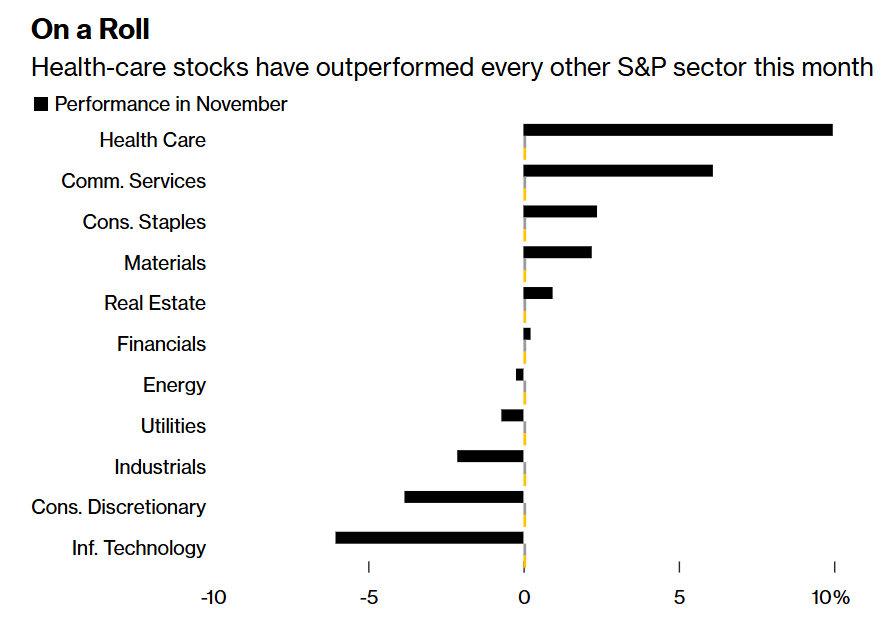
As the chart above shows, healthcare stocks are gaining momentum — outperforming all other sectors in the S&P 500 this month.
“Smart money” buys the healthcare sector
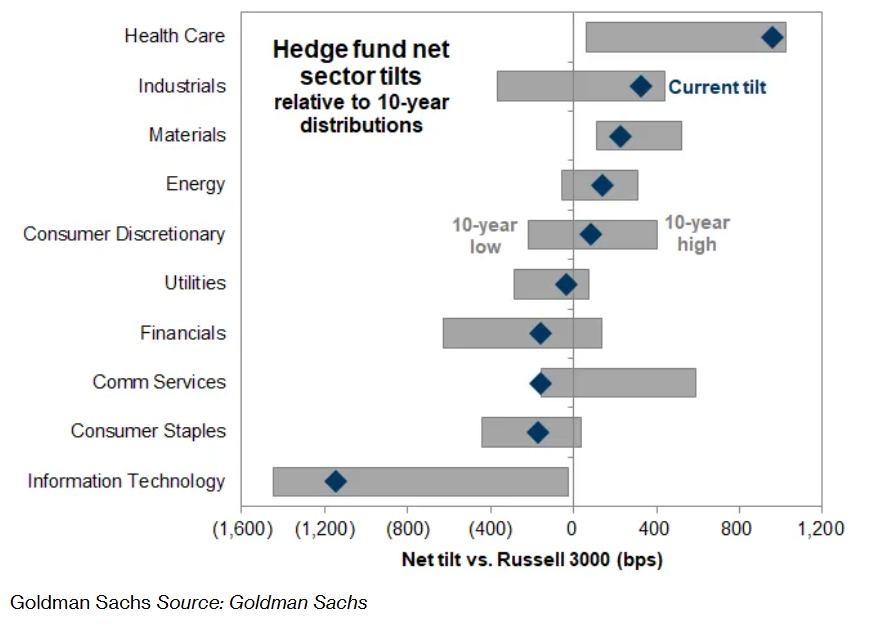
Most of this scale of capital rotation is driven by aggressive buying by hedge fund institutions that claim to be “smart money.” According to the bulk brokerage business statistics of Wall Street financial giant Goldman Sachs Group (Goldman Sachs), the US healthcare sector has been the value stock segment with the largest net purchases for four consecutive weeks, and last week's capital inflow was the largest inflow in more than five years.
The scale of mutual funds (Mutual Funds) purchases worldwide followed, increasing the allocation of this sector to the extent that such funds exceeded their allocation weight in the S&P 500 ETF, as shown by the agency's data.
“In the stock market where some technology sectors are clearly '100% perfectly priced' and there are fears and strong concerns about the AI bubble, investors are actively looking for undervalued values.” Sarah Hunt, chief market strategist at Alpine Woods Capital Investors, said.
At a time when healthcare stocks are surging, the S&P 500 index and the Nasdaq 100 index, which mainly focuses on technology stocks, are experiencing sharp fluctuations. Large intraday shocks have recently become the norm, and it is a good time for hedge funds to allocate value stocks. Global stock markets such as ORCL.US (ORCL.US), Nvidia (NVDA.US), AMD (AMD.US), and other “AI superdarlings” have been rare and continue to suffer severe falls for a long time. Among them, market default sentiment about Oracle is high, causing Oracle CDS transactions to be extremely popular.
Including Nvidia, Oracle, and popular global AI technology stocks such as TSMC, SK Hynix, Edwin Test, and Tokyo Electronics from Asia, have generally declined recently. The core logic behind this is that investors are increasingly worried that the future profits of these tech giants may not be sufficient to prove that current valuations are reasonable, and that the monetization/monetization path for AI applications is simply insufficient to support global technology companies to continue to spend huge sums of money to buy expensive Nvidia AI GPU computing power clusters. As non-agricultural data continues to weaken and occasionally negative growth, the market is increasingly concerned that a cooling US job market and continued inflation will reduce spending, and consumer stocks are also under pressure.
Strong upward movement in the global healthcare sector is largely in line with the performance of hedge fund research firm PivotAlpath Tracking, which compiled a health care index that rose 13% in the three months ending September. The company attributed the increase not only to global capital flocking to value stocks due to the fear of the AI bubble, but also to strong clinical trial results, unexpected acceleration in AI-enabled R&D pipelines, and an overall recovery in mergers and acquisitions between biotech and big pharma.
“Fund managers are currently optimistic about all the opportunities in the healthcare sector. However, there have been some obvious divisions within the sector, and excess earnings are being driven by the two forces of active mergers and acquisitions pipeline and smooth regulation.” PivotalPath CEO Jonathan Caplis said.
The real inflection point
In another research report that emphasizes quarterly positions, Goldman Sachs analysts said that excluding the brief spike in early 2020 and early 2023, hedge funds unexpectedly overallocated healthcare to the highest level in ten years while entering the fourth quarter performance assessment. Earlier in the third quarter, global fund managers had increased their overallocation to the healthcare sector by 260 basis points, while reducing allocation exposure to the optional consumer sector by almost the same amount.
Among some of the most notable individual stocks, the stock price of MSD, the US pharmaceutical leader, rose 23% in November. Previously, Wall Street was more optimistic about the company's future application prospects other than Keytruda, a major cancer drug, thanks to recent mergers and acquisitions and successful clinical trials.
Regenerative shares, on the other hand, rose sharply by 21%, after a high-dose version of its ophthalmic drug received regulatory approval. Investors expect this treatment to be in a better position to compete with Swiss pharmaceutical giant Roche Holding AG (Roche Holding AG)'s flagship drug. Amgen's stock price rose 14% this month. Previously, its quarterly earnings performance was far better than market expectations.
“The healthcare sector previously lagged behind the market for so long that people could grow even if they forgot about it. Now, in addition to being afraid of the AI bubble, when you see a real inflection point in both revenue and profit, the sector is finally receiving a large inflow of capital as a result.” David Mazza, CEO of Roundhill Financial Inc., said: “What makes this trend even more appealing is that valuations are still quite attractive for investment compared to historical data, so investors are receiving fundamental improvements without paying peak valuations.”
Needless to say, performance growth is also the core logic driving the emergence of hedge funds in healthcare. In the third quarter, America's largest public healthcare companies outperformed other industries. Increased use of new drugs and specialty drugs, continued growth in demand for diet pills, and strong growth in hospital visits all boosted profits.
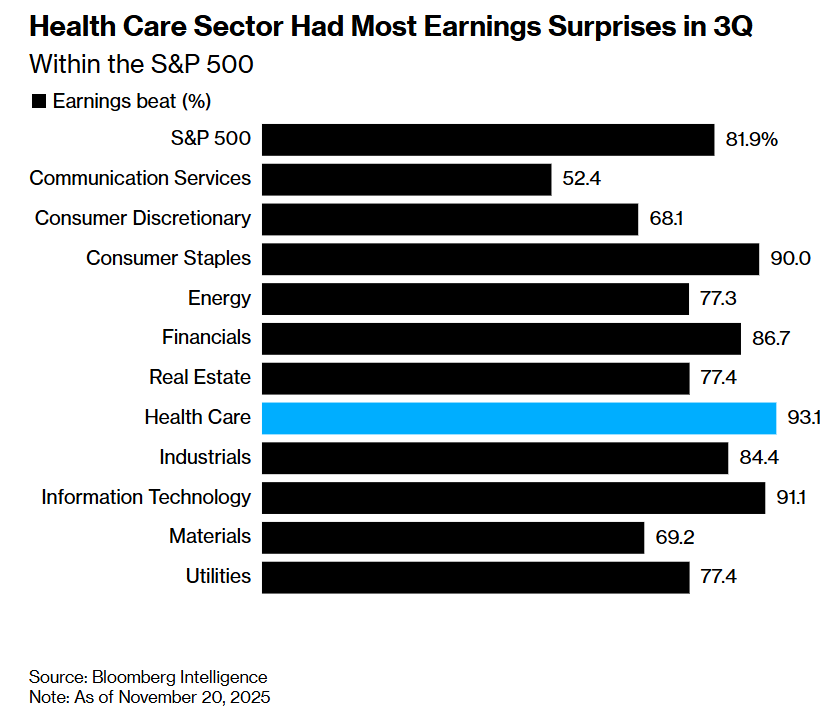
As shown in the chart above, among the 11 industry segments of the S&P 500 index, healthcare component companies in the index had the highest percentage of profits exceeding expectations during this period. It was also the industry's best performing quarter in more than four years.
In the US stock market, the current price-earnings ratio of healthcare stocks based on expected earnings for the next 12 months is only about 18.7 times, while the S&P 500 index as a whole is 22.1 times.
Goldman Sachs also pointed out that the trend towards the healthcare sector is most prominent in the biotechnology sub-field, which has benefited from the resurgence of clinical breakthroughs, the resurgence of mergers and acquisitions, and large-scale adoption of AI-driven drug development. Alnylam Pharmaceuticals Inc. is at the top of Goldman Sachs' so-called biotech “Rising Stars” (Rising Stars) list, while Abivax SA, Natera Inc. and Cidara Therapeutics Inc. were newly added to the bank's “VIP” list of hedge funds, that is, the most popular stock list for hedge funds.
“Christmas Faith” is facing a major test, and value stocks are expected to continue to rise
A few weeks ago, supported by global capital's continued popularity of popular AI concept technology stocks, steady corporate profit data, and consistent strong seasonal trends in the stock market, Wall Street's expectation that the US stock market would rise strongly again at the end of the year (the so-called “Christmas boom”) seemed almost certain, but with recent uncertain expectations of the Federal Reserve's interest rate cut and pessimistic opinions surrounding the “AI bubble,” Wall Street's institutional investors are no longer so sure about the rise in US stocks. Instead, bullish sentiment about value stocks continues to heat up.
Investors, on the other hand, continue to show signs of being cautious. The latest statistics show that demand for options to hedge against the downside risks of large technology stocks such as Nvidia and Microsoft is close to the highest level since August 2024. After three consecutive weeks of intense turmoil in global stock markets triggered by AI bubble rhetoric, the VIX Index is around 20 points, which is generally regarded as a sign of increased selling pressure on the market.
“Seasonal benefits are always investors' friends, but it's important to remember that it's not absolute.” Dan Greenhaus, chief economist and strategist at Solus Alternative Asset Management LP, said.
Ed Yardeni, founder of the Yardeni Research Investment Company named after him, said that the S&P 500 index is unlikely to rise to 7,000 points by the end of this year — this whole number will rise by about 4% from the current level. Yardeni said that the main reason is that some investors have settled profits on popular AI-related stock positions. JC O'Hara, chief market technical analyst at Roth Capital Markets, called for investors to remain cautious about technology stocks in a report last Sunday.
Wall Street financial giant Wells Fargo has downgraded the IT section of the S&P 500 Index (popular AI technology stocks such as Nvidia, Microsoft, and Broadcom are all in this sector) from “buy” to “neutral”. The core reason is that the current valuation is too high.
Wells Fargo strategists recently said that a wider sector rotation is emerging in the market, and investors are shifting from the technology sector to a defensive value sector. Therefore, Wells Fargo suggests investors gradually reduce their holdings in consumer and high-value technology stocks, while also recommending returning the allocation of healthcare stocks to a standard allocation, while moderately increasing the allocation to value sectors such as utilities, industry, and finance.
According to a recent J.P. Morgan Chase report, the core narrative of the current market has changed from “keeping an eye on the Federal Reserve” to “rotating from big market technology to value stocks.” The agency believes that whether interest rate cuts are suspended or further interest rate cuts will be strengthened in the future, capital migration from technology to value. J.P. Morgan strategists said that current value factors are undervalued globally, and US values in particular are very attractive.