
“AI+ treadmill” is hard to save! Next-generation treadmills and spinning bikes get cold, Peloton (PTON.US)'s AI ambitions are being hit
The Zhitong Finance App learned that the latest statistics show that Peloton Interactive Inc. (PTON.US), which focuses on fitness exercise bikes and treadmill products since this year, the “AI+ intelligent fitness product” terminal strategy — that is, the strategy centered around “AI+ exercise bikes” and “AI+ treadmills” has failed to achieve positive results. Since the launch of these new intelligent products, sales of fitness equipment driven by Peloton's new artificial intelligence technology have shown a weak trend, and since this year, the company has promoted this AI-driven fitness device as a core “catalyst” for fulfilling long-term growth promises and a complete reversal of business.
According to the latest media disclosure, according to statistics revealed by many people in charge of dozens of Dick's Sporting Goods and Johnson Fitness & Wellness stores across the US — these two are the two major physical offline retailers of Peloton equipment. After eight weeks of launch, the company's new AI product line called Cross Training Series only gained moderate market appeal in retail stores. Store managers said that although attracted by the newly launched high-end treadmills and exercise bikes driven by AI technology, there has been an increase in the number of customers who come to try it out, but this has not yet translated into impressive actual in-store sales.
Despite this, according to one insider, Peloton management still anticipates a gradual increase in sales with the arrival of the year-end holiday shopping spree in the US. The company is already running a major “Black Friday” promotion, including discounts of up to $1,500 on high-end treadmill plus accessory sets. According to data from the trade database ImportGenius, in order to meet the expected demand during the holiday shopping season, the company has recently increased its warehouse's seaborne import volume compared to previous years.
A Peloton spokesperson declined to comment. The company's stock price fell as much as 2.3% intraday on Tuesday, hitting a low of the day, then rebounded, closing at $6.74, up 2.1%. The stock is down about 23% this year so far.
Peloton, the “apple of the fitness industry” that fell to the altar, turned to an “AI+ strategy”
As shown in the chart below, when looking at sales by fiscal year and product line paid subscription benchmarks, Peloton's once “meteor” strong growth pace is difficult to replicate as the “pandemic dividend” completely declined from 2020 to 2022. Demand for Peloton smart fitness equipment continued to explode during the COVID-19 pandemic, and was once hailed by some Wall Street analysts as the “Apple Company in the global fitness industry.”
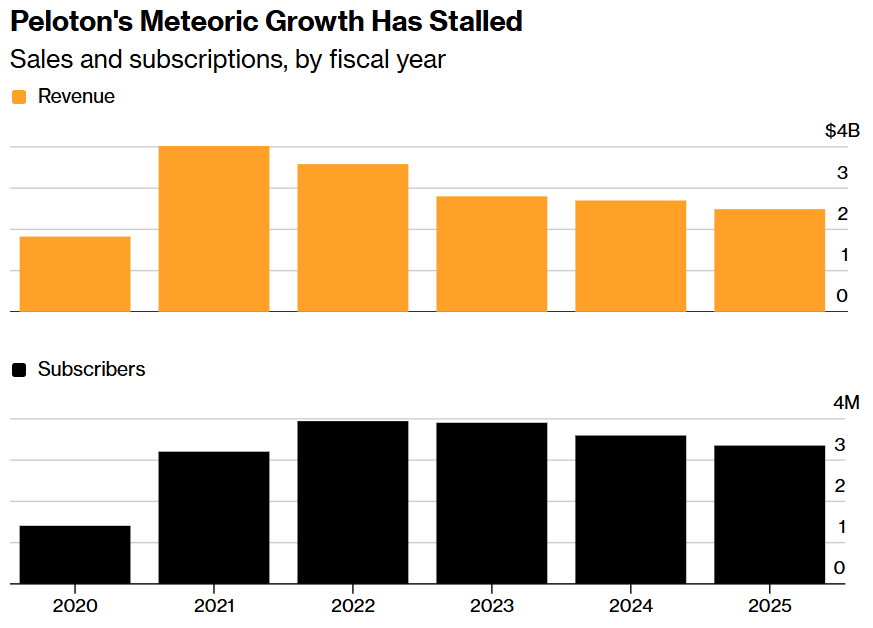
Peloton's sales have been sluggish for many years since the COVID-19 lockdown was completely over and people stepped out of their homes to exercise and get in shape outdoors and in gyms. Upgraded devices driven by AI technology released last month under the new management leadership include the redesigned Bike, Bike+, Tread, and Tread+, as well as the Row+, which replaced the previous fitness rowing machine. All of these intelligent new fitness machines are equipped with Peloton IQ, an AI platform that provides personalized guidance, exclusive insights, and scientific training plans.
The “new AI-driven devices” that Peloton management recently focused on are mainly the five new fitness machines in the Cross Training Series series newly released by Peloton. They add upgraded sensor systems such as cameras and microphones to the hardware, and are uniformly equipped with Peloton IQ, a complete AI-driven private education system in the software system, which is a complete upgrade to the old Original Series.
Peloton IQ is committed to providing personalized weekly training plans, course recommendations, performance analysis and summaries, and will automatically adjust according to users' goals and historical training. The new Cross Training series has also been significantly upgraded in the “AI era” in terms of hardware. The large swivel screen (swivel screen) is convenient for aerobic cutting to ground strength training, and the front speakers and Sonos tuning mean more emphasis on the immersive course experience, as well as faster Wi-Fi and more stable Bluetooth connections, plus being compatible with more wearable devices (Apple Health, Fitbit, Garmin, etc.).
For Plus fitness equipment models such as Bike+, Tread+, and Row+, it is also possible to achieve real-time motion correction, automatic counting, intelligent weight recommendations, free rhythm strength training, and advanced functions such as AI-based intelligent system training, advanced strength tracking, and adaptive aerobic training through the motion-tracking camera + computer vision on the fuselage.
Price tag shock
One of the key resistances may be a “sticker shock (sticker shock).” Peloton raised sales prices across its entire product portfolio — meaning equipment costs increased by an average of 11% and subscription fees by around 19%. Wall Street analysts expressed concern when Peloton announced the price increase, believing that it would weaken Peloton's ambition to attract new members in the current low-growth economic environment in the US.
As of the second week of November, the “Bike+” Cross Training Series product page on the e-commerce platform Amazon website shows that only about 50 people have purchased Peloton's newly launched “AI+ exercise bike” product in the past month. According to a source familiar with the matter, the Peloton warehouse's shipping flow was still very slow during about the same time period.
However, there have also been some positive signs: since the company launched the “Black Friday” promotion, the approximate number of sales expected for this product on the Amazon e-commerce platform has increased to more than 100 units. According to UBS Group (UBS) statistics, the number of visitors to Peloton's website in October was roughly the same as the same period last year — while website traffic dropped 18% year over year in September, which is a positive improvement.
The market launch in October coincides with a period when sales of fitness equipment are usually relatively quiet, as related spending generally picks up quickly in the early part of the Christmas shopping spree season from early to mid-December. Driven by consumers' determination to slim down and lose weight healthily in the new year, demand for fitness products will generally maintain strong growth until mid-February. Peloton said that this year's holiday shopping season revenue will reach US$665 million to US$685 million, which is roughly the same as the midpoint of the range compared to the same period last year.
“Many American families have tight budgets, and many people are concerned about discounts and offers.” Neil Saunders, managing director of GlobalData, said. “The problem with Peloton remains the same: its products are too expensive, so many consumers choose lower priced brands. I doubt that AI technology embedded in fitness devices may not necessarily bring much of a differentiated experience among mainstream consumer groups.”
Peloton's chief financial officer Liz Coddington said shoppers often go through a “period of consideration or indecision,” during which they research and evaluate before deciding whether to buy these expensive fitness equipment. She said at a Citigroup Inc. (Citigroup Inc.) internal investor conference in September: “This may take quite a long time to consider before someone decides to invest in our high-priced products.”
Meanwhile, CEO Peter Stern — a former Apple executive who joined Peloton earlier this year to lead the complete transformation of the business and steer the company's “AI Ambition” product line strategy, said in a performance conference call this month that the company plans to increase marketing investment to spread Peloton IQ's “AI+ fitness” knowledge to a wider range of American consumers. The platform has been positioned as one of Peloton's high-end intelligent fitness product line Core selling point.
Product safety may also be a top concern on the minds of some shoppers. Earlier this month, Peloton voluntarily recalled about 877,800 high-end intelligent Bike+ exercise models in the US and Canada. Earlier, there were reports that some products had broken seat tubes, causing cyclists to fall. Although this recall doesn't involve a recently launched hardware line, it's reminiscent of a 2023 scene — when Peloton recalled more than 2 million fitness cushions from its Original Bike product line.