
BDC's financial report shows the undercurrent of private equity credit in the US: the overall situation is stable, and the cracks are already spreading
The Zhitong Finance App learned that since this year, concerns about the US credit market have always lingered, especially the private equity credit market, which appears weak and opaque compared to the banking system. As a key bridge between SMEs and private equity capital, financial reports released by several commercial development companies (BDCs) earlier this month are seen as an important window into the health of the private equity market as market concerns continue to heat up. Although these financial reports reflect the stability of the overall private equity market, warnings from market participants suggest that we cannot let our guard down easily.
Overall stable, local pressure
Business Development Companies (BDCs) specialize in pooling private equity credit resources for various types of SMEs, which are often difficult to finance through traditional capital markets. John Cole Scott, president of CEF Advisors, once said, “BDC's latest earnings report is essentially a real-time stress test of private equity credit. Compared to banks, BDC's financial reports can provide more timely credit data.”
According to the data, Blue Owl Capital (OBDC.US)'s net investment income for the third quarter was US$190.1 million, which fell short of analysts' average expectations; Ares Capital (ARCC.US)'s net investment income for the third quarter was US$338 million, which also fell short of expectations. Main Street Capital (MAIN.US) and FS KKR Capital (FSK.US) had net investment income of $86.5 million and $159 million respectively in the third quarter. Furthermore, the dividends of these BDCs have remained stable.
At the same time, one of the core indicators for measuring the credit quality of BDC portfolios — the share of non-accrued investments (in fair value) — showed a fair situation. As of the end of the third quarter, Main Street Capital and FS KKR Capital accounted for 1.2% and 2.9% of non-accrued investments, respectively, down from 2.1% and 3.0% at the end of the second quarter. However, Blue Owl Capital's core indicator did not perform well, nearly doubling from 0.7% at the end of the second quarter to 1.3% at the end of the third quarter.
A low and stable share of unaccrued investment usually means that BDC borrowers are in good overall health. In contrast, a rising share of unaccrued investment is a clear danger sign that asset quality is deteriorating and that more loans may be at risk of default.
It is worth mentioning that most of BDC's new non-performing asset list transactions in the third quarter involved corporate loans to consumers. After Carlyle BDC listed Roomba manufacturer iRobot Corp as a bad asset, the company revised its credit agreement for the sixth time in August. Blue Owl BDC classified loans from online health insurance platform GoHealth Inc and wig supplier Beauty Industry Group as non-performing assets. As a result, the share of non-performing assets rose to 1.3% of the portfolio in the third quarter, nearly doubling from 0.7% at the end of the second quarter. FS KKR took over live events company Production Resource Group after an October restructuring.
As an industry leader, Ares Capital's share of non-performing loans remains low, and the issuance of new loans is strong, indicating that its risk control capabilities and asset choices are still resilient. Main Street Capital continued its conservative strategy, with high-rated assets accounting for more than 85% of the portfolio and maintaining a dividend coverage ratio of more than 1.3 times, showing strong cyclical resistance.
In contrast, FS KKR faces greater challenges. Its financial report revealed that some consumer finance and subprime car loans-related positions experienced a fair value reduction, and impairment reserves for the third quarter increased by about 18 million US dollars compared to the previous quarter. Although management emphasized that “the default rate is still within a manageable range,” the market is concerned about the results of its high concentration of assets.
The pressure on BDC's stock price reflects insufficient market confidence and may face greater pressure next year
Since this year, BDC stock prices have continued to be under pressure, and the S&P BDC index has significantly outperformed the US stock market. In response, Jefferies analyst John Hecht pointed out that BDCs generally hold a large number of floating interest rate loan assets. Against the backdrop of expectations of the Federal Reserve's interest rate cuts, their future interest income is being compressed, and dividend attractiveness has declined, thus triggering a correction in valuation. Furthermore, market concerns about the credit risk of the underlying assets of the BDC portfolio have also increased selling pressure.
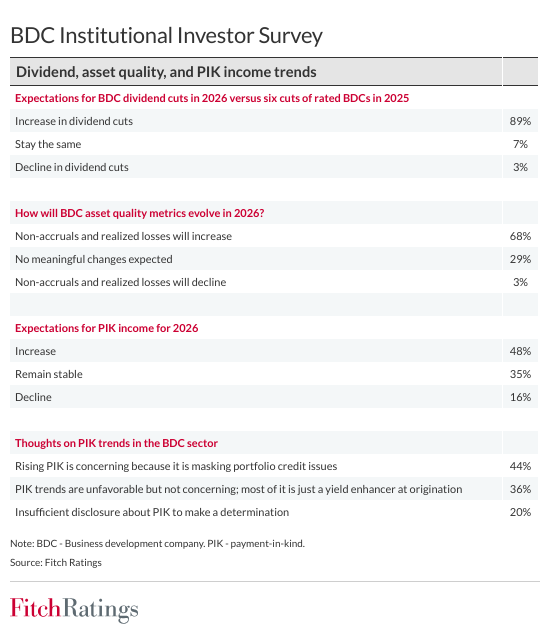
Listed commercial development companies (BDCs) may face greater pressure next year as interest spreads narrow further and the scale of payments in kind (PIK) is expected to rise, according to a report released by rating agency Fitch on Wednesday. Earlier this month, Fitch had already classified BDC's rating outlook as “deteriorating” on the grounds that the pressure on asset quality caused by the challenging economic environment will persist for a long time.
Fitch said that falling interest rates are another focus of investors' attention and will also push BDC to cut dividends further in the next few quarters. As dividends fall, BDC's leverage and liquidity levels are likely to decrease, and this dynamic will test BDC's tolerance for mechanisms such as PIK.
PIK allows borrowers to defer interest payments until the debt itself needs to be repaid. The mechanism accrues interest to loan principal rather than cash payments, providing temporary buffer to borrowers while whitewashing lenders' performance. However, the scale of such high-cost debt continues to expand, raising market concerns that private equity credit funds are using IPK to cover up the deterioration in loan quality.
Nearly half of the market participants surveyed by Fitch (including fixed income investors, banks, and BDCs) expect the size of PIK to rise in 2026. However, interviewees also emphasized the importance of distinguishing between “good PIK” and “bad PIK.” Fitch's report notes that while a “healthy PIK” constructed during the transaction design phase can improve returns and provide flexibility, additional PIK during restructuring or amending terms may “lead to an increase in ultimate non-performing assets and losses.” Although falling interest rates may ease borrowers' demand for such flexible mechanisms, Fitch believes that “PIK will remain high because fund managers are used to this option.”
Risk surges in the private equity market
Federal Reserve Governor Cook said on Thursday that given the “increased complexity and interconnectedness” of leveraged companies, officials should monitor how unexpected losses in private equity credit may spread to the wider US financial system. Cook said she is concerned about what can be learned from the increased use of PIK arrangements as seen in recent bankruptcy cases. She said, “When the scale and complexity of exposure to these arrangements lack transparency, when an industry experiences a period of rapid growth, and when these arrangements have yet to go through a full credit cycle, we are more likely to see cases like recent news stories reappear.”
Cook also said that the recent bankruptcy of private companies in the automotive industry has also revealed unexpected losses and exposures in a wide range of financial entities, including banks, hedge funds, and specialty finance companies. Her speech echoed Federal Reserve Governor Barr's concerns. Barr said earlier this week that he sees private equity as an area of potential risk.
However, Cook also said that the financial system remains resilient despite high asset values, the growth and complexity of the private equity market, and the potential vulnerability of hedge fund activities that may cause chaos in the treasury bond market.
In contrast, Jeffrey Gundlach (Jeffrey Gundlach), founder of Dual Tier Capital and the “King of New Debt,” warned the private equity market more sharply. He recently stated bluntly that the $1.7 trillion private equity credit market is undergoing “garbage lending”. Its speculative behavior is comparable to the eve of the 2006 subprime mortgage crisis, and may trigger the next round of collapse in the global market.
As a veteran bond investor, Gunlak is particularly concerned about the expansion of private equity funds to retail investors, saying it has created a “perfect mismatch” between liquidity promises and illiquid assets. He even predicted that the next major financial market crisis would come from private equity credit, which had the same characteristics as the 2006 repackaging of subprime mortgages.
Gunlak's concerns did not come out of nowhere. The bankruptcy of auto lender Tricolour and auto parts supplier First Brands provides evidence of risk accumulation in the private equity market. BlackRock recently directly deducted the value of the loan it provided to the home improvement company Renovo Home Partners from the face value to zero.
Furthermore, as a “popular” giant in the US private equity credit market, Blue Owl's recent severe setback also revealed a rift in this market. On Wednesday, Blue Owl suddenly announced the cancellation of the merger plan of its two private equity funds. This reversal caused its stock price to fall to its lowest point since 2023. The merger was originally intended to merge a private equity fund into the publicly listed Blue Owl Capital Corp., but investors may face book losses of up to 20%, causing a sharp rebound in the market and regulatory concerns.
Even worse, liquidity pressure is surfacing. There was a surge in redemption applications from the private equity funds involved. The redemption amount approved in the third quarter was about 60 million US dollars, which has already broken through the pre-set limit. Although Blue Owl promised to resume redemptions in the first quarter of next year after the merger ends, the market is concerned that if the redemption wave continues, the fund may be forced to limit capital outflows.
Another US private equity credit giant, Capital One, was also sold off due to rising non-performing asset ratios — the reduction in insiders holdings and the rise in bad write-off rates (42 basis points, far exceeding the seasonal norm of 19 basis points) are all alarms for the market.
Rich Privorotsky, head of Goldman Sachs Delta-One division, said bluntly in the latest report: “Perhaps we should pay more attention to Blue Owl and Capital One.” He pointed out that as the market indulges in the tech stock boom, the pressure of the “K-type economy” is showing — not only is Blue Owl facing investor withdrawal, but Capital One in the consumer finance sector is also falling due to rising non-performing asset ratios. This shows that the underlying assets of the US credit system, from institutional credit to personal credit, are bearing the slow impact of the monetary tightening cycle.
Although institutions such as Morgan Stanley predict a financing gap of 1.5 trillion US dollars for AI infrastructure in the next few years, of which about 800 billion US dollars may be covered by private equity credit, current market turmoil suggests that private equity may be the weakest part of supporting this grand narrative. The problem is that the market is generally concerned that lower interest rates will reduce private equity loan earnings, while the economic slowdown may increase the risk of SMEs defaulting, leading to a deterioration in asset quality. Josh Easterly, Co-Chief Investment Officer of Sixth Street Partners, warned that given anticipated interest rate cuts, private equity credit returns across the industry will no longer show the glory of the past few years.
summed
The BDC earnings report for the third quarter is like a mirror, reflecting the real picture of the US credit market where interest rate shifts intertwined with the economic slowdown: overall, it is still within a manageable range, but structural weaknesses are showing. The risks revealed by BDC's earnings report are a microcosm of multiple pressures at the macro level. Pressure on small and medium-sized enterprises is rising, and the debt burden accumulated over the past two years is still eroding corporate cash flow (especially for sub-prime borrowers who rely on short-term financing). Against the backdrop of slowing income growth, solvency is clearly weakening. Furthermore, the linkage between banks and private equity credit has deepened — industry data shows that currently about 30% of BDC funding comes from bank cooperation or structured financing arrangements. If credit risk spreads further, it may be transmitted to the traditional banking system through cooperative channels.
Investors need to pay close attention to changes in the solvency of SMEs, the evolution of BDC asset quality, and risk transmission between banks and private equity credit. Although market fluctuations are unavoidable in the short term, the possibility of a systemic crisis is still low without major shocks. However, as history has repeatedly reminded, credit risk often quietly accumulates in silence, and the real test may be yet to come.