
IPO Prospects|Rapid Revenue Growth | Xinde Semiconductor submits the table “while it's hot”. When will the high-end testing rising star give a profit schedule?
In recent years, with the rapid development of emerging technologies such as AI, 5G, the Internet of Things, and automotive electronics, it has stimulated strong demand for high-efficiency, low-power chips, thus driving the semiconductor market to continue to grow. The entire market is rapidly expanding, and in this context, the resources required for various segments have increased dramatically. This has promoted the further deepening of vertical specialization and has become a major trend in the development of the industry. Currently, although traditional semiconductor giants still maintain a certain level of IDM operation, more and more semiconductor companies are adopting a fabric-free model to invest more resources in complex chip designs and outsource their manufacturing and packaging testing processes to third parties.
According to the data, the size of the global semiconductor packaging and testing market in 2024 was 649.4 billion yuan, and it is expected to further increase to 933 billion yuan by 2029, with a compound annual growth rate of 7.5% during this period. The market is booming. Zhitong Finance noticed that Jiangsu Xinde Semiconductor Technology Co., Ltd. (hereinafter referred to as “Xinde Semiconductor”), which specializes in providing semiconductor packaging and testing technology solutions, recently submitted a listing application to the main board of the Hong Kong Stock Exchange.
According to the company's prospectus, Xinde Semiconductor was founded in September 2020. It has accumulated rich experience in packaging technology and has mass production capacity for advanced packaging, covering QFN, BGA, LGA, WLP and 2.5D/3D. Thanks to its technical capabilities and mass production capabilities, Xinde Semiconductor's packaging products have been recognized by many well-known customers, and the company's revenue continues to grow. However, for Xinde Semiconductor, which is determined to enter the capital market, it seems that the company's profitability still needs to be strengthened. Zhitong Finance will continue to pay attention to whether it can impress investors in the Hong Kong stock market in the future.
Rapid revenue expansion, profitability needs to be strengthened
In the “post-Moorish era,” where transistor density growth is approaching the limit of its scale, relying on new semiconductor packaging architectures as a key part of chip design and application has become a key driving force for improving chip performance, efficiency, and functional flexibility. According to Frost & Sullivan, Xinde Semiconductor is one of the few advanced packaging product providers in China to gather all technical capabilities such as QFN, BGA, LGA, WLP, and 2.5D/3D. At present, the company has built a “Chip and Advanced Packaging Technology Platform (CapIC)” covering all branches of advanced packaging technology to promote technical knowledge and continue to develop cutting-edge technology.
In terms of financial performance, in 2022 to 2024, Xinde Semiconductor's revenue was 269 million yuan, 509 million yuan, and 827 million yuan respectively, maintaining a rapid growth trend. In the first 6 months of this year, the company's revenue reached 475 million yuan, an increase of 20% over the previous year.
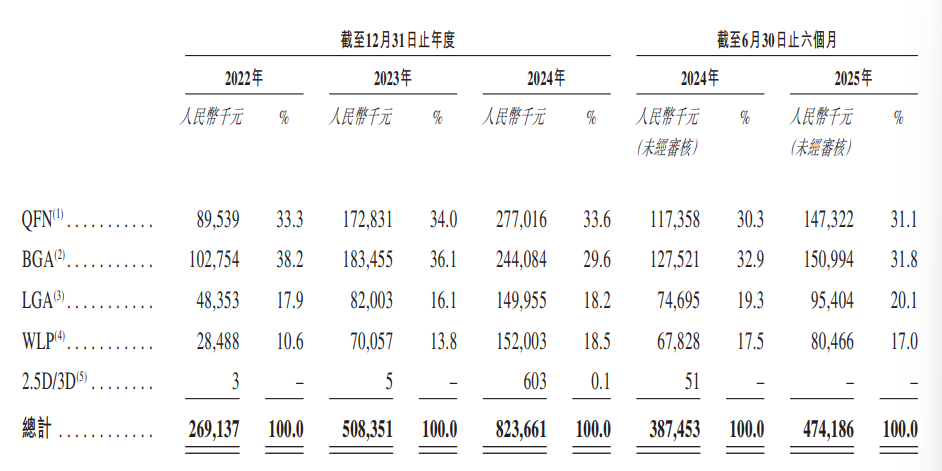
Looking at the split revenue structure, the vast majority of Xinde Semiconductors' revenue comes from providing packaging products and testing services, and this business accounted for more than 99% of revenue during the reporting period. In the same period, the company also generated a small portion of its revenue from waste and material sales. If we further divide the package testing services provided by Xinde Semiconductor by type, the revenue generated by providing QFN and BGA products has always accounted for the majority. In the first half of 2025, these two businesses accounted for 31.1% and 31.8% of revenue, respectively. During the reporting period, the revenue generated by Xinde Semiconductor's provision of LGA and WLP products continued to increase. Their share also increased from 17.9% and 10.6% in 2022 to 18.2% and 18.5% in 2024, respectively. In the first half of this year, these two businesses accounted for 20.1% and 17% of revenue, respectively.
In addition, according to region, the vast majority of revenue from Chip & D Semiconductors during the reporting period came from the domestic market. From 2022 to the first half of 2025, domestic market revenue accounted for 93.9%, 96.1%, 97.6%, and 97.9%, respectively. In the first half of this year, the company's total revenue from other Asian countries and the US market has shrunk to 9.899 million yuan, accounting for only 2.1%.

Despite the impressive overall revenue performance, as mentioned at the beginning of the article, there is still plenty of room for optimization in various profit indicators of Xinde Semiconductors. From 2022 to the first half of 2025, Chip Semiconductor's gross profit was -215 million yuan, -196 million yuan, -167 million yuan, and -774.05 million yuan respectively, with net profit of -360 million yuan, -359 million yuan, -377 million yuan, and -219 million yuan respectively. Up to now, the company has not achieved profit, but the good news is that Schindler's gross profit loss is narrowing year by year.

Can a new high-end test star take the lead later?
There are a total of about 150-200 OSAT (Commissioned Semiconductor Packaging and Testing) companies in China's semiconductor packaging and testing industry. Among these, most OSAT's overall revenue scale is small, and advanced packaging testing revenue accounts for a relatively low proportion of total revenue. Furthermore, due to the diversification of semiconductor products, two types of OSAT have been formed on the market, including general-purpose OSAT products and application-specific OSAT.
In terms of 2024 revenue, Xinde Semiconductor ranked 7th in China's general-purpose semiconductor OSAT, with a market share of about 0.6%. Additionally, Xinde Semiconductor is the most recently established player among the top eight companies in this field. What is certain is that in the more than 5 years since its establishment, Xinde Semiconductor has achieved strong growth performance in the field of segmentation, but when comparing the industry horizontally, it is not difficult to see that the gap with the industry's leaders is not small. Judging from last year's data, the total market share of the top three domestic general-purpose semiconductor OSAT participants is over 50%. In a sense, it can be said that they are out of step.

As a rising star in the industry, Xinde Semiconductor uses R&D as an important starting point for deepening its own barriers and achieving catch-up. According to the company, Xinde Semiconductor's R&D strategy covers five key dimensions, including high-performance 2.5D/3D packaging solutions, high-precision optical sensing solutions, automotive-grade packaging technology, innovative glass substrate technology, and iterative research and development of existing technologies, to construct a full-scenario technical layout.
In terms of market strategy, Xinde Semiconductor plans to strategically expand overseas markets. Next, the company plans to focus on entering the markets of Taiwan, South Korea, Japan, Southeast Asia, the US and Germany. Its goal is to establish a stable business foundation in these countries and regions, and then grow into a truly globally competitive packaging testing company in the future.
As Xinde Semiconductor officially launches its sprint to the Hong Kong Stock Exchange, this new star in the field of sealing and testing is bound to receive more attention in the future. This will surely be both an opportunity and a challenge for Xinde Semiconductor. Next, whether the revenue scale of Xinde Semiconductor can be further expanded, and when will the scale effect bring about profit elasticity. These questions are expected to be the core concerns of investors, and there is an urgent need for the company to provide answers.