
The cost of AI gambling: Oracle (ORCL.US) CDS costs have soared by 2 times, becoming a new tool to hedge against the AI collapse
The Zhitong Finance App notes that the once conservative database giant Oracle (ORCL.US) has now borrowed tens of billions of dollars and closely linked its fate to the artificial intelligence boom, and is rapidly becoming a weather vane for the credit market to measure artificial intelligence risks.
In recent months, traders have poured into the company's credit default swap contracts. Oracle's huge spending in AI-related fields, its central role in a range of interrelated transactions, and a weaker credit rating compared to participants such as Microsoft or Alphabet have made these contracts the go-to tool for hedging — or even shorting — the AI boom.
According to data from ICE Data Services, in recent months, the costs required to prevent the company from defaulting on debt within five years have tripled, reaching a peak of 1.11 percentage points per year on Wednesday, that is, about 111,000 US dollars for every 10 million US dollars protected.
Jigar Patel, a credit strategist at Barclays Bank, said that with the influx of artificial intelligence skeptics, the company's credit default swap volume had soared to about $5 billion in the seven weeks ending November 14. The trading volume for the same period last year was just over $200 million.
“As we often see in the market, liquidity creates more liquidity, and once this flywheel starts spinning, it often continues,” said Matt Schrager, co-head of automated trading at TD Securities.
Oracle's stock price also reflects growing investor concerns. From September 10 to the close of trading on Wednesday, its market value has shrunk by about one-third.
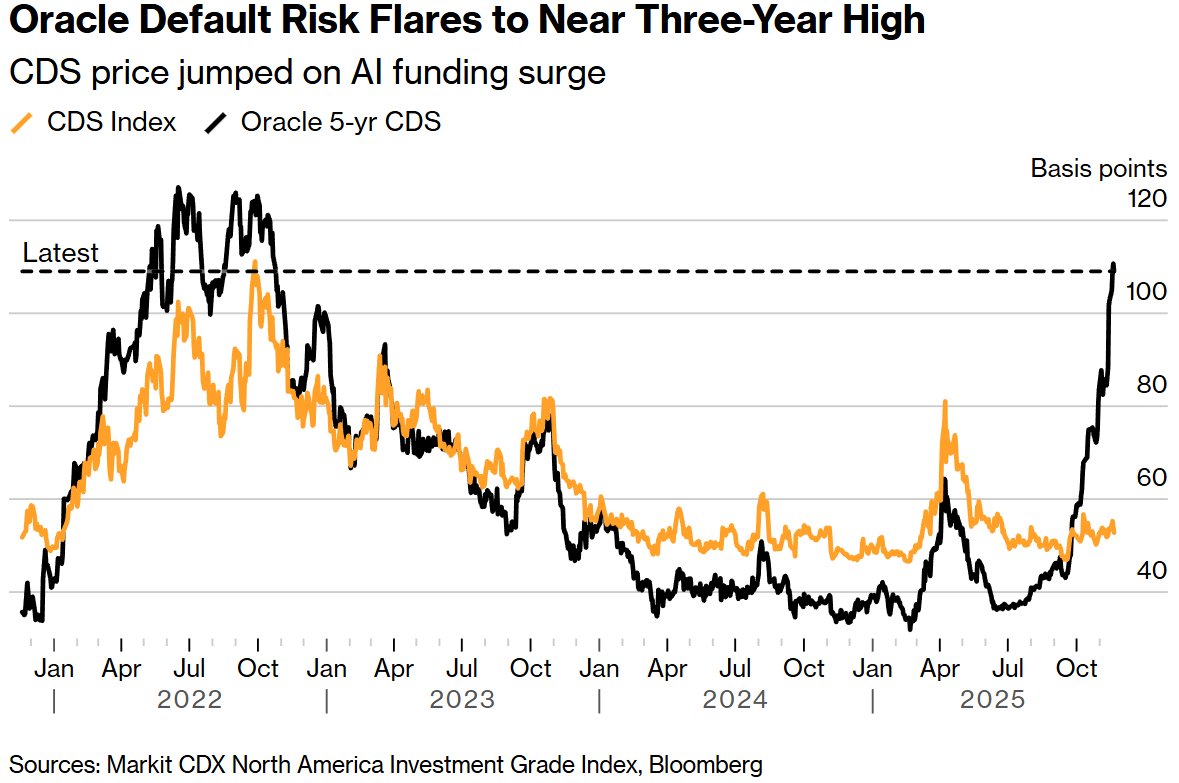
Oracle's default risk soars to nearly three-year high
To be clear, there are few opinions that the company, which has a triple investment rating and a market capitalization of about $620 billion, will soon default. Instead, the market view is that if investors' confidence in artificial intelligence falters, Oracle's credit default swaps will soar further, bringing significant profits to investors who buy the derivative and offsetting their losses in the broader market sell-off.
AI-related stocks returned early trading gains on Thursday, triggering widespread sell-off in the market due to renewed concerns that corporate revenue and profits may not keep up with the huge expenses associated with the technology. At one point, Oracle's stock price fell 5%, while the price of its bonds remained stable. Its credit default swap price dropped slightly to about 1.09 percent.
Oracle is one of the largest companies investing in artificial intelligence. Along with OpenAI and SoftBank Group, it is an important participant in the “Stargate” project, which plans to quickly invest 500 billion US dollars to build artificial intelligence infrastructure.
As part of the plan, a syndicate of about 20 banks will provide approximately $18 billion in project financing loans to build a data center campus in New Mexico, which Oracle will take over as the lessee.
The company also separately issued $18 billion in high-grade bonds in September, which is one of the largest corporate bond issues in the US this year.
Morgan Stanley analysts wrote last month that they expect Oracle's net adjusted debt to more than double from about $100 billion to about $290 billion by fiscal year 2028, and recommend investors buy the company's five-year credit default swaps and five-year bonds.
According to J.P. Morgan strategists, companies may sell about $1.5 trillion in high-grade bonds in the next few years to invest in artificial intelligence. The bank said that other markets, including junk bonds and leveraged loans, will also be flooded with artificial-intelligence-related debt.
Citadel Securities estimates that so-called hyperscale computing companies will net sale about $100 billion of high-grade bonds this year, and expects this figure to be the lowest level next year.
“Artificial intelligence is the 'Manhattan Plan' for hyperscale computing companies,” Citadel Securities credit analyst Jeff Eason and others wrote in a recent report. “CEOs believe that the risk of failure is as significant as the risk of overspending, or even greater.”