
Muddy Waters founder Bullock: Currently, it is not appropriate to short large US technology stocks
The Zhitong Finance App learned that Carson Block (Carson Block), the founder of the shorting agency Muddy Water Capital, said that currently is not the right time to short US tech giants, despite increasing warnings about a potential bubble in artificial intelligence (AI). Bullock said, “In the current market, I'd rather go long than go short. If you try to short Nvidia or any big tech stock, your investment career won't last long.”
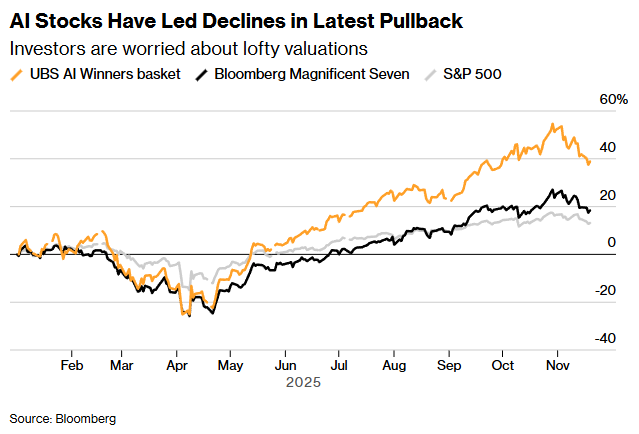
Recently, US stocks have fluctuated due to investors' concerns that the rise in technology stocks is overheating. The S&P 500 index has fallen more than 3% from its peak in October. However, Nvidia's post-market earnings report for US stocks on Wednesday showed that both revenue, profit, and outlook for the next quarter were significantly higher than market expectations. Nvidia's earnings report has largely allayed investors' fears that the unprecedented boom in global AI spending is about to subside. As of press release, the Nasdaq 100 futures index, which is dominated by technology stocks, rose 1.5% before the market on Thursday.
Meanwhile, Bullock revealed that he is looking at some of the smaller companies involved in the AI field to find potential shorting opportunities. He said, “You will see many companies that rub sides with AI and AI impersonators. These are the shorting targets you are looking for.” But at the same time, he said, “As long as market leaders like Nvidia continue to rise, this will be a very dangerous deal.”
Bullock also said that the boom in passive investment transactions has “destroyed the market and greatly weakened the ability to discover prices.” He explained, “No matter how expensive Nvidia becomes, it doesn't matter. All funds that buy the S&P 500 index will not sell Nvidia without a net outflow of capital. If they had an inflow of money, they would buy Nvidia every day at any price.”
What will happen to the US stock market in the future? Wall Street is clearly divided
Like Bullock, Dan Ives, head of technology research at Wedbush Securities, also expressed a positive attitude towards US technology stocks. He described the current market tension over AI trading as “short-sighted behavior,” and asserted that the tech stock market — the main force driving the rise in US stocks in the past two years — will continue for at least two more years.
The tech bully pointed out that there is strong demand for semiconductor ETFs in the market, stressing that “since June, we have observed a 30% increase in related demand.” He defined the current environment as a “capital expenditure supercycle,” believing that this is an early stage of technological change, and said investors are currently only in the “second and third stages” of the AI revolution. He also defended the huge capital expenses of big tech companies, explaining that “for every dollar invested in capital expenditure, these companies will eventually get a return of 8 to 10 dollars over the next few years.”
Jeff Krumpelman, chief investment strategist and head of the stock department at Mariner Wealth Advisors, also believes that the recent tech stock shock is more like fluctuations caused by profit settlement and shutdown, rather than a substantial shift in AI or profit fundamentals. The strategist emphasized that early-stage AI applications are still a strong theme that will continue for several years, and that current fluctuations should not be compared to the period when the internet bubble burst. “This is a real trend. Artificial intelligence is still in its early stages, and the prospects are real. It is definitely not a repeat of the Internet bubble of 2000.”
Michael Wilson, the chief US stock strategist at Morgan Stanley, made one of the most bullish voices on US stocks earlier this week. He predicts that the S&P 500 index will rise 16% over the next year, supported by strong corporate profits. Michael Wilson expects the S&P 500 index to trade around 7,800 points by the end of 2026. This target is one of the highest levels among Wall Street strategists, and it also means that the index will achieve double-digit gains for the fourth year in a row.
Michael Wilson said, “We are in the midst of a new bull market and profit cycle, especially for many sectors of the index that previously lagged behind.” The strategist expects earnings per share of S&P 500 companies to grow 17% and 12%, respectively, over the next two years. He mentioned that the stronger pricing capabilities of enterprises, efficiency improvements brought about by artificial intelligence, relaxed tax and regulatory policies, and stable interest rates are all supporting factors.
Still, there are still cautious voices on Wall Street. Goldman Sachs strategist Peter Oppenheimer, who previously accurately predicted that US stocks will outperform other regional stock markets this year, predicts that US stocks will continue to lag behind other major global markets in the next ten years. Strategists expect the S&P 500 index to have an annualized yield of 6.5% over the next ten years, the weakest performance among all regions; emerging markets are expected to be the strongest, with an annualized yield of 10.9%.
Furthermore, UBS as a whole has a firm bearish stance. On the one hand, UBS is concerned that US stock valuations are at a high level in the past 40 years, and technology stocks are highly concentrated, and there is a risk of a valuation bubble. On the other hand, UBS believes that the slowdown in US economic growth will have an indirect impact on US stocks. The bank predicts that the annual growth rate of US GDP will slow sharply from 2.0% in the second quarter to 0.9% in the fourth quarter. It also expects interest rates to drop 1% before the end of the year, which is double what the market expected.
UBS clearly warns that there is a clear downside risk in US stocks in the near future. In addition, the bank also mentioned that the global economy may face a brief slowdown due to tariff measures. This situation will also have an impact on US stock investors' decisions, further increasing market uncertainty.