
Nvidia (NVDA.US)'s performance broke when the “AI bubble theory” haunted! Demand for AI computing power continues to explode, data center revenue soars 66%
The Zhitong Finance App learned that the “AI chip superpower”, the company with the highest market capitalization in the world with the title of “Earth's Most Important Stock” and is at the core of the wave of artificial intelligence fanaticism — NVDA.US (NVDA.US), has given extremely strong revenue outlook expectations for the current quarter and explosive performance growth data that far exceeds market expectations. It can be described as completely crushing the “AI bubble argument” that has completely destroyed the recent popular market “AI bubble argument”, which has greatly mitigated the unprecedented global AI spending of stock market investors There is concern that the boom is about to ebb.
After the announcement of Nvidia's earnings report and performance outlook, the current Nvidia stock price with a market value of about 4.5 trillion US dollars soared more than 6% after the US stock market. The chip sector in the US stock market, especially the AI computing power industry chain leaders in this sector that are closely linked to AI training/inference systems — such as TSMC, Broadcom, AMD, and Micron Technology's stock prices have all risen sharply, changing the recent downward trajectory of stock prices falling into a sluggish downward trajectory due to AI bubble rhetoric sweeping the market.
Undoubtedly, after a lapse of many months, global investors once again felt the huge shock brought by the “AI belief” of AI fanatical investment capital, which led to a huge rise in stock prices in the semiconductor and AI application software sectors. The last time I felt the impact of AI on this scale was when Nvidia's total market capitalization surpassed the $4 trillion mark in July — becoming the first listed company in the world to surpass $4 trillion in market capitalization.
Demand for AI computing power continues to blowout around the world, and AI infrastructure investment projects led by the US government are getting bigger, and tech giants continue to invest huge sums of money to build large-scale data centers, which largely means that for investors who have long loved Nvidia and the AI computing power industry chain, the “AI belief” that has taken the world by storm “supercatalysis” to the stock prices of computing power leaders is far from over. They are betting that the stock prices of AI computing power industry chain companies led by Nvidia, TSMC, and Broadcom will continue to interpret the “bull market curve.”
Nvidia, the “AI chip hegemon” with a market share of 90% in the AI accelerator field, said in a performance statement released after the US stock market on Wednesday EST that it is expected that the total revenue for the fourth fiscal quarter of the 2026 fiscal quarter ending January next year will be about 65 billion US dollars, far exceeding Wall Street analysts' previous average expectations of about 62 billion US dollars — this forecast can be described as being continuously raised since technology giants such as Google and Microsoft announced strong results at the end of October. It can be seen that even in this way, the official outlook given by Nvidia is still stronger than analysts' expectations that have continued to rise. To the extent that global demand for AI computing power infrastructure has exploded, Nvidia's performance is still on a trajectory of soaring since 2023.
This latest outlook indicates that market demand for Nvidia's AI GPU computing power clusters is still strong. These expensive and high-performance AI chips are used to develop large AI models such as the GPT series and to provide the most powerful computational performance for AI inference that requires an infinite level. The latest performance outlook means that Nvidia's total revenue will increase tenfold over the same period of the three-year period. Furthermore, Nvidia's newly announced net profit even far exceeds the combined revenue of the two long-standing rivals, AMD and Intel's latest quarterly earnings.
Concerns from the outside world have been accumulating about whether the crazy spending on this kind of AI computing power infrastructure is sustainable, and whether the massive demand for computing power related to AI application ecosystems such as ChatGPT, Claude, and Grok AI will continue. Nvidia's extremely strong performance can be described as shattering concerns about the demand for AI computing power.
The AI chip hegemon bombarded the “AI bubble argument” with extremely strong performance
“Demand for artificial intelligence computing power is still growing exponentially.” Nvidia CEO Hwang In-hoon, who has the title of “Godfather of AI,” said in a statement. “AI is everywhere, omnipotent, and can do everything you want.”
“There is a lot of talk about the AI bubble, but from our point of view, I haven't seen a bubble; all the actual situations about AI computing power requirements are completely different. ” Hwang In-hoon said during the performance conference call. “Sales of the latest generation Blackwell architecture AI GPUs far exceeded expectations. Cloud GPUs have been sold out, and computing demand for AI training and inference continues to grow at an exponential rate. We have entered a virtuous cycle in the AI era. ”
Regarding “how long is the actual economic life span of GPUs,” Nvidia CFO Colette Kress gave a positive answer — that is, the A100 GPU that was shipped six years ago is still working at full capacity this year, which also refutes recent “big empty” Michael Burry (Michael Burry) questions that devices such as AI GPUs actually last only 2-3 years. Barry even warned at the time that tech giants were playing a dangerous accounting “trick” aimed at artificially boosting short-term profits.
In the after-market trading of US stocks after the financial report was released, Nvidia's stock price once rose by more than 6%. By the close of Wednesday, the stock had risen 39% this year, outperforming the S&P 500 Index and the Nasdaq 100 Index. The market capitalization broke through the unprecedented supermark of 5 trillion US dollars on October 29. However, since the end of October, Nvidia's stock price has dropped 7% due to the AI bubble rhetoric.
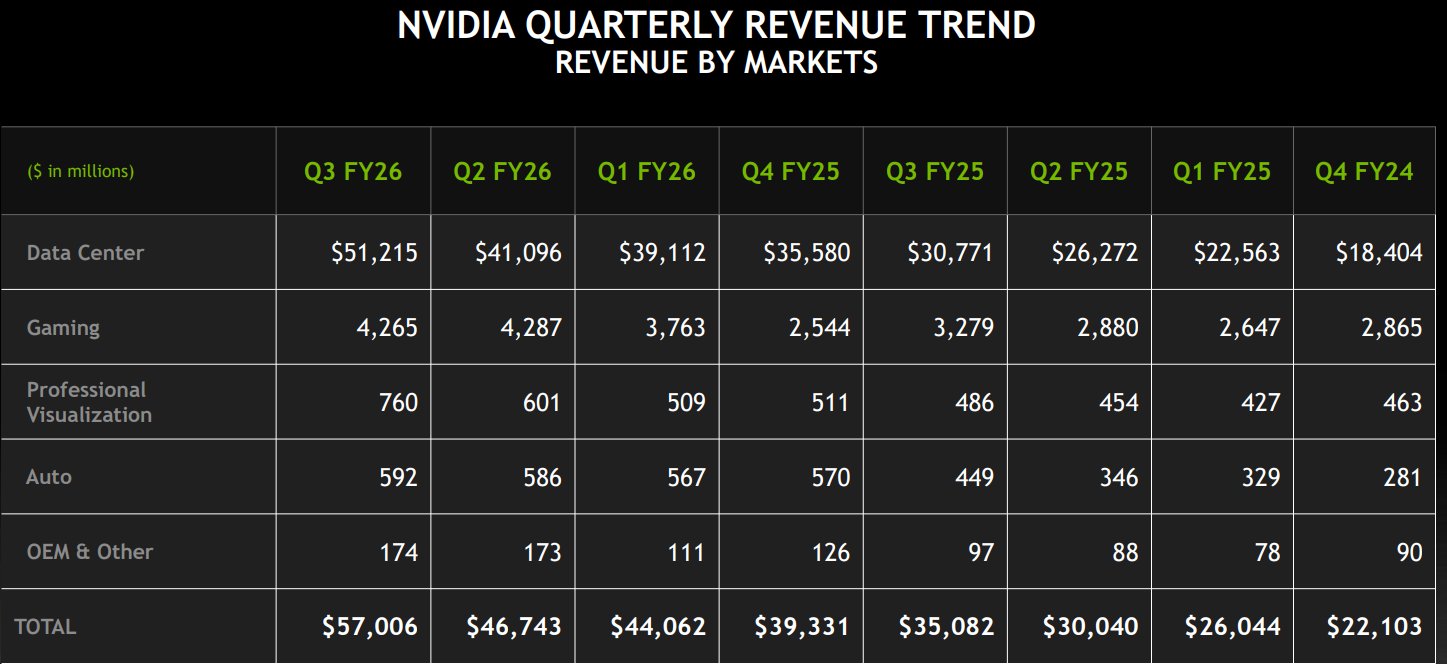
According to the latest financial data, in the third fiscal quarter of the 2026 fiscal year ending October 26, Nvidia's total revenue surged 62% year on year to reach the highest revenue scale of 57 billion US dollars in history. The year-on-month increase was 22%, higher than analysts' general expectations of 55.2 billion US dollars after recent continuous increases. Excluding certain items, NON-GAAP earnings per share were $1.30, compared to what analysts generally expected to be $1.26. In terms of net profit, under GAAP standards, Nvidia's Q3 net profit surged 65% year over year to US$31.9 billion, compared with 21% month-on-month, and operating profit also increased 65% year over year to US$36 billion.
Nvidia's performance and outlook for the next quarter prove that Nvidia is still a well-deserved “strongest seller” in the global AI field. With a market share of up to 90% in the field of AI training/inference, Nvidia has taken advantage of the unprecedented boom in global enterprise deployment of AI. Nvidia was initially famous worldwide for selling PC-side graphics processors (that is, computer GPUs), but after discovering that its parallel architecture is suitable for artificial intelligence and a wide range of high-performance computing, in recent years, Nvidia AI GPUs, which have a large number of computing cores, can execute multiple high-intensity AI tasks at the same time, and are extremely good at processing parallel computing have become the most core hardware in the chip field in recent years, building an extremely broad moat with AI GPU+ InfiniBand high-performance network equipment cluster+CUDA ecological barriers.
Since the introduction of ChatGPT, as AI's influence on the global high-tech industry and technology development has increased, CPUs that focus on single-threaded performance and general-purpose computing are still an indispensable part of the chip field, but their position and importance in the chip field is far less than that of GPUs. After all, the original purpose of CPU design was to process general-purpose computation between various routine tasks, rather than processing large-scale parallel computing models and high-computational density matrix operations like GPUs. Nvidia CEO Hwang In-hoon emphasized that the global shift to artificial intelligence has only just begun. He believes that GPU-accelerated computing to accelerate specific tasks by breaking down specific tasks into smaller parts and performing parallel processing is beginning to dominate.
Google's recently released series of AI product portfolios based on Gemini 3 can be described as bringing an unprecedented “AI shock effect” to users around the world, which will inevitably bring huge demand for AI computing power. It can be described as further verifying that “the AI boom is still in the early stages of construction where computing power infrastructure is in short supply” as Wall Street called. Furthermore, once “stock god” Buffett opened a position, Google ranked among Berkshire's top ten biggest stocks. The strong AI computing power combination brought by Google+Nvidia can be described as comprehensively strengthening the “AI bull market narrative” recently, strongly refuting the “AI bubble moment” that some investors are anxious about.
Wall Street firm Citi recently said that short-term market weakness/downward pullback may be within investors' general expectations, and the “artificial intelligence fundamental narrative” that supports the long-term bull market in the stock market is still intact. This may create significant opportunities to buy at dips during the pullback period. Citi also said that the bears' AI bubble theory is simply untenable. The agency emphasized that the main contradiction in the current AI chip market is insufficient supply rather than insufficient demand — the most direct indication is that TSMC's CoVos advanced packaging production capacity will continue to be in short supply throughout 2026.
Philippe Laffont, founder and portfolio manager from Coatue Management, said that there is a very important difference between the current AI investment boom and the “Internet bubble era” — he called it a “hyperscale advantage”. This refers to tech giants with extremely strong cash flow, including Google's parent company Alphabet, Microsoft, and Amazon, which are expected to invest more than 500 billion US dollars to continue investing heavily in AI computing power infrastructure next year, and unlike the internet bubble The era is that these tech giants with strong cash flow and steady profitability are the core driving force of this big AI wave. This is quite different from the 2000 internet bubble period — most of the leaders at the time were unprofitable companies.
Demand for AI computing power continues to explode, and Nvidia's data center business is still strong! 66% year-on-year increase
“The market has reacted very positively to the latest news of Nvidia's earnings report, as it shows that AI computing power infrastructure spending momentum has not weakened to any extent,” Brian Mulberry, senior client portfolio manager at Zacks Investment Management, said in a report. His investment company has held Nvidia shares for a long time. “The market demand for Nvidia hardware solutions remains extremely strong,” he said.
European financial giant Saxo Bank said, “Given Nvidia's huge impact on global stock sentiment, particularly in terms of leadership in artificial intelligence, semiconductors, and the broader technology industry, its performance can either calm tension or add new uncertainty.” “Undoubtedly, strong numbers may boost market bullish sentiment by restoring confidence in the semiconductor industry's growth trajectory and investment topics related to artificial intelligence computing power.”
Judging from the spending expectations of tech giants that have already announced financial reports, US tech giants Meta, Microsoft, Google, and Amazon continue to soar in their financial reports on the most core artificial intelligence infrastructure (including AI GPUs, AI ASICs, enterprise storage systems, nuclear power equipment expenses, data center power systems, etc.), continuing to show a strong signal of “burning money to buy Nvidia GPUs.” Furthermore, AI application leaders such as OpenAI, xAI, Anthropic, and Palantir, or government departments focusing on “sovereign AI systems” continue to spend huge sums of money to build AI data centers, and the fanatical wave of global artificial intelligence layout shows no sign of abating.
Hwang In-hoon has repeatedly downplayed his concerns about the AI bubble. He said at the GTC conference last month that Nvidia has “gained visibility” of more than 500 billion US dollars in revenue visibility from 2025 to 2026. Nvidia Chief Financial Officer Colette Kress said that Nvidia even had a chance to surpass the goal of cumulative revenue of 500 billion US dollars from 2025 to 2026 given by Hwang In-hoon at the GTC conference at the end of October.
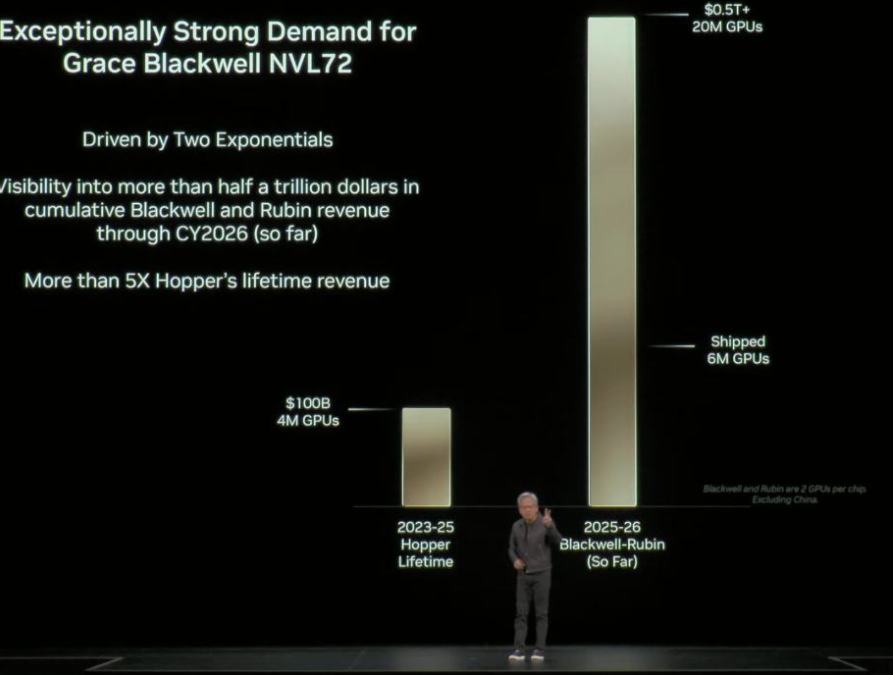
From the perspective of revenue data, Huang Renxun made a big prediction at the GTC conference — that is, the cumulative revenue of Blackwell and Rubin is expected to exceed 500 billion US dollars from 2025 to 2026, including only the Blackwell and Rubin AI GPU computing power clusters, which does not include the revenue of important business segments such as automotive chips and HPC, and does not include any degree of Chinese market expectations. Wall Street sellers and buyer investment institutions may have begun to incorporate this latest surprising expectation into their basic investment models.
The data center business division, which is currently Nvidia's core business unit, is the H100/H200 and Blackwell Ultra architecture AI GPUs provided by this department to provide extremely powerful AI computing power infrastructure for data centers around the world. Financial reports show that as the wave of AI deployment is in full swing around the world, Nvidia's data center business achieved revenue of 51.2 billion US dollars in the third fiscal quarter, surging 66% year on year and 25% month-on-month, while Wall Street's average forecast was 49.3 billion US dollars. The gaming PC business, which has been the company's main source of revenue for a long time, recorded revenue of 4.3 billion US dollars, an increase of 30% over the previous year, slightly below the average market forecast of 4.4 billion US dollars.

As shown in the chart above, Nvidia's profit has even surpassed the combined revenue data of its two major rivals, AMD and Intel.
However, Nvidia's expansion also faced challenges. US restrictions on the export of high-end AI chips to China have basically excluded Nvidia's AI computing power products from this important market.
Hwang In-hoon has been lobbying Washington to repeal these rules — which he believes are counterproductive to the national security goals he is supposed to serve. However, even after some of the harshest restrictions have been retracted, Nvidia has not included any sales from Chinese AI accelerators in the forecast.
Furthermore, some investors are also concerned about the large-scale transaction structure that Nvidia has reached with customers, fearing that this circular economy is a “left hand over right” in the field of AI computing power. The deals involved Nvidia's investment in AI startups such as OpenAI and Anthropic, raising questions about whether these agreements are creating “human demand” for Nvidia's AI GPU series products.
At the same time, some of Nvidia's competitors are becoming more optimistic that they can finally challenge the company's monopoly position in the AI chip field. For example, earlier this month, AMD predicted that its AI chip business would grow exponentially, and strongly appreciated the prospects of upcoming AI computing power clusters. Data center operators are also increasingly inclined to use more self-developed AI ASIC chips — this effort will reduce their dependence on Nvidia's AI GPU clusters.
Isn't $5 trillion the end? The market is already expecting Nvidia's market capitalization to hit $8 trillion
Wall Street financial giant Loop Capital recently raised the agency's target share price for Nvidia from $250 to $350 — meaning that the market capitalization is expected to break through $8 trillion, the highest level on Wall Street, and more and more investment institutions are beginning to look at the landmark target of $300. The target price of 300 US dollars within 12 months means that Nvidia's market capitalization will break the 7 trillion US dollar super mark. As of Wednesday's US stock close, Nvidia's stock price closed at $186.520.
According to Wall Street giants Morgan Stanley, Citi, Loop Capital, and Wedbush, the global AI infrastructure investment wave with AI computing power hardware as the core is far from over; it is only at the beginning. Driven by an unprecedented “AI inference computing power demand storm”, the scale of this round of AI infrastructure investment, which will continue until 2030, is expected to reach 3 trillion to 4 trillion US dollars.

Recently, the prices of global DRAM and NAND series high-performance storage products have continued to rise rapidly. In addition, OpenAI, the world's highest-valued AI startup, has reached an AI computing power infrastructure deal of more than 1 trillion US dollars, and the “king of chip foundry” TSMC, storage giants SanDisk, Samsung, and SK Hynix announced extremely strong performance exceeding expectations and raised revenue growth expectations for 2025 and 2026. It can be said that they have jointly greatly strengthened AI GPUs, ASIC and HBM, data center SSD storage systems, liquid cooling systems, “Long-term bull market narrative logic” for AI computing power infrastructure sectors such as core power equipment.
The demand for AI computing power brought about by generative AI applications and inference terminals dominated by AI agents can be called a “sea of stars”, which is expected to drive the AI computing power infrastructure market to continue to show exponential growth. “AI inference systems” are also Hwang In-hoon's biggest source of future revenue for Nvidia.
“This is an unrivaled global AI arms race (AI Arms Race), and the driving force behind the next AI chapter will be the continued fervent AI spending by big tech companies, and this spending wave hasn't slowed down in any way towards 2026... We believe this is a huge positive and testing moment for the AI revolution's multi-headed logic. Although investors have had some anxiety related to the AI bubble over the past few weeks, this does not prevent investors from continuing to choose to enter the market on dips.” A team of Wedbush analysts led by senior analyst Daniel Ives said.
A team of analysts from Cantor Fitzgerald said that the rapid and extremely widespread implementation of generative AI applications proved that this big wave of AI is not a bubble in any sense. “Over the past 12 months, the world's largest recommendation systems have adopted generative AI. For example, search moved to generative AI. Social media is moving to generative AI.” “Users independently generate innovative content and AI-based advertising recommendation engines, all of which have moved from traditional machine learning to generative AI. With the large-scale migration from traditional computing to generative AI alone, Nvidia saw capital expenditure of up to $2 trillion. We're definitely not in a bubble; instead, the market is beginning to see how 'high-quality' AI can bring about a significant positive return on investment.” Cantor Fitzgerald wrote in a research report that is bullish on Nvidia's stock price to $300.