
Is General Electric’s Aerospace Shift Justifying the Stock’s 78% Rally in 2025?
- Wondering if General Electric (GE) is trading at a fair price right now? You are not alone, and we are about to dig into what the numbers say about its value.
- GE’s stock has soared 78.0% year-to-date and jumped 470.0% over the last three years, though it pulled back by 3.8% in the past week.
- Recently, investor sentiment has been shaped by news of GE’s ongoing transformation, with its recent spin-offs and renewed focus on aerospace as key developments. This strategic shift has investors reevaluating GE’s future growth and potential risks, further fueling price changes.
- Despite this momentum, GE currently scores 0 out of 6 on our undervaluation checks. Let’s walk through different ways to assess what the stock is really worth, and keep an eye out for a smarter perspective on valuation that you will not want to miss at the end of this article.
General Electric scores just 0/6 on our valuation checks. See what other red flags we found in the full valuation breakdown.
Approach 1: General Electric Discounted Cash Flow (DCF) Analysis
A Discounted Cash Flow (DCF) model estimates a company's intrinsic value by projecting its future cash flows and discounting them back to today’s value. This method provides a picture of what the company is truly worth, based on expected future performance rather than short-term market swings.
For General Electric, the current Free Cash Flow stands at $6.45 Billion. Looking ahead, analysts forecast rising cash flows through 2029, with projections indicating Free Cash Flow could reach $10.59 Billion by the end of that year. It is important to note that while analysts provide estimates for the next five years, values beyond that, such as in 2030 and onward, are extrapolated to give a sense of long-term trends.
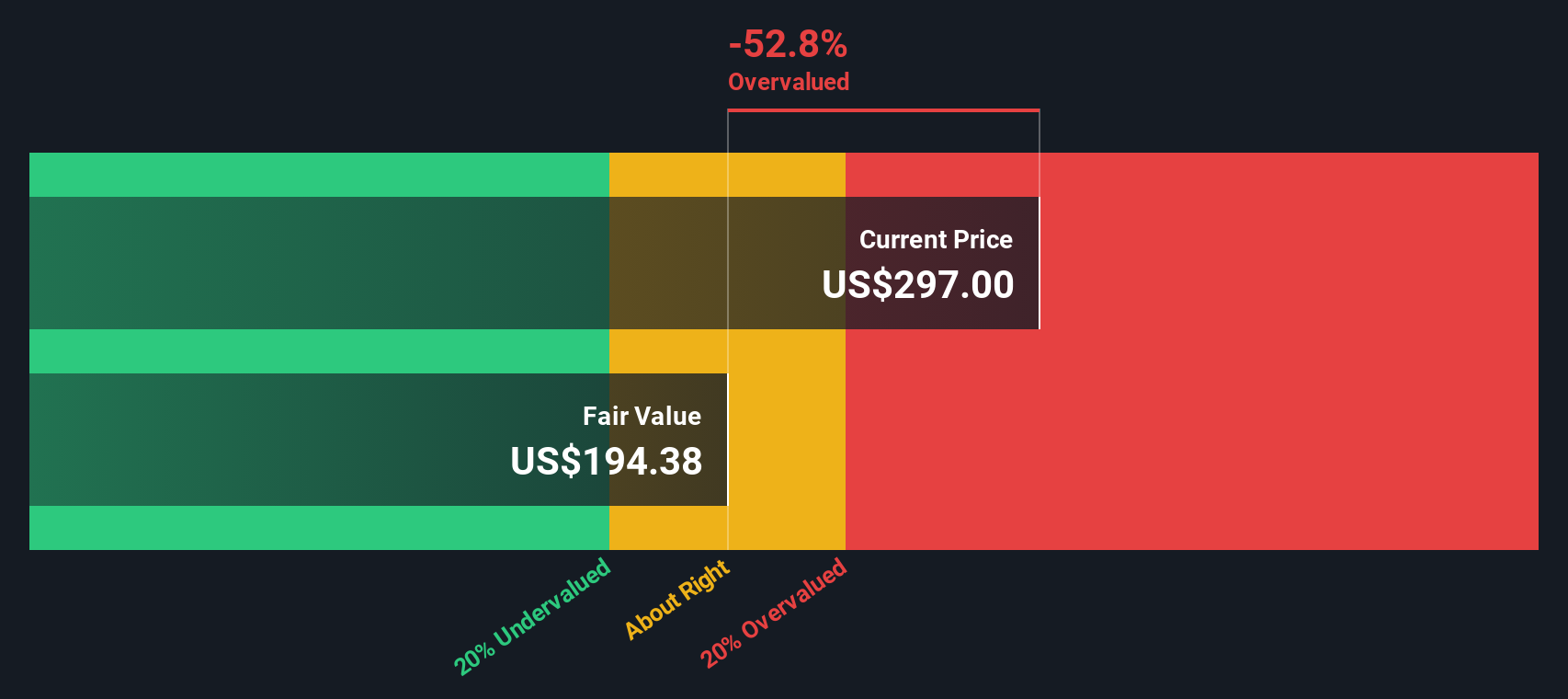
Based on these projections, the DCF model estimates General Electric's intrinsic value to be $215.99 per share. However, the current market price implies the stock is trading at a 39.0% premium to this intrinsic value. This suggests it is significantly overvalued by this method.
Result: OVERVALUED
Our Discounted Cash Flow (DCF) analysis suggests General Electric may be overvalued by 39.0%. Discover 894 undervalued stocks or create your own screener to find better value opportunities.
Approach 2: General Electric Price vs Earnings
The Price-to-Earnings (PE) ratio is the standard yardstick for valuing profitable companies because it directly links a company’s market price to its earnings power. For companies like General Electric that generate consistent profits, using the PE ratio helps investors understand how much they are paying for each dollar of earnings.
What qualifies as a “fair” PE ratio is not just about the current earnings. Growth prospects, the stability of those earnings, and the risk profile all factor in. Companies with stronger growth and lower risk typically justify higher PE multiples, while slower growth or higher risk bring those numbers down.
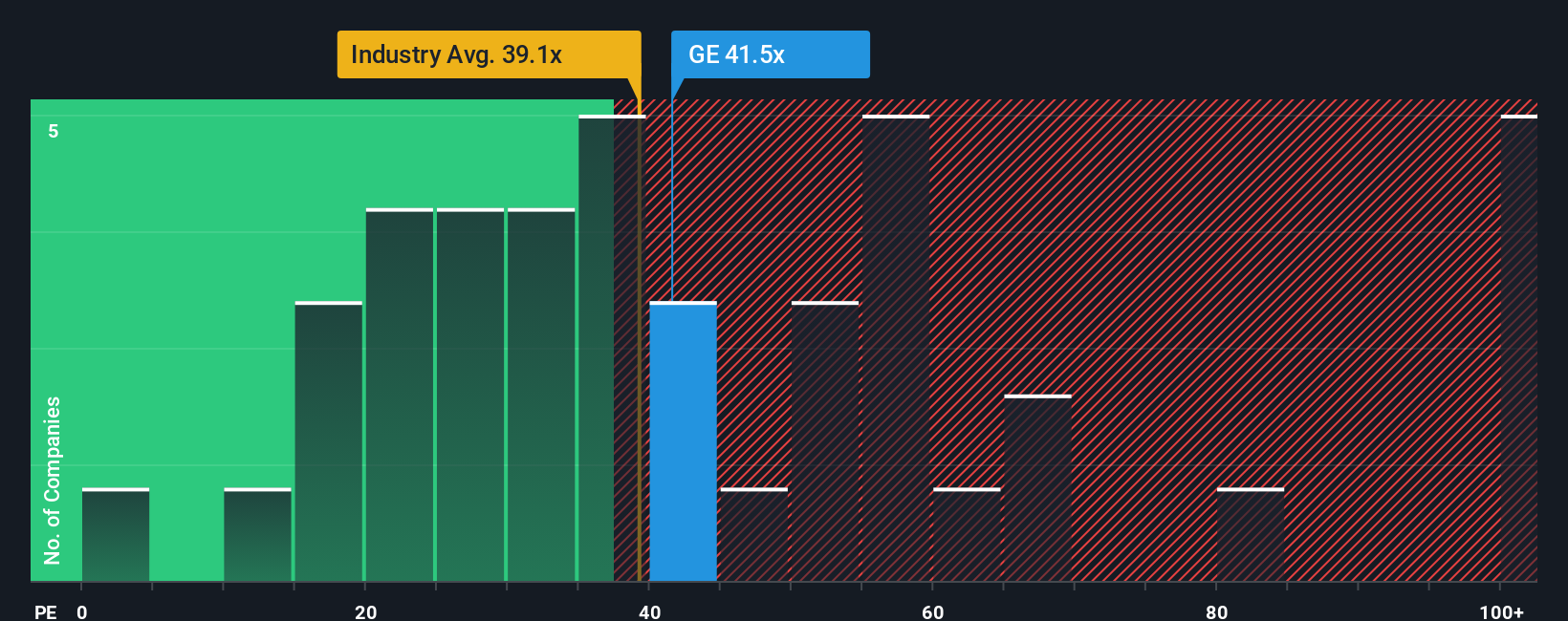
General Electric currently trades at a PE ratio of 39.3x. That is above the average for its Aerospace & Defense industry peers (37.7x) and the broader peer group (25.9x). However, the Simply Wall St Fair Ratio model, which considers not only growth and profit margins but also industry norms, risk, and company size, sets the fair multiple for GE at 36.0x.
The Fair Ratio offers a more tailored benchmark than simply comparing GE to other companies. It recognizes GE’s unique blend of earnings outlook, risks, margins, and market position, providing a more realistic marker for fair value than any one-size-fits-all industry or peer average.
With the actual PE ratio at 39.3x and the Fair Ratio at 36.0x, GE appears valued a bit higher than what its fundamentals would suggest.
Result: OVERVALUED
PE ratios tell one story, but what if the real opportunity lies elsewhere? Discover 1417 companies where insiders are betting big on explosive growth.
Upgrade Your Decision Making: Choose your General Electric Narrative
Earlier we mentioned that there is an even better way to understand valuation, so let’s introduce you to Narratives. A Narrative is your personalized investment story, making it easy to combine your big-picture view of General Electric with your own forecasts for its future revenue, profit margins, and valuation. Rather than relying solely on models or consensus data, Narratives let you define what you believe will drive GE’s future and translate that belief into a clear forecast and fair value.
Narratives are simple to build and accessible right from the Community page on Simply Wall St, where millions of investors share perspectives. Linking the company’s background, competitive strengths or challenges, and industry changes to your own financial estimates, Narratives help you make more confident decisions about buying or selling by comparing your fair value to the current share price.
As new information such as news, earnings, or sudden events emerges, Narratives update automatically so your outlook is always current and relevant.
For example, some investors see GE’s expanding aerospace engine demand and digitalization as a reason to target a bullish fair value as high as $343 per share. Others focus on risks from industry cycles or supply chain challenges and opt for a cautious target as low as $266. This shows that the best investment plan is the one built on your own Narrative.
Do you think there's more to the story for General Electric? Head over to our Community to see what others are saying!

This article by Simply Wall St is general in nature. We provide commentary based on historical data and analyst forecasts only using an unbiased methodology and our articles are not intended to be financial advice. It does not constitute a recommendation to buy or sell any stock, and does not take account of your objectives, or your financial situation. We aim to bring you long-term focused analysis driven by fundamental data. Note that our analysis may not factor in the latest price-sensitive company announcements or qualitative material. Simply Wall St has no position in any stocks mentioned.
Have feedback on this article? Concerned about the content? Get in touch with us directly. Alternatively, email editorial-team@simplywallst.com