
IPO News | Dongshan Precision (002384.SZ) reports that the Hong Kong Stock Exchange is the world's largest supplier of edge AI equipment PCB
The Zhitong Finance App learned that according to the Hong Kong Stock Exchange disclosure on November 18, Suzhou Dongshan Precision Manufacturing Co., Ltd. (abbreviation: Dongshan Precision, 002384.SZ) submitted the Hong Kong Stock Exchange main board, with UBS Group, Haitong International, GF Securities, and CITIC Securities as co-sponsors. According to Insight Consulting, Higashiyama Precision is the world's largest supplier of edge AI equipment PCBs. Its products are mainly used in smartphones, personal computers, automobiles, industrial and IoT devices, and is rapidly expanding its capabilities to the data center terminal market.
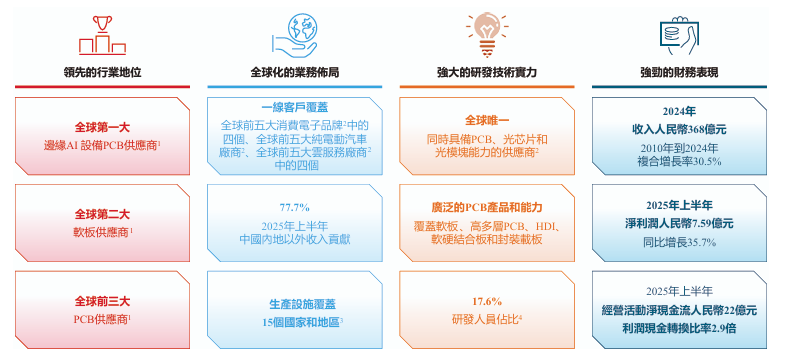
According to the prospectus, Higashiyama Seimitsu is an innovation-driven company focusing on the field of intelligent manufacturing with a global vision and layout. Since its establishment, Higashiyama Precision has established a leading market position in the core product field. According to Insight Consulting, in terms of revenue in 2024, the company is the world's largest supplier of edge AI equipment PCBs, the world's second-largest soft board supplier, and the world's top three PCB suppliers.
Higashiyama Precision has built a diverse product portfolio around core value customers. The company's PCBs, precision components, touch panels, liquid crystal display modules and optical module products are widely used in consumer electronics, automobiles, data centers, communication equipment, and industrial control equipment. The company actively exploits synergies in R&D, engineering, supply chain and operation to provide customers with a comprehensive one-stop solution. It is one of the few suppliers in the industry that can provide a rich and diverse product portfolio for the world's top technology companies. Furthermore, according to Insight Consulting, Higashiyama Precision is the only supplier in the world that also has PCB, optical chip, and optical module capabilities. In total, it accounts for about 9% to 14% of AI server material costs. Among most AI servers, its cost is second only to GPUs, enhancing the company's ability to enter the high-growth data center terminal market.
The company's long-term partners cover four of the top five global consumer electronics brands, four of the world's top five pure electric vehicle manufacturers, and four of the top five global cloud service providers. The company is deeply involved in the early stages of customer product design, thereby establishing long-term trusting partnerships with customers and grasping the latest industry developments and technology trends. Combined with intelligent manufacturing capabilities and global layout, this approach is critical to meeting customers' high standards for product quality, delivery efficiency, and supply chain stability.
Higashiyama Precision is committed to expanding its global manufacturing layout while improving local regional operation and service capabilities to meet the evolving needs of customers. The company's recent acquisition of European auto parts supplier GMD is a further reflection of this strategy, thereby integrating manufacturing expertise into localized operating practices and providing first-class services to a wider customer base. In the six months ended June 30, 2025, the company contributed 77.7% to customer revenue outside mainland China. As of the last practical date, the company had production facilities in 15 countries and regions in Asia, North America, Europe and Africa, and the company's overseas employees accounted for about 20% of the total number of employees.
The following chart shows the company's core business achievements:
Financial data
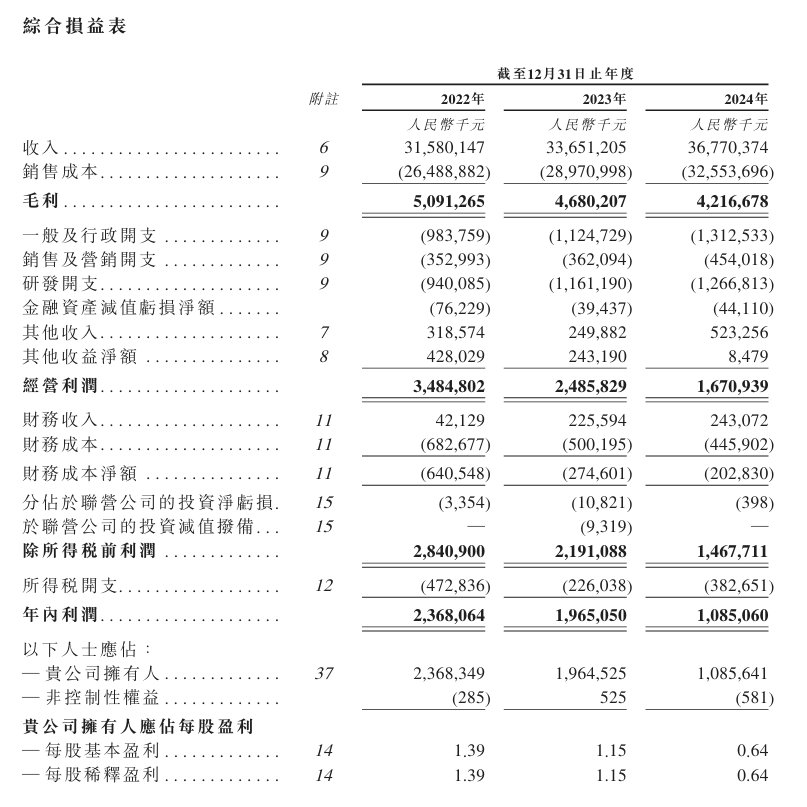
Revenue:
The company recorded revenue of 31,580 billion yuan (RMB, same below), 33.651 billion yuan and 36.77 billion yuan in 2022, 2023, and 2024, respectively. During the track record period, electronic circuits were the company's largest source of revenue.
Gross profit:
The company recorded gross profit of 5,091 billion yuan, 4.680 billion yuan and 4.217 billion yuan in 2022, 2023, and 2024, respectively. The company's gross profit declined from 2022 to 2024, mainly due to a decrease in gross profit of communication equipment components and an increase in losses in other products (mainly LED display products).
Profit during the year:
The company recorded annual profits of 2,368 billion yuan, 1,965 billion yuan and 1,085 billion yuan in 2022, 2023, and 2024, respectively.
Industry Overview
PCB industry
PCBs are basic components in electronic devices, providing key functions such as accurate electrical interconnection, low loss signal transmission, and mechanical support. The continuous improvement in the performance of electronic equipment is driving more stringent requirements for PCBs, especially in terms of higher circuit density, enhanced signal integrity, and improved thermal management, which in turn directly promotes technological upgrading in the PCB industry. Furthermore, the emergence of new application scenarios is generating huge demand for high-end PCBs, creating important growth opportunities for the industry.
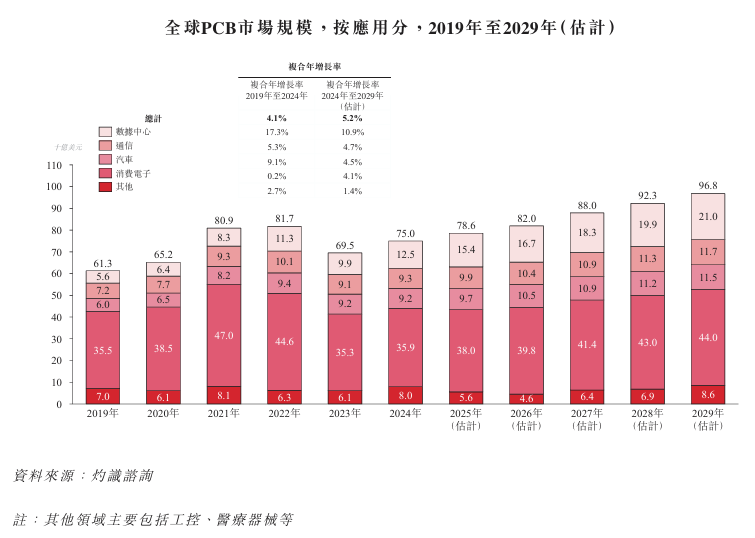
According to different application areas, in 2024, in the global PCB industry market size, the data center PCB market size is 12.5 billion US dollars and the communication PCB market size is 9.3 billion US dollars; data centers benefit from the development of AI and grow rapidly. By 2029, the market size will grow to 21 billion US dollars, and the compound annual growth rate from 2024 to 2029 is 10.9%. The market size of communication PCBs will reach 11.7 billion US dollars in 2029, and the compound annual growth rate from 2024 to 2029 will reach 4.7%. In 2024, the market size of consumer electronics PCBs and automotive PCBs was 35.9 billion US dollars and 9.2 billion US dollars respectively. Benefiting from the rapid development of edge AI devices, the consumer electronics industry and the automotive electronics industry continued to introduce new developments under the intelligent trend. In 2029, the consumer electronics and automotive electronics markets were 44 billion US dollars and 11.5 billion US dollars respectively, with compound annual growth rates of 4.1% and 4.5% respectively.
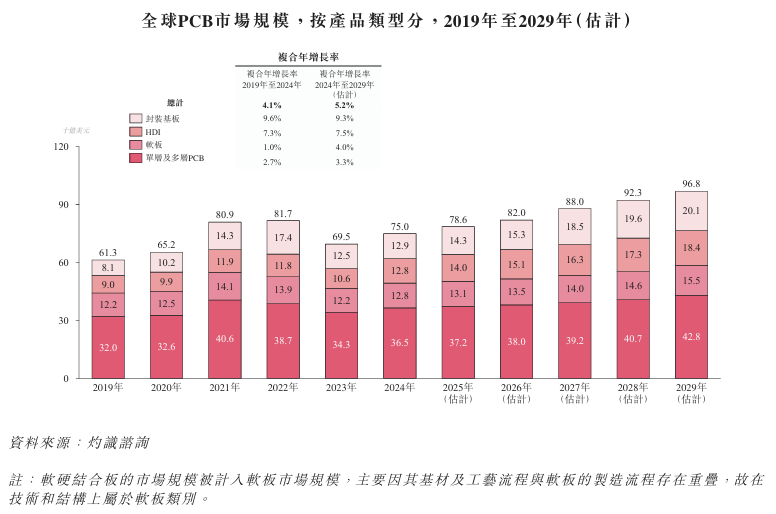
PCBs can be divided into single-layer and multi-layer PCBs, HDI, soft boards, and packaging substrates according to the product structure. According to different product structures, in 2024, in terms of sales revenue, the global market size of single-layer and multi-layer PCBs, HDI, soft boards and sealed boards was US$36.5 billion, US$12.8 billion, US$12.8 billion and US$12.9 billion, respectively. It is estimated that by 2029, the global single-layer and multi-layer PCBs, HDI PCBs, flexible boards and encapsulated boards will reach US$42.8 billion, US$18.4 billion, US$15.5 billion and US$201 billion respectively, with compound annual growth rates of 3.3%, 7.5%, 4.0% and 9.3% respectively from 2024 to 2029.

The main raw material costs for PCBs include copper-clad sheets, copper foil, and copper balls. The cost of copper materials accounts for 70% of the total raw material cost of PCBs, so PCB costs are highly correlated with copper prices. The global average annual settlement price of copper increased from US$5,999.7 per tonne in 2019 to US$9,146.8 per tonne in 2024. In the future, copper prices are expected to remain relatively stable in a relatively high range as the global industry is upgraded and the development of renewable energy and infrastructure is increasingly promoted.
Soft board industry
Soft board refers to a flexible, foldable PCB made of a flexible copper-clad plate as the base material. It has performance advantages such as lightness, bendability, and high wiring density, and is a key basic component for miniaturizing, lightweight, and highly reliable interconnection of electronic devices. In the field of consumer electronics, soft boards are the mainstream solution for high-speed signal transmission between internal display modules, cameras, biometrics, etc. of smartphones, tablet computers, and wearable devices; in the field of automotive electronics, soft boards are widely used in automotive battery management systems (BMS) and vehicle displays. In the field of industrial control, FPC uses its high reliability and spatial adaptability in complex environments to achieve stable and efficient connections for industrial equipment. As edge AI devices integrate more functions into smaller designs and FPCs that can achieve 3D wiring and high-density interconnection, demand will continue to grow under the impetus of high-end and customized trends, becoming a key driving force for the value increase in the edge-side PCB industry.

The global soft board market is showing a steady growth trend. The market size will reach US$12.80 billion in 2024 and will grow to US$15.5 billion in 2029, with a compound annual growth rate of 4.0%. From 2019 to 2024, judging from the market size contributed by various application scenarios, consumer electronics is the largest application scenario for soft boards. In 2024, the corresponding market size was 9.7 billion US dollars, accounting for about 75.8% of the global total, but it accounted for a slight decrease compared to 80.3% in 2019. In the future, the consumer electronics market will benefit from increased shipments of smart devices such as smartphones, AR/VR devices, and wearable devices, driving the growth in the size of the soft board market. Automotive electronics is the fastest-growing application field in the global soft board industry. The market size reached 1.4 billion US dollars in 2024, accounting for 10.9%. It is expected to rise to 14.2% by 2029, mainly due to increased EV penetration, upgrading of intelligent driving technology capabilities, and new application scenarios on the vehicle body brought about by the development of the intelligent driving industry.
Edge AI equipment PCB industry
The commercialization of edge AI technology is becoming a core factor driving the upgrading and value reshaping of the edge AI equipment industry. Edge AI devices mainly include AI consumer electronic terminals, automotive terminals, industrial terminals, medical devices, etc. On the one hand, in the field of AI consumer electronics, the new cycle of hardware switching and the increase in the value of individual products are further driving market growth; on the other hand, edge AI is a key technology to enable ADAS and smart cockpit human-robot co-driving, driving the evolution of automobiles from means of transportation to mobile intelligent spaces.
According to shipment statistics, global shipments of edge AI devices will reach about 360 million units in 2024. In 2029, global shipments of edge AI devices will reach [2] billion units, with a compound annual growth rate of 40.7% from 2024 to 2029. With the introduction of new edge AI devices, edge AI devices will have more brand-new functions and application scenarios, which will drive the shape and performance of electronic devices on terminals, and also drive an increase in their unit price. As far as shipments are concerned, AI phones, personal computers, and tablets are the top three categories of edge AI devices with the largest shipments. The penetration rate of AI-enabled models in various product segments is expected as follows: for smartphones, the penetration rate will rise from 13.2% in 2024 to 59.4% in 2029; for tablets, the penetration rate will rise from 20% in 2024 to 67.0% in 2029; for personal computers, the penetration rate will rise from 18.6% in 2024 to 72.0% in 2029.
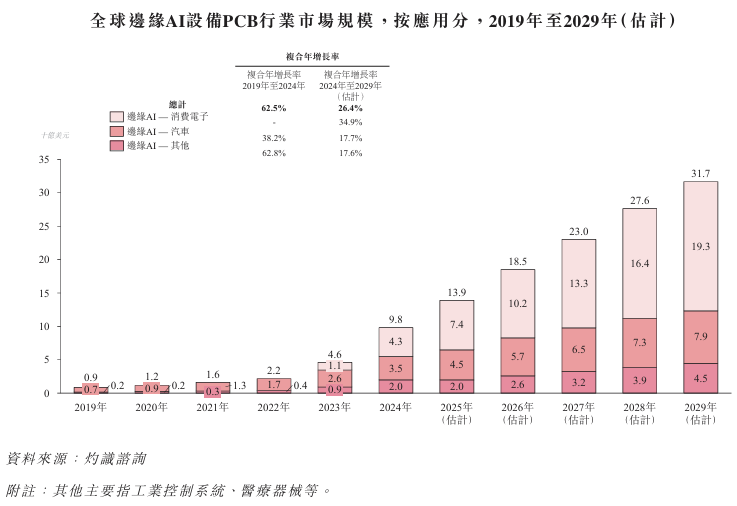
As the core carrier supporting edge node AI computing, the global edge AI equipment PCB industry rapidly expanded its market size as demand for edge computing power exploded. The global edge AI device PCB market is part of the overall global PCB market, which is equivalent to the size of the PCB market deployed in edge AI devices. It is an important driving force for the future growth of the global PCB market, and its market share is steadily increasing. The global edge AI equipment PCB industry has surpassed 9.8 billion US dollars in 2024, with a compound annual growth rate of 62.5% from 2019 to 2024. Looking at growth expectations, benefiting from the penetration of generative AI in edge scenarios and the acceleration of edge AI deployment, the market will enter a period of rapid growth. The PCB market for edge AI devices is expected to grow to US$31.7 billion in 2029, and the compound annual growth rate from 2024 to 2029 is 26.4%, which is significantly higher than the overall growth rate of the global PCB industry.
Board of Directors and Executive Information
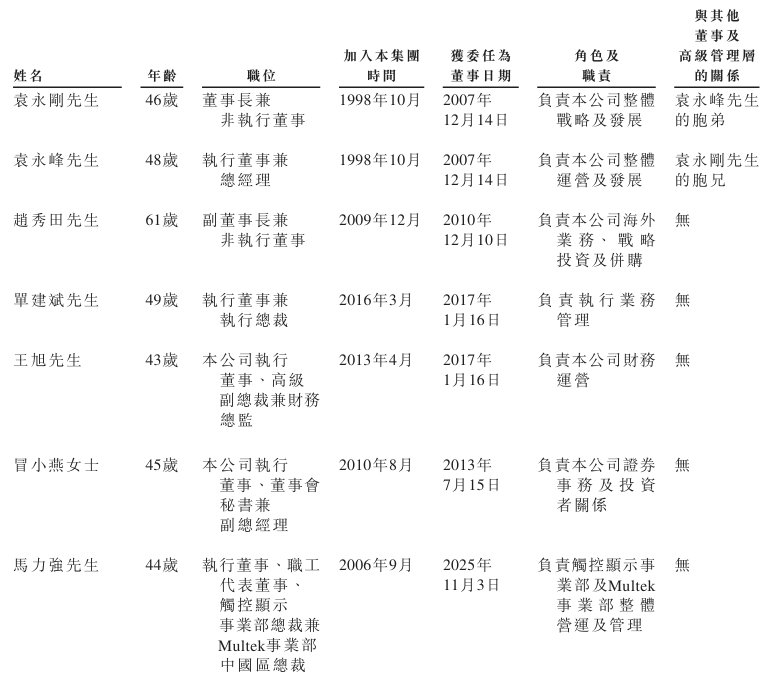
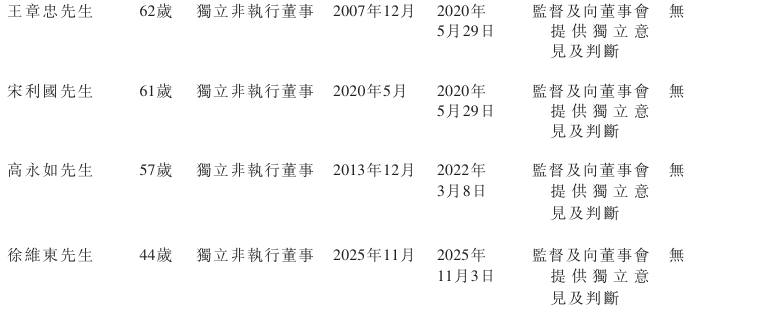
The board of directors consists of 11 directors, including 5 executive directors, 2 non-executive directors and 4 independent non-executive directors. The term of office of directors is three years, and they can be re-elected at the end of their term of office. According to relevant Chinese laws and regulations, independent non-executive directors cannot be re-elected for more than six years.
Shareholding structure
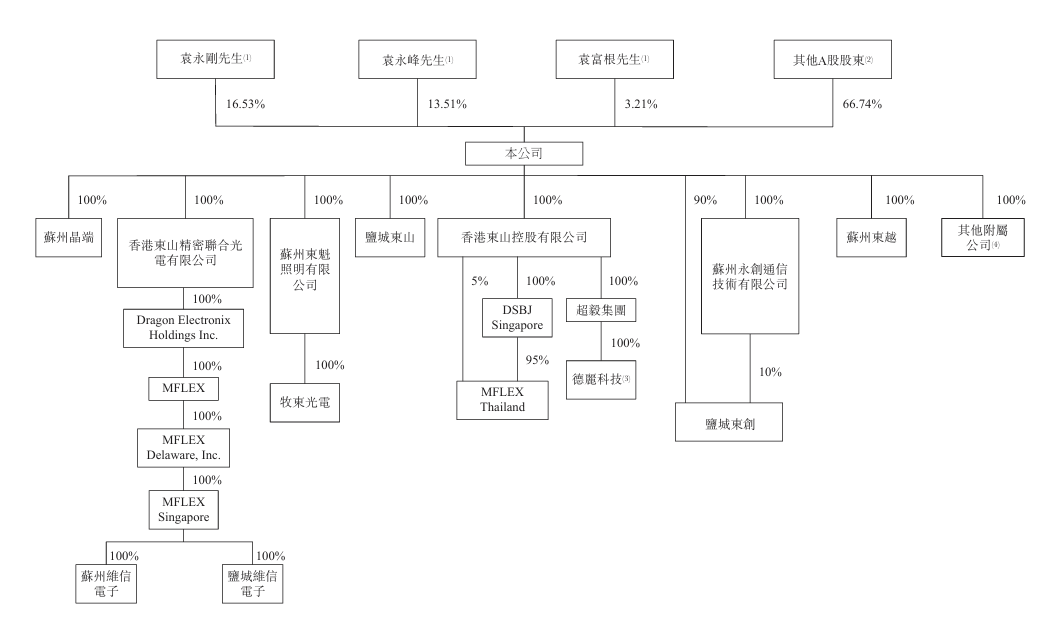
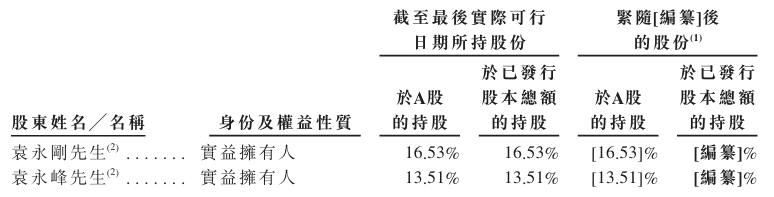
Mr. Yuan Yonggang, Mr. Yuan Yongfeng, and Mr. Yuan Fugen are the largest shareholder groups, holding 16.53%, 13.51% and 3.21% of the shares, respectively.
Other A-share shareholders held a total of 66.74% of the shares.
As of the last practical date, the company held 8,839,701 A shares as treasury shares. These shares do not include any shareholders' rights, including but not limited to shareholders' voting rights and dividend rights.
Intermediary team
Co-sponsors: UBS Securities Hong Kong Limited, Haitong International Capital Limited, Guangfa Finance (Hong Kong) Limited, CITIC Securities (Hong Kong) Limited
Company Legal Adviser: Related to Hong Kong and US Law: Fuller Law Firm; Related to Chinese Law: Haiwen Law Firm
Co-sponsor Legal Adviser: On Hong Kong and US Law: Ann Sherman & Stirling; On Chinese Law: King & Wood Mallesons
Auditor and reporting accountant: Tianjian International Certified Public Accountants Limited
Industry Advisor: Insight Industry Consulting Co., Ltd.
Compliance Advisor: New Berry Finance Co., Ltd.