
The AI bubble theory is back! Silicon Valley Venture Godfather Peter Thiel Clears Out Nvidia (NVDA.US) to Embrace “Safe Haven” Apple (AAPL.US)
The Zhitong Finance App learned that the latest 13F report of Thiel Macro LLC, an investment agency owned by Peter Thiel (Peter Thiel), the “godfather of venture capital” in Silicon Valley and a close friend of US Vice President Vance for a long time, did not show that it was only a slight adjustment to Nvidia's position, but a complete withdrawal from its position with NVDA.US (NVDA.US), the “supremacy of AI chips.” Peter Thiel's move comes at a surprising moment, when Wall Street is busy claiming that Nvidia is the preferred technology stock and insisting that the so-called “AI bubble moment” is simply a matter of market concern.
Although Nvidia's recent market capitalization broke through the epic milestone of $5 trillion, and Wall Street continued to raise Nvidia's price target to the beginning of close to $300, this did not stop Tyr from completely withdrawing from the stock position. Additionally, Peter Thiel's hedge fund organization reduced its overall stock portfolio by about two-thirds and concentrated its capital on three major market capitalization technology stocks — Apple (AAPL.US), Microsoft (MSFT.US), and Tesla (TSLA.US). Among them, Microsoft and Apple opened positions for the agency for the first time, while Tesla drastically reduced their positions.
Some analysts believe that Peter Thiel's latest position change is far more than a simple rebalance, but more like a clear statement.
Peter Thiel himself warned not long ago that the market's hype cycle about AI is going far ahead of its actual economy, and his third-quarter portfolio adjustments are in line with this view.
Although Peter Thiel himself has repeatedly praised Nvidia's absolute leadership in the field of artificial intelligence hardware, his latest investment decisions suggest that he believes AI transformation will be a “slow burning” process. Furthermore, he has stated that in his opinion, it will be platform-based software companies that can provide lasting economic growth value, not pure chip companies that currently have the highest valuation in history.
Peter Thiel's move to clear Nvidia's popular AI technology stock in the third quarter up to September 30 can be described as fully echoing the “AI bubble argument” that led to the recent pullback in global technology stocks, highlighting that as tech giants continue to spend huge sums of money to build AI computing power infrastructure, and the AI monetization path is still very vague, and the valuation of these AI hot technology stocks is getting higher, Tyr is increasingly skeptical about the sustainability of this AI investment fervor that has continued for more than 2 years. As the global stock market continues to recoup from an all-time high due to the “AI bubble argument” continuing to ferment, investors now have plenty of reasons to cash out or profit from highly valued stock assets closely linked to AI, such as Nvidia, Micron, SK Hynix, Google, Microsoft, and Edwin Tests.
Who is Peter Thiel?
Peter Thiel is not an investment tourist wandering around the tech world. In fact, he played an important role in the ecological construction of the modern tech industry and is known as the “Godfather of Silicon Valley's venture capital.”
He co-founded the global fintech giant PayPal, and ran the company as CEO at the time, eventually leading its listing and trading in the US stock market, and later became Facebook's first external investor.
Later, he co-founded Palantir (PLTR.US), the “AI+ Data Analysis” leader and US defense AI system builder, which is currently popular with investors around the world, and has always served as the company's chairman. At the same time, he helped Founders Fund become one of the most influential venture capital companies in Silicon Valley, investing heavily in companies such as SpaceX and Airbnb.
On the investment side, he runs Thiel Macro LLC, a hedge fund institution under his name. The hedge fund held approximately $74.4 million in US stocks in the third quarter, which is a sharp cliff-style drop from $212 million in the second quarter.
Furthermore, as of 2025, Till's personal net worth has reached a staggering $16.3 billion.
Till sells Nvidia at the height of AI frenzy
Thiel's third-quarter 13F position report revealed one of the most drastic investment shifts in the technology sector since this year. Although Nvidia continued to be successful over several quarters and surpassed the $5 trillion market cap, Thiel's hedge fund, like many retail investors who are bearish on Nvidia, has taken the opposite direction of clearance.
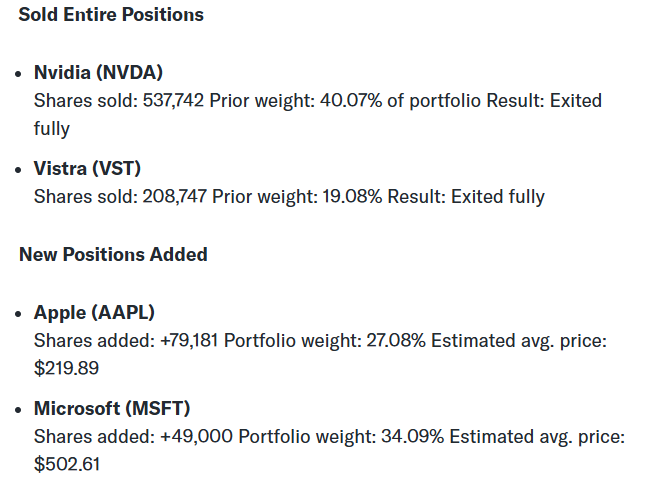
The hedge fund not only completely cut Nvidia's holdings, but even completely withdrew. In other words, it cleared Nvidia shares in the third quarter, which can be described as accurately predicting the market panic and sell-off caused by the AI bubble.
More than 537,000 shares, accounting for about 40% of Nvidia's portfolio, disappeared from the latest 13F report, and Vistra Energy (VST.US), the biggest winner of the US power stock boom since 2024, was also completely liquidated by the hedge fund, which previously accounted for 19% of its portfolio.
What's more remarkable is that although Nvidia's quarterly sales rose sharply from $39.3 billion to $46.7 billion, of which data center business revenue increased sharply by 56%, and Wall Street analysts generally expect sales to reach $1 trillion by 2030, Thiel has completely withdrawn from this stock position.
The hedge fund institution named Till revealed that overall US stock holdings fell from nearly US$212 million in the second quarter to US$74.4 million in the third quarter, a decrease of nearly two-thirds.
Furthermore, the hedge fund has an exchange rate of over 80%, leaving only three holdings: Tesla, Microsoft, and Apple.
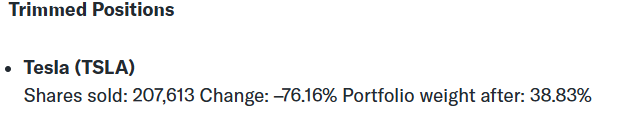
However, Tesla's position was cut by about 76%, leaving only 65,000 shares, or nearly 39% of the hedge fund portfolio. Meanwhile, Thiel's hedge funds have invested heavily in Microsoft and Apple, accounting for 34% and 27% of their portfolios, respectively.
The details of Thiel's hedge fund institution's 13F portfolio operations in the third quarter are as follows:
Why Tyr's complete withdrawal from Nvidia positions would send a very different signal
With Thiel's complete withdrawal from Nvidia's holdings, the market clearly received a clear bearish and negative signal at a moment of complete fascination with AI.
Nvidia's fundamentals are outstanding, and Till has praised its absolute dominance, saying that Nvidia is clearly a strong leader in AI hardware.
On the other hand, he warned that the market's hype cycle for the AI boom had exceeded his own expectations. He compared this moment to 1999, when investors were pricing a future that would take about 15-20 years to materialize.
He's not the only one who thinks so. Amazon founder Jeff Bezos described the huge boom in AI as a “perfect industrial bubble.” Goldman Sachs CEO David Solomon pointed out that the stock market may experience a healthy correction of 10% or more within 12 or 24 months. Similarly, legendary investor James Anderson called Nvidia and OpenAI's $100 billion financing plan for revolving AI “unsettling.”
Recently, Michael Burry (Michael Burry), the prototype in the Hollywood movie “The Big Short,” also established a large number of bearish short positions on the two core beneficiaries of the AI investment frenzy in US stocks — Nvidia and Palantir. The stock prices of both giants have doubled several times since 2023.
This is why Tyr turned to Microsoft and Apple. These tech giants have more diversified revenue sources, such as huge cloud computing business scale, consumer electronics devices, and software-based service business lines.
Till believes that AI is transformative, but it is a process of slow progress, and only platform-based software service companies provide real sustainable economic growth benefits, rather than the current “pure chip companies” with high valuations. Microsoft and Apple, on the other hand, are technology giants that build platforms, ecosystems, software+hardware+services, and have a “long-term profit base” in the integration of AI+cloud+devices. Furthermore, compared to Nvidia, Microsoft and Apple may have a stronger debt structure, more rock-solid free cash flow, and a more mature diversified business model, which is attractive when he tries to avoid “high bet+high volatility.”
Since 2023, Apple (AAPL.US), the tech giant with the world's most popular consumer electronics product lines such as iPhones and iPads, has faced a great deal of opposition on Wall Street because it has not spent a lot of money to lay out AI computing power infrastructure in this unprecedented artificial intelligence boom like other tech giants such as Google and Meta. However, since April, Apple's conservative and unique “save money and use AI” strategy has now suddenly become a major boon for this consumer electronics giant, causing the market to notice that Apple actually has both a “safe haven” and an “AI beta” investment position.
Although Apple, which has a huge iPhone ecosystem and an installed base of over 2.3 billion devices, is still regarded by Wall Street as one of the potential winners of the AI craze, it does not bear the major risk of such heavy AI computing power infrastructure capital expenses, and has sufficient free cash flow on its books. Coupled with Wall Street analysts, the “blue ocean of AI reasoning” and “physical AI” will become Apple's new revenue generation engine in the future. All of this has made Apple stock the only technology stock in the global technology industry with a “safe haven” and AI risk exposure at a time when the global AI investment wave is being questioned by the market.
“The logic of market hedging is that Apple is still a big tech company, but it's not a pure AI company like Nvidia, but Apple is still involved with AI.” said Brian Mulberry, client portfolio manager from Zacks Investment Management. “The market has a very positive perception of Apple, that is, it doesn't have to answer the big question that other companies have to face, which is called the torture of the soul: What is the return of the huge amount of capital you have invested in the AI field?”