
Identifying the AI bubble as a “big short” Bury resolutely liquidates Scion Fund
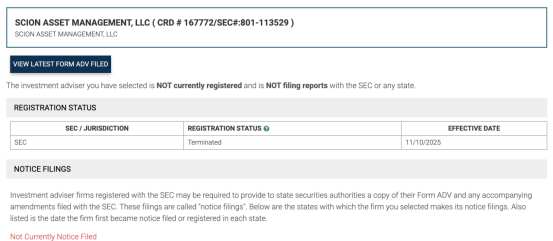
The Zhitong Finance App learned that Michael Burry (Michael Burry), an investor famous for accurately predicting the 2008 subprime mortgage crisis and the prototype of the movie “The Big Short,” is leaving the asset management business. According to the latest US Securities and Exchange Commission (SEC) documents, his Scion Asset Management LLC officially terminated its registration status on November 10, 2025, local time.
Meanwhile, a screenshot of an investor letter signed by Bury and dated October 27 was circulated on social media platform X, drawing widespread attention. According to the letter, Bury plans to liquidate its funds and return the principal amount to investors before the end of the year.
“It is with a heavy heart that I will clear these funds and return the principal amount before the end of the year — keeping only a small audit/tax reserve,” Barry wrote in the letter. “The current market's assessment of the value of securities is at odds with my judgment, and this has been going on for quite some time.”
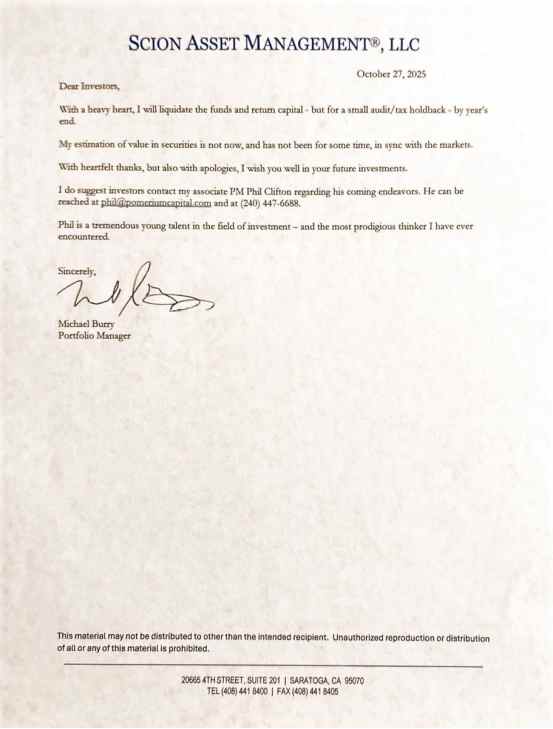
The letter's authenticity has not been verified. However, several mainstream media quoted the contents of the letter and confirmed that the termination of Scion Asset Management's registration was shown in the SEC files.
Bruno Schneller, managing director of Erlen Capital Management, said: “Bury's decision was not so much about 'quitting' as about moving away from a game he thought was fundamentally manipulated.”
Long-term divergence: Bury's “valuation disagreement”
Scion Asset Management, which managed $155 million in assets as of March, has long been viewed by the market as a weather vane for detecting bubble risks. And Barry's statement may indicate that he is once again questioning the current market valuation system.
The “disagreement with the market” mentioned in the letter was interpreted by many market participants as a sign that Burry believes the market is overvalued and lacks rationality. Recently, Bury has also repeatedly publicly criticized the potential risks of large technology companies and artificial intelligence (AI) valuations.
Last week, Bury's Scion Asset Management revealed that it has established short positions with AI darlings Nvidia (NVDA.US) and Palantir (PLTR.US), implying that it is cautious about AI transactions that are driving the market's sharp rise this year.
Although Burry clarified on X that the size of his Palantir deal was about $9.2 million, not the $912 million misunderstood — each contract was 100 put options expiring in 2027 and executed at a price of $50 — he executed the deal last month. However, in another post, he criticized that big tech companies such as Microsoft (MSFT.US), Google (GOOGL.US), Oracle (ORCL.US), and Meta (META.US), while investing billions of dollars in Nvidia chips and servers, are suspected of whitewashing profit data by extending the useful life of assets.
He estimated that between 2026 and 2028, these accounting operations could reduce the depreciation expenses of the entire industry by about 176 billion US dollars, thereby inflating reported profits.
In the same post, Barry added that he is now “committed to much better things (on to much better things),” and said he will announce new trends on November 25.
The difficult situation of shorting institutions
In recent years, thanks to the market's infinite optimism about the technology industry and the strong interest of retail investors, bearish views have become increasingly unpopular in the market. Bury has also joined the ranks of many well-known investors and is struggling to move forward in such a market environment.
Earlier this year, the famous shorting agency Hindenburg Research (Hindenburg Research) suddenly closed down. Previously, the company released a series of high-profile bearish reports, including shorting India's Adani Group and American electric truck manufacturer Nikola.
Jim Chanos, a veteran shorter known for successfully shorting months before the energy trader Enron went bankrupt, also recently had a dispute with Strategy (MSTR.US), a Bitcoin holding company owned by Michael Saylor. Chanos believes Strategy's valuation premium is unreasonable, but this criticism was fiercely refuted by Saylor.
The reverser's farewell
Bury's liquidation decision highlights his consistent reverse investment philosophy — when value judgments are disconnected from market prices for a long time, he would rather quit rather than compromise.
Driven by AI and technology stocks, the US stock market has repeatedly reached new highs this year, and Burry has issued multiple warnings since the beginning of the year. His departure was viewed by some market participants as a symbolic protest against this “wave of speculation.”
According to the September report from J.P. Morgan Asset Management, AI-related concept stocks have contributed 75% to the S&P 500 index increase since OpenAI launched ChatGPT in November 2022.
“Bury may think that the current market valuation system has deviated from reality,” a London fund analyst said in an interview. “When an investor who sticks to fundamental analysis finds that the market has been unreasonable for a long time, stopping the game itself is a rational choice.”
It is currently unclear where Bury will invest the fund after liquidating it. The market speculates that he may switch to the family office or private investment sector. The November 25 plan mentioned by Berry may reveal his new investment path.
Schneller of Erlen Capital Management believes that Bury may switch to a family office model and only manage its own funds. According to regulations, investment advisors with an asset management scale of $100 million or more must register with the SEC and are mainly subject to federal regulation rather than state regulation.
But whatever the outcome, this “crisis prophet” once again expressed his position in a very symbolic way — when price is far from value, exit may be the purest insistence.