
Are US small-cap stocks ushered in a historic investment window? The valuation gap hit its highest in 40 years, and the wave of mergers and acquisitions may become a reversal engine
The Zhitong Finance App learned that for many years, US small-cap stocks have failed to reach their high beta reputation — especially in terms of excellent performance during the boom period. Analysts say this may be about to change as earnings growth for smaller companies is expected to outpace that of larger companies.
Relatively low valuations could also trigger a wave of mergers and acquisitions, further boosting the sector.
Scotiabank strategist Hugo St-Marie wrote in a research report on November 11 that the profits of small and medium capitalization S&P 600 companies are expected to increase 14% in the third quarter, which will exceed the S&P 500 growth rate of nearly 12%.
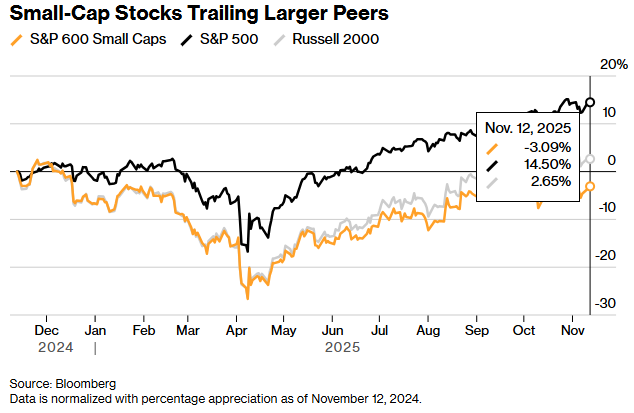
The performance of small-cap stocks lags behind that of large-cap stocks
Chris Tesin, chief investment officer of Acuitas Investments LLC, said that further interest rate cuts should help boost the profits of smaller companies with relatively high debt, and for investors seeking excessive returns in 2026, small-cap stocks may be poised to go.
Tesin believes that valuation and profit growth are “still important”. At some point, investors will choose to return to small-cap stocks that have increased profits much higher than large-cap stocks, but are valued less.
He said, “I don't think the world has changed so much that big trees are growing faster. Do you really think sequoia trees will always outgrow saplings?”
Corporate mergers and acquisitions may also boost the small-cap stock community. Due to the lackluster performance of stock prices over the years, some companies appear to have attractive valuations, especially compared to large-cap stocks. The poor performance since 2022 was so significant that Scotiabank strategists described its valuation gap as the “steepest” level in the past 40 years.
The Russell 2000 index has risen 10% so far this year, while the S&P 500 has risen 17% and the Nasdaq 100 has surged 21%. Going back to the end of 2022, the relatively poor performance was even more obvious. The increase of nearly 40% in the S&P 500 index was almost double that of the Russell 2000 index.
According to a Bank of America Securities report, this differentiated performance has made small-cap stocks “historically cheap,” so much so that M&A activity in this field is expected to reach the highest level in decades.
“The difference in return is so big that you can drive a truck,” Tessin said.
Investors continued to withdraw their capital from small-cap stocks this year. So far in 2025, with the exception of two months, iShares core S&P small-cap ETFs have all experienced net outflows.
Jefferies stock strategist Steven DeSanctis wrote that the speed of mergers and acquisitions of companies in the Russell 3000 Index is expected to break the record set in 1996, and that high acquisition premiums are often “very beneficial to the performance of small-cap stocks.” “Animal spirit has returned with numerous mergers and acquisitions.”
What is certain is that a dramatic reversal in small-cap stocks in the short term is not a market consensus.
Ed Clissold, chief US strategist at Ned Davis Research, said: “Small-cap stocks are indeed cheaper than large-cap stocks, which is of course their advantage, but in almost all cases, valuation differences require a catalyst — and this is exactly what is currently lacking.” He said investors may have to wait “a few years” to see small-cap stocks outperform the market, and this usually happens during the recovery phase after a recession.
Clissold said, “We are at a point where valuation is really important. If someone wants to buy small-cap stocks exploratively, this is fine, but be aware that you may have to wait a while to see this deal take effect.”