
IPO Prospects|The storage industry has entered a boom cycle. Can the listing of Baiwei Storage (688525.SH) in Hong Kong stimulate strategic potential?
Since September, the storage industry has arguably been the best-performing sector in the capital market. Take A-shares as an example. As of November 13, the biggest stock price increases of Shannon Xinchuang (300475.SZ), Demingli (001309.SZ), Jiang Bolong (301308.SZ), and Baiwei Storage (688525.SH) since September were 423%, 258.94%, 288%, and 142.45%, respectively. It can be seen that stocks in this sector are strong in the market.
However, the reason behind storage companies receiving market funding is mainly because storage industry products are already in short supply and have begun to rise in price one after another. As the explosion of AI computing power drives high-end demand and the world's major producers strategically cut production capacity for traditional products, this has led to a structural imbalance between supply and demand in the storage industry, which has driven up the price of all types of storage products. CITIC Securities said that the upward boom in the storage industry will continue until at least the second half of 2026.
Facing the boom cycle that has begun in the industry, Baiwei Storage, which has doubled its stock price in a short period of time, recently made a new move. The Zhitong Finance App observed that Baiwei Storage has begun a new listing journey in Hong Kong. It submitted a listing application to the main board of the Hong Kong Stock Exchange on October 28, with Huatai International as the sole sponsor.
According to Frost & Sullivan data, Baiwei Storage is the only independent storage solution provider in the world with wafer-level packaging capabilities. Based on the relevant revenue in 2024, Baiwei Storage is the world's largest independent storage manufacturer with independent packaging manufacturing. Furthermore, the company is also the world's largest supplier of AI emerging end side semiconductor storage solutions, and is in a leading position in various AI end side applications.
According to Baiwei Storage, the capital raised by the company's Hong Kong listing will be used to upgrade the iterative self-developed main control chip, storage solution design, and improve advanced packaging and testing capabilities. At the same time, the company will use part of the capital for international expansion and search for potential strategic investment, cooperation, and mergers and acquisitions, while the remaining funds will be used for operating capital and general corporate purposes.
Expansion of diverse application scenarios drives continued rapid revenue growth
From the perspective of the industrial chain, the storage industry can be divided into three major links: upstream wafer and master control chip design and manufacturing, midstream storage product manufacturing, and downstream terminal applications. Among them, the midstream link plays a key role in connecting upstream and downstream, and is the core hub for value creation in the industrial chain.
The original upstream storage wafer manufacturers include Samsung, Changxin Storage, Changjiang Storage, etc., and supporting chip manufacturers such as main control chips include Lanqi Technology, Huirong Technology, etc.; midstream storage product manufacturing mainly refers to product design and integration according to the specific requirements of downstream customers (such as mobile phone manufacturers and data centers) for capacity, speed, power consumption, size, interface (such as PCIe), and reliability. At the same time, purchased storage wafers (dies), main control chips, etc. are made into modules (such as memory sticks, SSDs) that can be plugged or welded through packaging technology, and then tested to ensure that product performance standards are met.
It is worth noting that there are two main business models for manufacturing midstream storage products. One is an independent memory manufacturer. They do not manufacture storage wafers themselves, but focus on solution design, package testing, and large-scale delivery, which can quickly respond to the diverse needs of the market. Such manufacturers are also commonly known as module manufacturers in the industry. Another model is integrated device manufacturing (IDM), where original manufacturers such as Samsung and Micron extend downstream, produce their own wafers and directly sell their own storage modules. This type of product is usually aimed at enterprise and high-end consumer markets where performance and consistency are extremely high.
However, Baiwei Storage is a module manufacturer, but in order to enhance its competitiveness in the industry, it uses an integrated R&D packaging and testing model operation, covering storage medium analysis, main control chip design, firmware algorithm development, software and hardware innovation, and advanced packaging and testing. With this integrated R&D, packaging and testing model, Baiwei Storage is one of the few companies in the industry that has full stack capabilities to transform NAND and DRAM into storage solutions. Through integrated storage solutions, R&D and manufacturing processes, it solves diverse storage needs in various industry verticals and different application scenarios.
According to the prospectus, the high-performance semiconductor storage solutions provided by Baiwei Storage have covered various application scenarios such as the emerging end side of intelligent mobile and AI, PC and enterprise storage, and smart cars and other application fields. At the same time, relying on integrated technical capabilities, the company also provides advanced sealing and testing services for core customers in the industry.
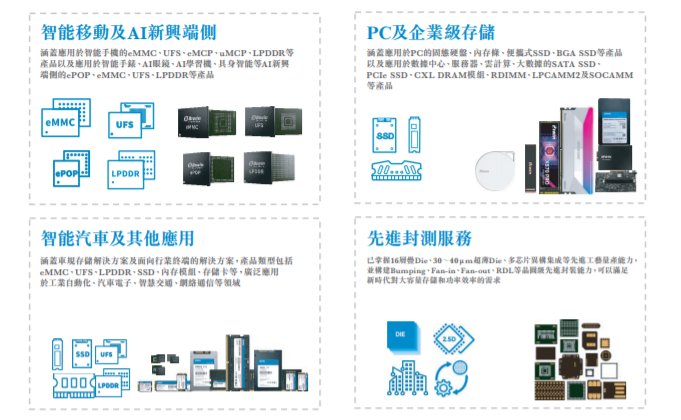
In the emerging field of intelligent mobility and AI, Baiwei's storage solutions include low-power DDR (LPDDR), eMMC, UFS, ePOP, eMCP, and uMCP. These solutions have been widely used in smartphones, tablets, AI/AR glasses, smart watches, AI learning machines, personalised intelligence, and other emerging AI terminals. Notably, well-known customers such as Meta, Google, Xiaomi, OPPO, vivo, Honor, Voice, Motorola, ZTE, TCL, Positivo, Rokid, and Thunderbird Innovation have all adopted the company's solutions.
In the field of PC and enterprise storage, Baiwei Storage's PC storage solutions include SSDs, DRAM modules, portable SSDs (PSSDs), and BGA SSDs, which are widely used in terminals such as desktops, notebook computers, and e-sports consoles to provide fast and reliable data processing for everyday tasks and high-performance computing. In addition, Baiwei Storage's enterprise-grade storage solutions include SATA SSDs, PCIe SSDs, CXL DRAM modules, RDIMM, LPCAMM2, and SOCAMM, which are mainly deployed in data centers and servers to provide high-capacity, low-latency storage support for intensive data processing and AI-driven workloads. The company's solutions have been approved and adopted by leading server manufacturers and well-known Internet companies.
In smart cars and other applications, Biwei's storage solutions include automotive-grade LPDDR, eMMC, UFS, and memory cards, as well as SSD and DRAM modules for other industrial fields. These solutions support advanced smart car functions such as autonomous driving, smart cockpit, and real-time navigation. Baiwei's storage solutions have passed strict certifications from several leading domestic automotive OEMs, and have been successfully delivered in large quantities.
From a revenue perspective, Baiwei Storage has achieved continuous rapid growth. From 2022 to 2024, Baiwei Storage's revenue was 2,986 billion yuan, 3,591 billion yuan, and 6.695 billion yuan, respectively. As of the first half of 2025, Baiwei Storage's revenue was 3,912 billion yuan, an increase of 13.69% over the previous year.
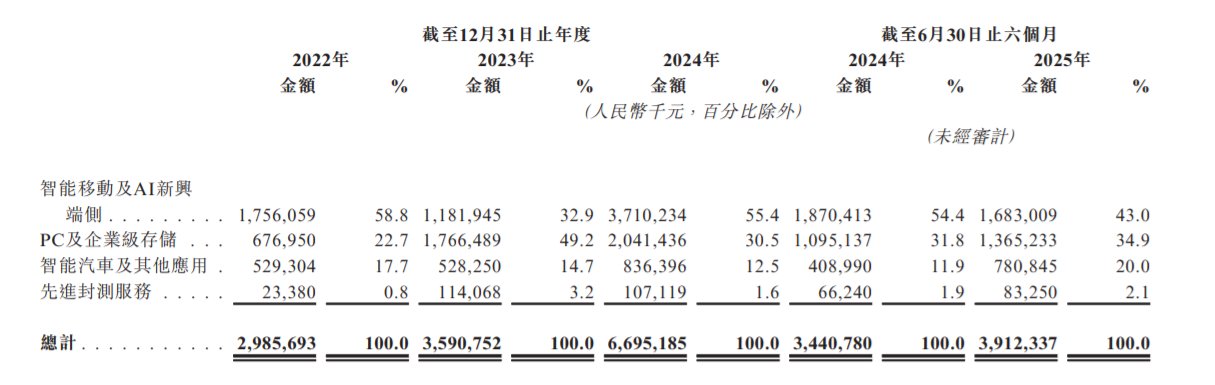
Behind the continued increase in revenue, it is mainly due to the gradual recovery in downstream demand and the expansion of new customers. This has enabled Baiwei Storage to achieve an overall growth trend in revenue from smart mobile and AI terminals, PC and enterprise storage, smart cars, and other applications. In 2024, the three major businesses accounted for 55.4%, 30.5%, and 12.5% of revenue, respectively. The remaining 1.6% are advanced sealing and testing services, which still account for a small share.
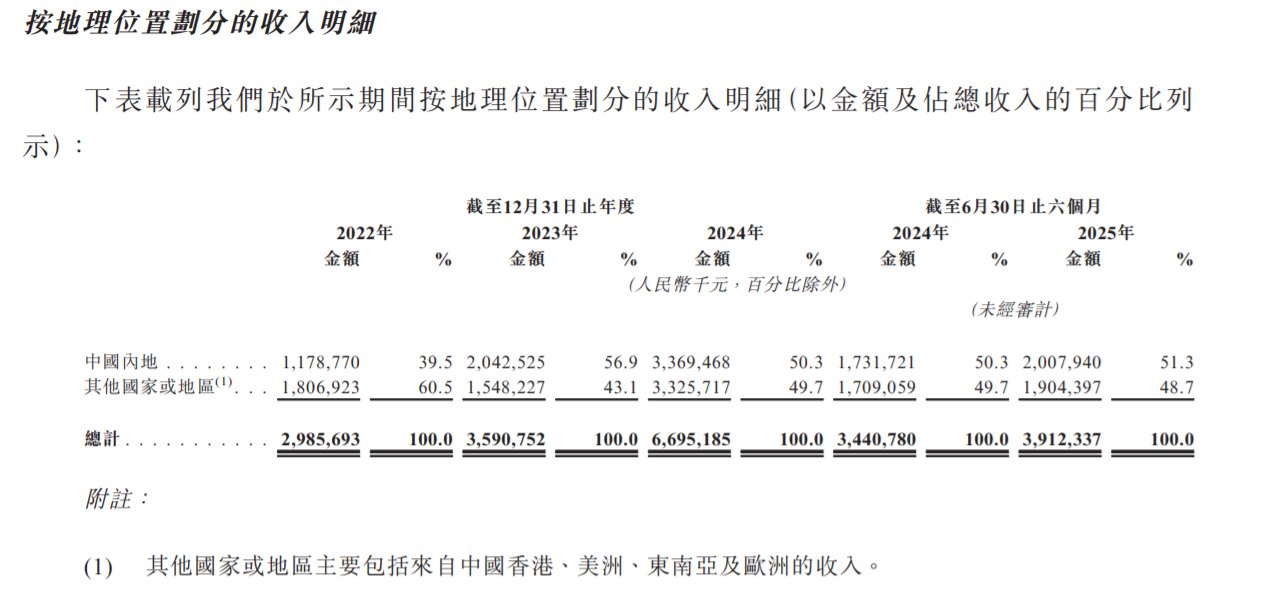
In terms of geographical location, BIWEI Storage has adopted a domestic and foreign two-wheel drive development model. In 2024, BIWEI Storage's revenue from mainland China and other countries or regions will account for 50.3% and 49.7%, respectively. Thanks to the concerted efforts of domestic and foreign markets, they have jointly promoted the high revenue growth of Baiwei Storage since 2022.
However, from the profit side, the fluctuations in Baiwei Storage are very obvious. According to the data, from 2022 to 2023, the adjusted net profit of Baiwei Storage under non-international accounting standards was 78.269 million yuan, 500 million yuan, and 473 million yuan, respectively. As of the first half of 2025, Baiwei Storage recorded an adjusted net loss of 91.122 million yuan, which directly changed from profit of 470 million yuan in the first half of 2024 to loss.
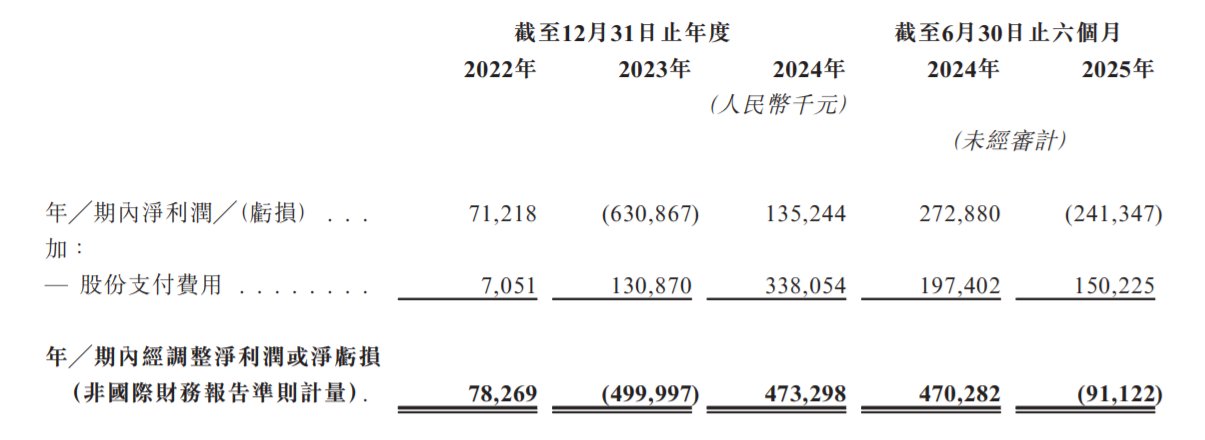
However, behind Baiwei Storage's “crazy roller coaster” on the profit side, is mainly because the storage industry is a typical cyclical industry, and module manufacturers need to prepare goods in advance. Once industrial demand falls and product prices drop, then there will be a situation of “high-priced inventory and low-price sales”, leading to huge losses.
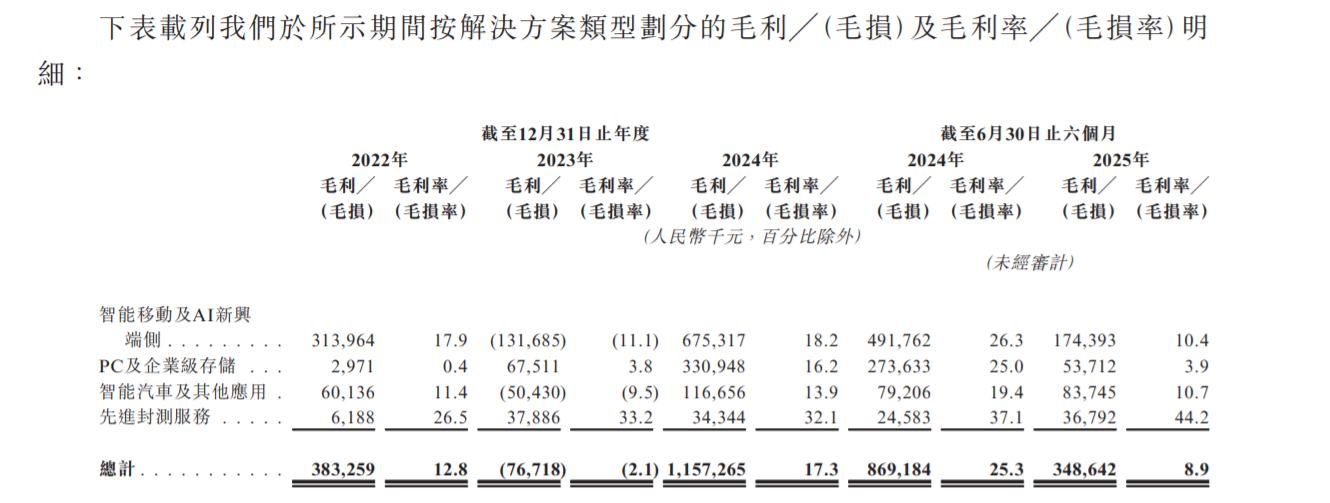
From 2022 to 2024, Baiwei Storage's gross margins were 12.8%, -2.1%, and 17.3%, respectively. The drop in product prices in 2023 directly led to a gross loss recorded during the period. The gross margin for the first half of 2025 was 8.9%, a year-on-year decline of only 16 percentage points, so net profit also changed from profit to loss during the period. It can be seen from this that product price is a key factor in determining Baiwei's storage performance.
Inventory dividends have boosted short-term performance, and medium- to long-term strategic potential has yet to be unleashed
If you look closely, it's easy to see that the current storage sector in the A-share market is led by module manufacturers, as is the case with Demingli and Jiang Bolong. This is because the business model of module manufacturers is bound to be highly price sensitive, and in the short term, the performance elasticity and certainty of module manufacturers are significantly higher than other links in the industry chain.
The business model where module manufacturers need to prepare goods in advance can cause large losses in the downturn of the industry, but once the industry enters a boom cycle where prices continue to rise, the module manufacturer's profit release is also amazing, because module manufacturers use asset-light management. In the price increase cycle, as long as stocks are quickly completed, then the upstream price increase can be directly converted into their own profit. This is clearly reflected in Baiwei Storage's latest financial report.
According to the third quarter financial report released by Baiwei Storage on October 31, its revenue for the reporting period was 2,662 billion yuan, up 68.06% year on year. Net profit after deduction for the period was 213 million yuan, a sharp increase of 457.26% year on year, turning a loss into a profit, while losing 59.71 million yuan for the same period in 2024. This indicates that Baiwei Storage has indeed begun to benefit from the industry's price increase cycle.
Meanwhile, Baiwei's inventory at the end of the third quarter of 2025 increased further. According to the data, as of December 31, 2024, Baiwei's inventory was 3,537 billion yuan, rising to 4.382 billion yuan as of June 30, 2025. As of September 30, Baiwei's inventory rose to 5.695 billion yuan, an increase of 61% year-on-year and 29.96% month-on-month.
Continued sharp increases in inventory will lay a solid foundation for the explosive growth of Baiwei Storage's performance in the short term. However, it is worth noting that the profit explosion brought about by the inventory dividend is not sustainable. When the inventory dividend disappears, module manufacturers need to purchase wafers at market prices, and whether it is possible to guarantee the stable delivery of memory chips will become a key factor affecting performance.
Baiwei Storage said that the company has always adhered to a diversified supply strategy and further deepened cooperation with major global storage wafer manufacturers and foundry factories. By signing LTA (long-term supply agreements) with major storage wafer manufacturers, it effectively guarantees the stable supply of key raw materials, providing a solid foundation for continued business expansion.
Based on this, whether module manufacturers can achieve medium- to long-term success in the big price increase cycle depends on how the company uses this “window period” to achieve strategic upgrading. At this time, the dimensions of market competition will shift from “competing for inventory” and “fighting for stability in raw material supply” to competing for technology, products, and ecology, and Baiwei Storage has shown certain advantages.
At the technical level, Baiwei Storage, as the only independent storage module factory with advanced wafer-level packaging capabilities in the world, has built a full chain of technical capabilities of “chip design - solid state algorithm - advanced packaging and testing”. At the product and ecological level, Baiwei stores precision card slots on high-growth tracks such as AI terminals (mobile phones/PC/glasses) and smart cars, and customers cover giants such as Meta, Google, and Xiaomi.
It can be seen from this that in terms of strategic layout, Baiwei Storage already has the potential to achieve continuous growth in the medium to long term. However, whether it can take advantage of the current industry boom cycle and the dual opportunity of going public in Hong Kong to realize this potential into impressive financial performance on a medium- to long-term level is still the key to its leapfrog development, and it is worth continuing attention.