
If you urgently need a stock that combines safe haven and AI beta attributes, it's Apple (AAPL.US)
Since 2023, Apple (AAPL.US), the tech giant with the world's most popular consumer electronics product lines such as iPhones and iPads, has faced a great deal of opposition on Wall Street because it has not spent a lot of money to lay out AI computing power infrastructure in this unprecedented artificial intelligence boom like other tech giants such as Microsoft, Google, and Meta. However, since April, Apple's conservative and unique “save money and use AI” strategy has now suddenly become a major boon for this consumer electronics giant, causing the market to notice that Apple actually has both a “safe haven” and an “AI beta” investment position.
As investors begin to examine when tech giants such as OpenAI, Facebook's parent company Meta Platforms, and Microsoft will be able to reap positive returns, these are kinetic individual stocks that once had the strongest gains this year, but now fluctuations have intensified markedly. As a result, the market is re-evaluating the unique position of Apple, which has never participated in the “AI money burning war,” in AI technology updates and iterations.
Although Apple, which has a huge iPhone ecosystem and an installed base of more than 2.3 billion devices, is still regarded by Wall Street as one of the potential winners of the AI craze, it does not bear the major risk of such heavy AI capital expenses, and has sufficient free cash flow on its books. Coupled with Wall Street analysts, the “blue ocean of AI reasoning” and “physical AI” will become Apple's new revenue generation engine in the future. All of this made Apple stock the only technology stock in the global tech industry with a “safe haven” and AI risk exposure when the global AI investment wave was questioned by the market last week.
Unlike tech giants such as Microsoft, Google, and Amazon, Apple can avoid a soul torture
“The logic of market hedging is that Apple is still a big tech company, but it's not a pure AI company like Nvidia, but Apple is still involved with AI.” said Brian Mulberry, client portfolio manager from Zacks Investment Management. “The market has a very positive perception of Apple, that is, it doesn't have to answer the big question that other companies have to face, which is called the torture of the soul: What is the return of the huge amount of capital you have invested in the AI field?”
This investment argument is actually pretty simple. According to the Zhitong Finance App, Apple will provide millions of iPhone users with the most advanced AI features by using cutting-edge AI models from other AI technology companies — many Wall Street analysts believe that end-side users will be exposed to the most advanced AI for the first time through Apple iPhone devices, thereby greatly benefiting from this global super-AI wave of trillions of dollars, while avoiding the huge AI computing infrastructure expenses required to develop their own AI systems — and this is exactly what many of its big tech peers are doing.
“Judging from capital investment and the degree of leverage, Apple is the giant with the least exposure to AI computing power expenses among the 'Big Seven Tech Giants' (Mag7).” Brian Pollak, portfolio manager from Evercore and chairman of the Investment Policy Committee, said. “It is definitely likely to become the core beneficiary of the AI wave, especially the 'physical AI' that is about to become popular around the world, and Apple does not have to invest capital expenses on the same scale as tech giants such as Google and Microsoft.”
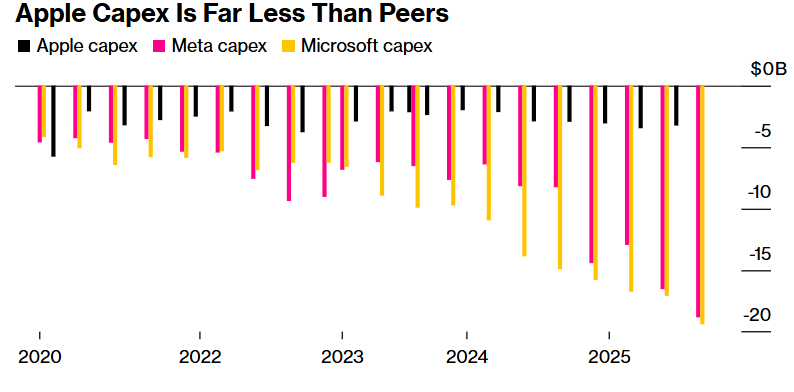
As shown in the chart above, Apple's capital expenditure outlook is far lower than that of other tech giants. According to Wall Street analysts' forecasts, Apple's capital expenditure in the current fiscal year (ending September 2026) is only about 14 billion US dollars. In contrast, Microsoft's capital expenditure for the fiscal year ending June is expected to exceed $94 billion, and even some analysts expect it to exceed the $100 billion mark. However, Facebook's parent company Meta is only half of Apple's market capitalization, yet the company's management expects capital expenditure to exceed 70 billion US dollars in 2025.
This clear difference can be seen from Apple's stock price performance. In a year dominated by the AI investment boom, Apple was the worst performer in the “Bloomberg Magnificent 7 Index” (Bloomberg Magnificent 7 Index), rising only 7.6% so far in 2025, while the stock price of Google's parent company Alphabet Inc has risen sharply by 53%, and the stock price of “AI chip hegemon” Nvidia has risen 48%. Even the S&P 500 index and the Nasdaq 100 index have clearly outperformed Apple's stock price performance so far this year.
However, when technology stocks were hit last week due to market concerns about huge AI spending heating up, Apple's performance was far better than its rivals and related indices. It almost leveled off in these five trading days, while other big tech stocks generally fell sharply. In fact, in the second half of this year, Apple's stock price has risen 31%, outperforming the S&P 500 and Nasdaq 100 indices, as well as many big tech competitors.
“Its balance sheet is extremely stable, its cash flow is extremely strong, and the business moat built by the iPhone ecosystem is also very broad.” Pollak displayed. “All of these factors make it more defensive than technology companies that spend more capital on AI and have higher leverage for AI business exposure.”
Even on Monday, the difference was clear: as market optimism about the end of the US government shutdown heats up, almost all AI concept stocks jumped sharply, while Apple's stock price was mediocre due to market concerns that poor sales of the new Air could lead to delays in next year's iPhone Air.
As investors begin to worry more and more about the exaggerated extent of AI spending and hope to see some degree of AI return or AI monetization from these investments, this kind of differentiated treatment is particularly critical.
“Momentum is weakening, and interest in 'buying on the diff' is also declining.” Mark Grant, chief global strategist at Colliers Securities, said. “The valuation of some AI technology stocks has moved away from fundamentals.”
Apple has both “safe-haven and AI” attributes
On the second day after the release of the latest earnings report, despite mixed results, it also showed an unexpected decline in revenue in the Chinese market. Apple's stock price still rose by nearly 3%. For Apple with a market capitalization of up to 4 trillion US dollars, this increase was rare.
In contrast, some of its “Big Seven” stock targets, including Meta and Microsoft, continue to be sold off due to heavier AI capital expenses and lower than anticipated revenue prospects. For example, after CEO Mark Zuckerberg (Mark Zuckerberg) emphasized in the Meta earnings call that the company needed to invest more in AI computing power infrastructure, Meta's stock price plummeted by more than 11% on October 30, the biggest one-day drop in the company's stock price in nearly three years.
At a time when the stock prices of tech giants are falling collectively and the S&P 500 and Nasdaq 100 indices are recovering, the performance of Apple's stock price continues to outperform the general market, marking that Apple's stock price has returned to its “safe-haven nature in the midst of sharp fluctuations” — in the past, every time the market was turbulent, Apple's extremely strong ability to generate cash and a rock-solid balance sheet made it relatively unscathed. At the same time, for investors who love the AI investment wave, Apple, which has “AI beta” (AI beta) attributes, is also a technology stock target worth focusing on, so Apple can be described as having the dual attributes of “safe-haven and AI.”
As consumers directly connect to this epoch-making generative AI technology through smart hardware in the Apple ecosystem, the AI inference side is expected to become Apple's new revenue generation channel, and this old-school tech giant may still become one of the core beneficiaries of the AI wave. According to a recent research report released by Bernstein (Bernstein), a well-known investment agency on Wall Street, the trillion-dollar “super blue ocean” that is expected to be brought by huge AI inference systems by 2030 should bring long-term benefits to these large technology companies that focus on IT hardware and consumer electronics, such as consumer electronics giant Apple.
On the other hand, Wall Street is betting that “physical AI” may be Apple's next supergrowth engine. The Morgan Stanley analyst team wrote that Apple is likely to grow into a heavyweight market player in robotics and the broader “physical AI” field, and the agency believes this is another huge market comparable in size to the generative AI market where ChatGPT is located. According to Nvidia CEO Hwang In-hoon's opinion, “physical AI” emphasizes allowing robots/autonomous operating systems to sense, reason, and act in the real world.
Morgan Stanley analyst Erik Woodring wrote, “As AI and robots change the physical world, Apple can use its vertical integration capabilities, the huge installed base of more than 2.3 billion devices, and Apple's proprietary robotics technology, which is not yet fully recognized, to become a leading player in the field of embodied intelligence.” The agency said it has carefully estimated that by 2040, the series of robot products that Apple is planning, the Apple Robotics series, is expected to bring a huge revenue opportunity of about 130 billion US dollars, which is equivalent to “about 30% of Apple's current revenue base, and may account for at least 10% of its stock price pricing trajectory and up to 25% of its market value.”
Currently, market optimism about AI is still very strong, and there is almost no risk that technology companies with large market capitalization will lose their absolute position as “popular stocks” in the market sentiment. Bank of America analyst Vivek Arya said that even if the current AI skepticism is “overexaggerated,” such doubts are still healthy for these tech giants, and a short-term pullback is an excellent opportunity to buy on dips.
“The widespread skepticism about AI capital expenditure is understandable, and is likely to be a reverse benefit, helping to reduce overcrowded positions.” Bank of America analyst Arya wrote in a November 10 research report. The recent weak performance reflects unrelated factors such as a government shutdown, and “the potential AI computing power demand environment is still extremely strong,” Arya said.
All of this has made investors start to think about what kind of role Apple will play in a stock market that continues to be dominated by the AI investment boom. Is it an important hedge against sudden market downturns? Or is it just a big tech stock that hasn't fully grasped the current AI development trend? The answer is: Apple has the dual attributes of “safe-haven and AI.”