
Wholesale electricity prices are falling, but the bill is still rising! The cost of the energy transition has become an “unbearable burden” for British households
The Zhitong Finance App learned that British households are in the midst of a new type of energy crisis — household energy bills are still rising despite the continued drop in wholesale electricity and gas prices. This widening gap is increasing the political pressure facing the British government. The authorities are not only raising billions of pounds for the clean energy transition, but also trying to convince voters that the transition will reduce electricity costs. As Chancellor of the Exchequer Rachel Reeves begins preparing the budget to be announced later this month (it is widely anticipated that there will be multiple tax increases), ministerial officials are under tremendous pressure to explain to the public why consumers will still have to bear higher costs in the context of a slowing global energy market.
According to data from energy consulting firm Cornwall Insight Ltd., the UK's domestic energy costs will rise again in April next year due to the increase in grid fees and policy costs, and the UK's domestic energy costs are already one of the most expensive in Europe. At the same time, however, wholesale energy prices in the UK are expected to fall during the same period.
Like many other European countries, the British government believes that rapidly building cheaper renewable energy will reduce electricity costs in the long run. This view was strengthened after the outbreak of the Russia-Ukraine conflict in 2022 caused gas prices to soar. However, the upfront costs of switching from a gas-based system to a system dominated by renewable energy are now increasingly being borne by British households.

Non-wholesale costs drive up UK household energy bills
Craig Lowrey, chief consultant at Cornwall Insight, said, “The problem is that customers feel an immediate impact on their bills and wait a long time before they see the benefits of the transformation.”
British ministerial officials promised that by 2030, large-scale expansion of wind and solar power will reduce energy costs. But Octopus Energy, one of the UK's largest energy suppliers, revealed to lawmakers last month that even if wholesale electricity prices fall short, energy bills could still rise by as much as 20% in the next few years because all other costs are rising.
The scale of investment required to support the energy transition is enormous. The UK Gas and Electricity Market Office said that by 2030, grid upgrades alone could cost about 80 billion pounds (about 105 billion US dollars). The energy regulator is expected to approve transmission grid operators' new spending plans in December this year, which will increase annual bills by more than £50 starting next year and more than £100 by 2031. These expenses will be used for a range of projects, including the construction of new overhead cables, to deliver large amounts of wind power to electricity centers such as London.
data analysis
Recent data clearly shows drastic changes in the cost structure of energy bills. According to the Cornwall Insight report, the wholesale cost portion of the UK energy bill has dropped by about 77% since the beginning of 2023, while the cost of policies to support the government's renewable energy construction has risen by 41% over the same period.
However, Andrew Sissons, project deputy director at the British research agency Nesta, pointed out that current discussions on the drivers of the UK's energy bills often overlook the overall picture because most households pay combined electricity and gas bills. He said, “When we explore the drivers of rising energy bills, we can clearly see that wholesale costs — that is, the part affected by gas prices — are still the main cause. This is one of the reasons we believe the UK must stop using gas heating as soon as possible and switch to clean electric heating.”
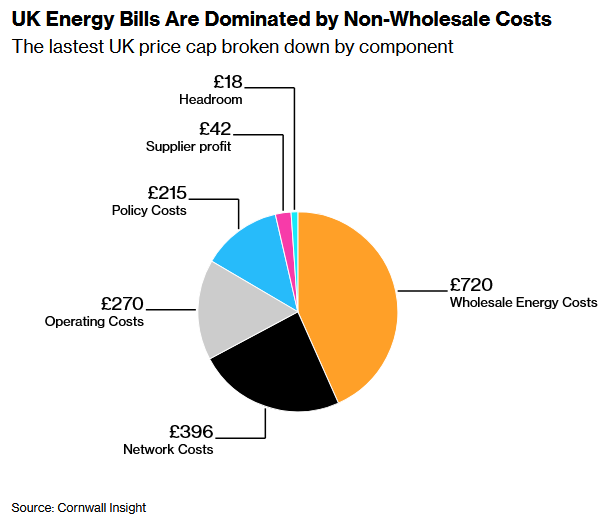
Currently, the cost of supporting renewable energy and other low-carbon projects is almost entirely charged through electricity rather than gas bills. Nesta's analysis shows that policy costs now account for nearly one-fifth of the average electricity bill, but only about 7% of gas bills. This price distortion has led to abnormally high electricity costs.
Meanwhile, after oil and gas prices soared to historic highs in 2022, it was difficult for more and more British people to pay their bills, and household energy debt in the UK has surged from £1.8 billion four years ago to over £4.4 billion.
Reeves has stated that measures will be taken to ease the financial pressure on ordinary people. According to people familiar with the matter, Reeves is studying a range of options to reduce energy costs, including possible adjustments to taxes and climate taxes. Reeves wants to ensure that any reforms are gradual, rather than simply removing VAT from energy bills — the latter would benefit the most energy-intensive wealthy.
Situation comparison
Across Europe, the practice of many governments requiring people to share the costs of decarbonization may also cause voter dissatisfaction. Energy bills are still a heavy burden in Germany. According to data from the German Federal Statistical Office, in 2024, about 4.2 million people (about 5% of the total population) are in arrears on electricity or gas bills.
Although household electricity prices in Germany have declined since 2023, the decline is far lower than wholesale prices. According to data from the energy lobbying group BDEW, wholesale electricity prices have dropped 36% in the past two years, while residential electricity prices have only dropped 16%. According to statistics from price comparison platform Verivox, the share of taxes and grid charges in bills continues to expand, and grid fees have risen 47% since 2020.
The biggest obstacle is geographical conditions. Most wind farms in Germany are located in the windy north, while energy-intensive industries are concentrated in the west and south. This mismatch requires large-scale grid expansion, including Germany's longest transmission line currently under construction.
In the end, it is the consumer who pays the bill. According to data from the Agora Energy Transition Think Tank, grid-related costs will rise by about 22% by 2030. To cushion the impact, the German government plans to use 6.5 billion euros to subsidize grid costs next year. Verivox estimates that this will reduce household expenses by an average of 6%. Similar subsidy policies are expected to continue until 2029.

France is unique in Europe. Its huge installed nuclear power capacity keeps wholesale electricity prices at the lowest level in Europe, averaging around €30 per megawatt-hour compared to the UK or Germany. Although France is also developing renewable energy and upgrading power grids, the scale is relatively small. Jonathan Hoare, a researcher at Aurora Energy Research, pointed out that since nuclear energy and hydroelectric power generation facilities are already spread all over the country, France's highest-level power grid infrastructure requires few major upgrades.
Over the long term, the logic of the UK's energy transition still holds true. Compared to systems that rely on natural gas, energy systems dominated by renewable energy should ultimately be cheaper and less affected by global market fluctuations. National Grid CEO John Pettigrew emphasized that current grid investments are critical to maintaining system reliability and affordability for years to come.
However, the demand side must follow up simultaneously. Rachel Fletcher, director of regulation and economics at Octopus Energy, said the investment focus should shift to electrification of homes and transportation, and pointed out that policymakers have focused too much on the supply side in the past. “Fundamentally, the reason we're driving up the bill is because we're prioritizing infrastructure and haven't fully explored whether there are more economical alternatives that don't require a lot of new assets to decarbonize electricity use,” she admits.