
Concerns about the AI bubble are sweeping the world! SoftBank's market capitalization evaporates more than $50 billion in a single week, and technology stocks collectively “cool down”
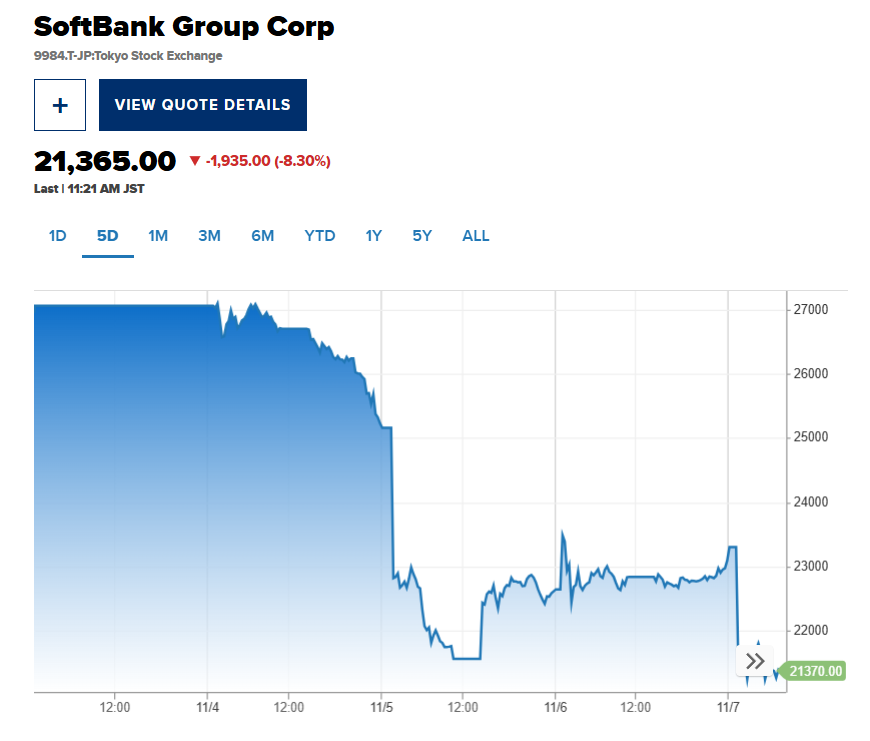
The Zhitong Finance App learned that Japan's SoftBank Group stock price resumed its decline on Friday, mainly because investors were once again wary of excessive valuations in the field of artificial intelligence (AI), leading to a collective decline in related stocks.
As an investment giant with a broad presence in AI infrastructure, semiconductors, and applications, SoftBank's stock price in the Tokyo stock market fell by more than 8%. Previously, SoftBank's stock price plummeted 10% on Wednesday, the worst single-day performance since April, and rebounded slightly by nearly 3% on Thursday. If Friday's decline remains unchanged, the group's market capitalization will shrink by about $53 billion this week.
“SoftBank's stock price fell because many investors viewed it as OpenAI's only listing alternative investment target,” said David Gibson, senior research analyst at MST Financial.
He added that the pullback shows that the market's cautious sentiment towards the AI industry is heating up. Investors have gradually realized that most OpenAI collaborations are still in a potential stage, have not yet been implemented, and there is uncertainty about the funding prospects.
According to reports, OpenAI CEO Sam Altman has discussed a federal loan guarantee plan with the US government to encourage chip factory construction. Earlier, the company's chief financial officer also stated that he would like to receive chip financing support at the federal level.
Other Japanese tech stocks were also lower. Semiconductor testing equipment manufacturer Edwin Test fell more than 6%, chip manufacturer Renesas Electronics fell nearly 4%, and chip-making equipment company Tokyo Electronics fell about 1.5%.
Arm (ARM.US), a British chip design company owned by SoftBank Holdings, occupies a key position in the global mobile and AI processor sector, and its NASDAQ-listed stock fell 1.21% overnight. The stock price of TSMC, the world's largest chip foundry, also fell 0.6%.
Additionally, Nvidia (NVDA.US) supplier SK Hynix fell by more than 1%, and its South Korean memory chip counterpart Samsung Electronics fell 0.5%.
The weakness of Asian tech stocks was also dragged down by the overnight decline in US AI concept stocks. Despite strong quarterly results, Qualcomm (QCOM.US) shares fell nearly 4% due to warnings of possible loss of future Apple (AAPL.US) business; strong performance AMD (AMD.US) fell 7% on Wednesday, while Palantir (PLTR.US) and Oracle (ORCL.US) fell about 7% and 3% respectively; Nvidia and Meta Platforms (META.US) also closed down.
The market excitement caused by the AI boom raises concerns that a tech bubble is forming. Some experts pointed out that the current valuation of AI companies has begun to resemble the Internet bubble in the late 1990s, and the increase in stock prices far exceeds actual profit expectations.
Laura Cooper, a global investment strategist at Nuveen, said that the economic impact of AI is unquestionable, but market fluctuations are unavoidable.
“But it's still too early to assert that a bubble has formed. “Today's AI capital expenditure is mainly borne by companies with abundant cash and sound balance sheets, rather than cheap credit or speculation,” she said. “The greater risk is not the bursting of the bubble, but valuation fatigue — investors are tired of paying higher and higher premiums for AI returns that are not delivered on time.”