
When AI hits a deficit: global debt issuance hits a record, market demand is still hot
The Zhitong Finance App learned that as issuers use relaxed market conditions to finance everything from the boom in artificial intelligence (AI) projects to the recovery of mergers and acquisitions, the scale of global bond issuance has soared to record levels since this year. According to the data, global bond issuance has reached 5.95 trillion US dollars since 2025, exceeding 5.93 trillion US dollars for the whole of 2024. There is more than a month left in this year, and Wall Street is preparing for the busiest November in more than a decade, which indicates that the scale of global bond issuance will surely reach a new high in 2025.
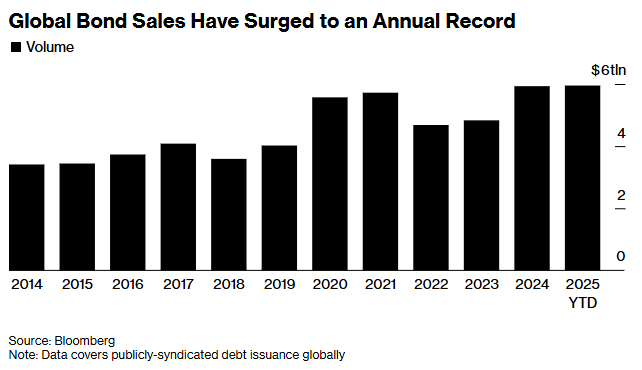
This year's bond issuance boom was mainly driven by financial institutions and the government. Governments have stepped up debt issuance to cover widening budget deficits. Meanwhile, tech giants such as Alphabet (GOOGL.US) and Meta Platforms (META.US) issued huge bonds, increasing the size of the telecommunications industry's debt by two-thirds year-on-year.
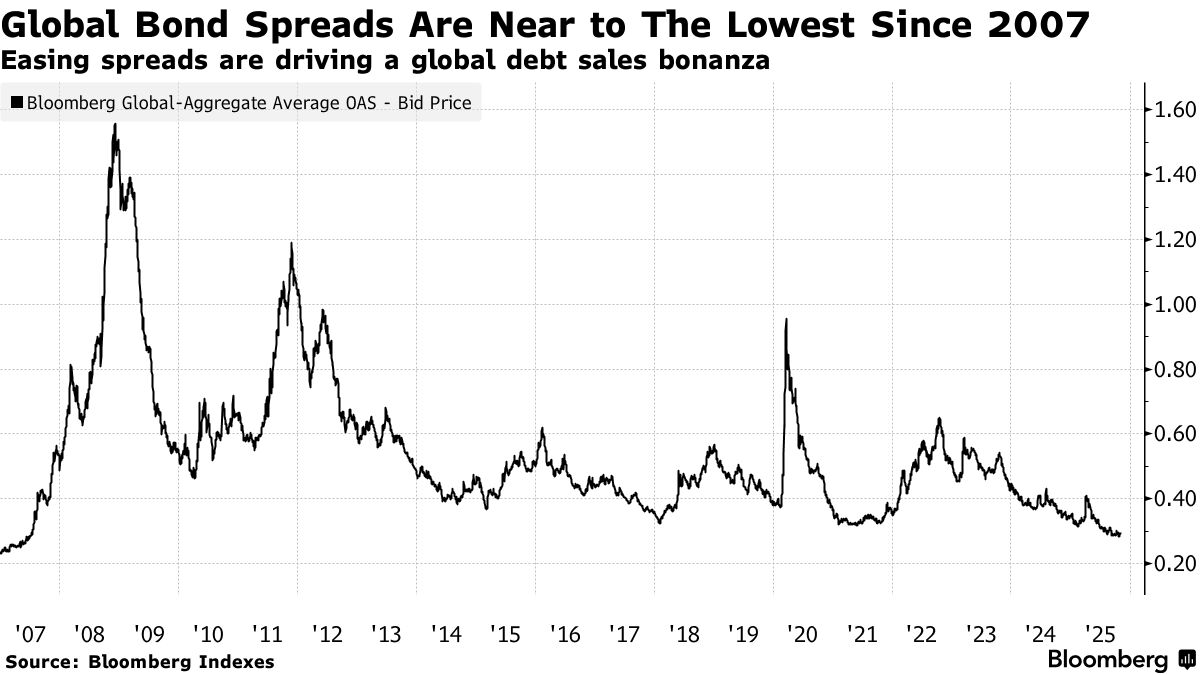
Although the debt torrent is causing corporate credit spreads to widen, global credit risk indicators are still hovering near their lowest level since 2007. Market demand remains strong, and the total return of bond investors this year is over 7%, the best performance in the past five years.
Sabrina Fox, a leveraged finance expert at Fox Legal Training, said, “We are in a period where demand for credit, flexibility, and debt management is at an all-time high. All of these factors are working simultaneously. The market pricing is perfect.”
Meta issued a total of 30 billion US dollars in bonds on October 30. This is the largest US high-rating bond sale since 2023, attracting up to 125 billion US dollars in subscription demand, setting a record high in the history of public corporate bond issuance. Alphabet also returned to the European bond market on November 3, issuing multi-issue Euro-denominated benchmark bonds with a total scale of 3 billion euros to finance its record spending on AI and cloud infrastructure. Japan's SoftBank, which is betting heavily on AI, also issued dual-currency bonds in October.
John Sales, head of Goldman Sachs's American investment-grade bond syndication business, said: “It is perfectly reasonable to assume that a significant portion of capital expenditure will be in the form of debt.” He pointed out that these tech giants have excellent balance sheets, so they have the ability to increase leverage when the Federal Reserve cuts interest rates and interest spreads are low.
At the same time, investors' demand has completely kept up with bond issuance. BNP Paribas estimated in September that in the US market, investors can reinvest about $74 billion more in cash than the bonds issued by the company.
November bond issuance wave
The issuance of high-grade US bonds set records in both September and October, and the bond issuance boom continued until November, although the issuance window is expected to narrow as we enter the December holidays. Matt Brill, head of investment-grade credit at Invesco North America, said, “If you can keep enough money to last the next two weeks, it could be very beneficial because I think supply will run out at that time.”
American companies have also sped up the pace of issuing bonds in Europe. According to the data, Alphabet, Colgate-Palmolive, Booking Holdings (BKNG.US), and Morgan Stanley (MS.US) each issued bonds in the euro market this week, while Verizon (VZ.US) issued pound-denominated bonds for the first time since 2020.
As of Thursday, the bond issuance boom continued in the European market. Eleven borrowers, including France Telecom Orange, Spain's CaixaBank (CaixaBank), and Austria's Raiffeisen Bank International, are expected to price new bonds. Among them, Orange is issuing the largest five-issue Eurobond since 2019.
Public sector borrowing surges
Since the impact of the pandemic caused government budgets to become unbalanced, the surge in public sector borrowing has been a key factor in boosting bond issuance records. According to estimates, the share of investment-grade bonds issued by the government and government agencies this year reached 69%, the highest level since the 2010 global financial crisis.
The International Monetary Fund (IMF) stated last month that global public debt is expected to exceed 100% of GDP in 2029, the highest since 1948 — when countries were recovering from World War II.
In terms of issuing sovereign bonds, Spain took the lead by issuing bonds three times this year, raising a total of 35 billion euros (about 40 billion US dollars). The 14 billion pound (about 18 billion US dollars) treasury bonds issued by the UK in September and the 18 billion euro two-issue treasury bonds issued by Italy in January are also among the largest transactions of the year. Both Spanish and Italian bond issuances attracted over €140 billion in subscriptions.
However, this is not a “national feast” for the debt market. Recent large-scale corporate bond transactions have all come from highly rated and well-known companies, and these huge amounts of financing may squeeze other potential issuers. There are already signs that oversupply is driving up risk premiums. The average spread on US high-rated bonds widened to 82 basis points on Monday, the highest since July 1.
Mark Clegg, senior fixed income trader at Allspring Global Investments, said: “Many investors are happy to sell low-rated bonds and buy these newly issued high-liquidity AA bonds. The question is, when will investors be able to maintain oversized positions in the technology sector with peace of mind?”
M&A financing
Abundant liquidity is also reflected in the high-yield bond market. A number of lenders, including Bank of America, Citigroup, and Morgan Stanley, have just participated in the largest leveraged takeover financing in history — providing debt support for the $20 billion acquisition deal for video game maker Electronic Arts (EA.US).
According to the data, global M&A transactions surpassed $1 trillion in the third quarter. This is only the second time in records that this level has been reached. This is a shift from the earlier sluggish environment caused by the US tariff turmoil.
Conor Hillery, co-head of Europe, Middle East and Africa (EMEA) at J.P. Morgan Chase, predicts that “next year there will be major mergers and acquisitions in the EMEA region” due to lower interest rates, improved valuations, and a backlog of transactions that need to be completed. Goldman Sachs CEO David Solomon recently expressed similar views, pointing out that “there has been an amazing increase in market activity.”
Anish Shah, head of global debt capital markets at Morgan Stanley, said, “The size of the acquisition financing market for a high-quality single B or BB credit entity may even be double the size of the largest financing seen in this year's market.” He added, “The current market has a very high carrying capacity. When it comes to quality assets, we're in the midst of an expansion phase. If syndicated loans are further combined with private credit investors, the size of debt will increase significantly. There is currently plenty of capital in the market.”