
Can Haohai Biotechnology (06826) find the key to a recovery in valuation due to “falling and buying more” by Hong Kong Stock Connect
On November 5, Haohai Biotechnology (06826) announced that the company spent HK$805,700 to repurchase 29,600 shares. This is the third consecutive trading day since November of this year that the company has carried out stock repurchase operations.
The Zhitong Finance App observed that up to now, Haohai Biotech has carried out a total of 23 stock repurchases this year, including 11 in the first half of the year and 12 in the second half of the year. The 12 share repurchases in the second half of this year were also divided into two stages. The first phase was from September 15 to September 24, and the second stage was from October 27 to November 5.
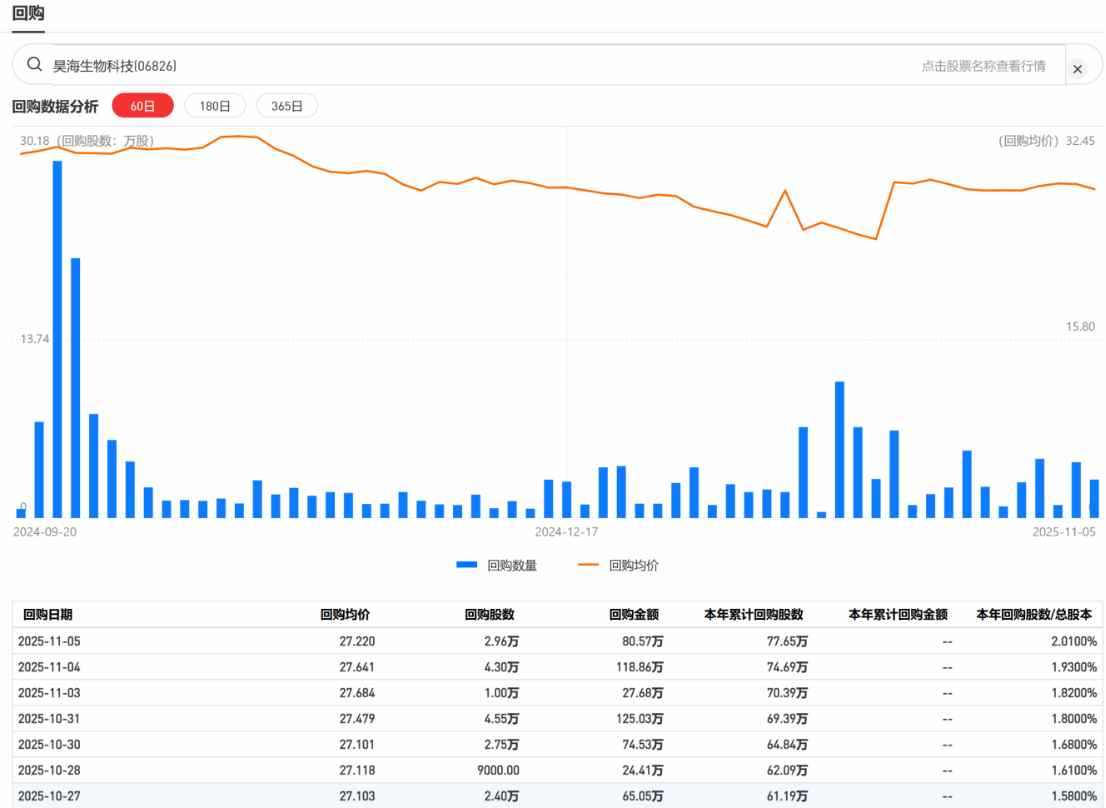
However, in the middle of these two stages, Haohai Biotech's stock price experienced a slight V-shaped reversal: after about a month and a half of fluctuation and decline, the company's stock price slowly began to rise. As one of the “Three Musketeers of Medicine and Aesthetics” back then, Haohai Biotech's current PE (TTM) valuation is only 14.82 times, which is 20 times lower than the industry average. Behind the pressure on valuations, it shows that the company's resilience to risks is being tested by the market.
The decline in performance is already a “bright card”
On the evening of October 24, Haohai Biotech revealed its 2025Q3 financial report. Financial reports show that the company's revenue for the third quarter was 594 million yuan, down 11.29% year on year; corresponding net profit to mother fell 11.39% year on year to 93.5821 million yuan. In the first three quarters of this year, the company's revenue was 1,899 million yuan, down 8.47% year on year; corresponding net profit to mother of 305 million yuan, down 10.63% year on year
Behind the decline in quarterly revenue, the company was affected by insufficient domestic consumer demand, increased industry price competition, and tax rate adjustments, which further led to a year-on-year decline in net profit.
In fact, this performance is also a continuation of Haohai Biotech's semi-annual report for this year. According to the company's semi-annual report, its current revenue was 1.304 billion yuan, down 7.12% year on year; net profit to mother was 211 million yuan, down 10.29% year on year. It can be seen that compared to the semi-annual report, the decline in Haohai Biotech's revenue and net profit in the first three quarterly reports increased further.
In its semi-annual report, Haohai Biotech revealed the growth of its division's business. In terms of revenue structure, the medical and aesthetic business revenue was 575 million yuan, accounting for 44.35% of total revenue, making it the company's largest source of revenue. Among them, revenue from hyaluronic acid products was 347 million yuan, down 16.80% year on year, mainly affected by the subsidiary Qisheng Biotech value-added tax rate adjustment; revenue from human epidermal growth factor products was 92.3799 million yuan, up 13.73% year on year.
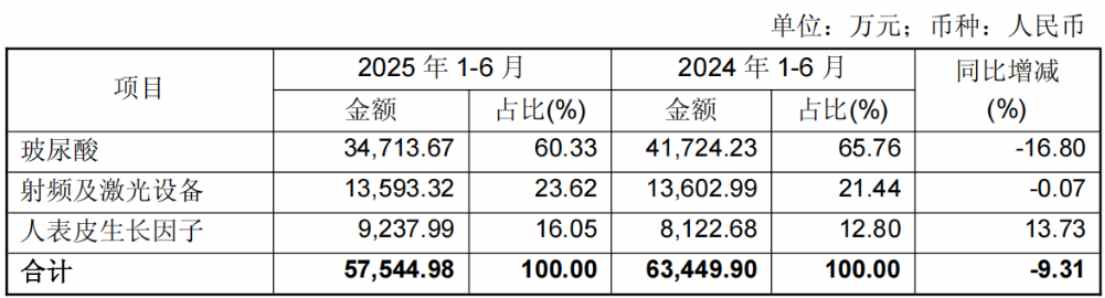
It's easy to see that although the fourth-generation organic crosslinked hyaluronic acid “Haimei Yuebai”, which is the high-end hyaluronic acid brand of Haohai Biotech, was approved for listing during the period, it formed a high-end product matrix along with the company's other “Sea Charm” series products. However, it is currently a shift period for the medical and aesthetic industry. Even with the technical barriers of high-end hyaluronic acid, it is still difficult to stabilize its share in the medical and aesthetic market.
From the semi-annual report to the three-quarter report, the downturn in Haohai Biotech's business is actually a clear sign. Therefore, after the disclosure of the financial report on October 24, the company's stock price did not fluctuate significantly, and the stock price closed up 1.49% the next day.
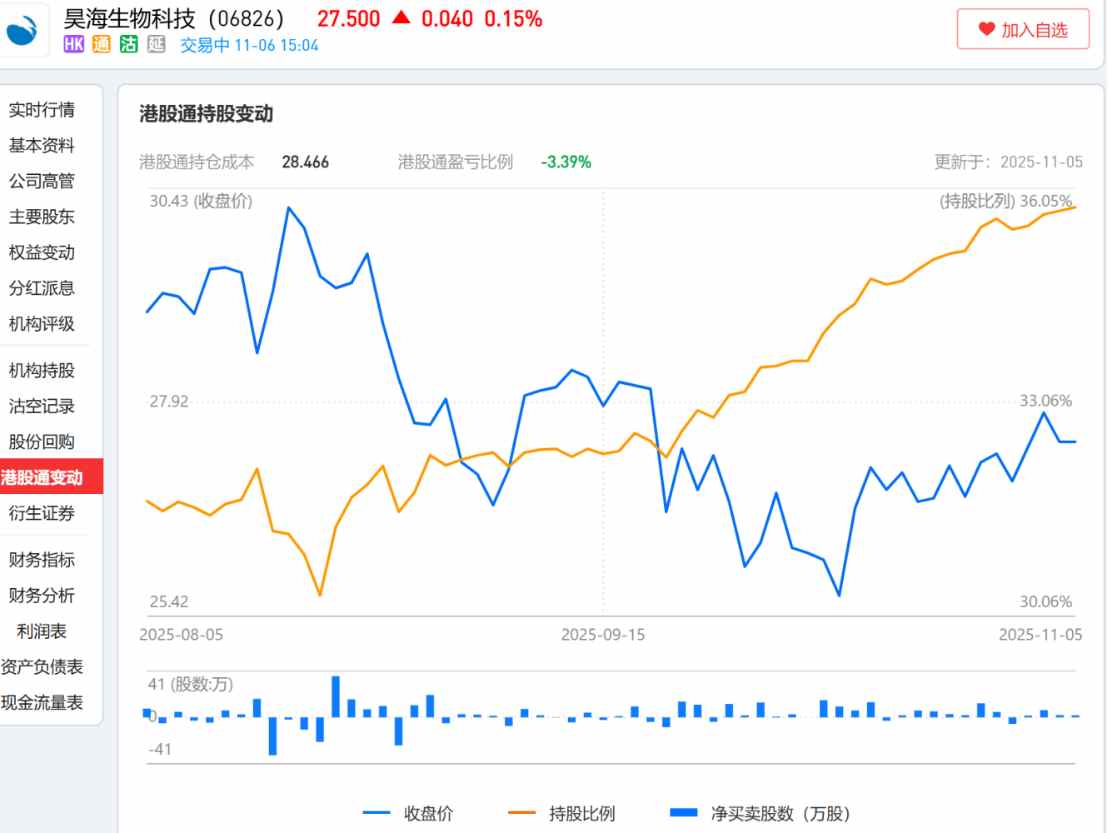
Although the company's stock price and valuation have declined in recent years due to shocks in the medical and aesthetic market, the continued decline in stock prices and the company's net assets of HK$26.93 per share still provide some room for arbitrage for investors in the secondary market. According to data from the Zhitong Finance App, after August 20 this year, Hong Kong Stock Connect increased its investment in Haohai Biotechnology, and the shareholding ratio increased from 30.35% to 35.78%.
Broker transaction data for the past 20 days also showed that Hong Kong Stock Connect (Shanghai) was the largest net buyer of Haohai Biotech, with a net purchase amount of 1,112,600 shares.
Will botulinum toxin be the “key” to rising valuations?
On March 3, 2021, Haohai Biotech and Eirion of the United States signed an equity investment agreement and product license agreement. On the premise of meeting the agreed transaction milestones, the company will subscribe for Eirion's newly issued Series A preferred shares for 31 million US dollars and hold about 13.96% of Eirion's shares.
At the same time, Eirion also authorized Haohai Biotech to develop, sell, and commercialize a variety of products, including ET-01, a botulinum toxin product for external use, AI-09, an injectable botulinum toxin product, and ET-02, a small-molecule drug product used to treat hair loss and gray hair.
According to the Zhitong Finance App, the four “main players” of medical and aesthetic injection materials account for 98% of the share of hyaluronic acid, collagen, botulinum toxin, and regenerated materials, forming the core layout of the medical and aesthetic injection market. At a time when recombinant collagen is currently popular in the market, Haohai Biotech chose to bet on botulinum toxin while stabilizing the hyaluronic acid market, which means it is taking the lead.
Looking at the overall market, hyaluronic acid and botulinum toxin are widely used, mature, and most frequently used, so the market size is large. In the 2024 market segment structure of medical and aesthetic injectable materials in China, hyaluronic acid for medical and aesthetic injections accounts for about 36%, and botulinum toxin for medical and aesthetic injections accounts for about 29%. The four major materials as a whole present a pattern of “hyaluronic acid leading the way, botulinum toxin followed, collagen rises, and regenerative materials break through”.
Looking at the breakdown, hyaluronic acid, which has the largest market share, dominates the domestic medical and aesthetic market, and the total market share of domestic brands has reached about 50%-60%. Among them, the three leading companies of Huaxi Biotech, Aimeike, and Haohai Biotech contributed more than 80% of the domestic market share.
Collagen, which has been popular in recent years, is the third largest category with a 19% market share, and is currently the fastest growing track in the field of medical and aesthetic materials. According to the data, the compound growth rate of domestic recombinant collagen in 2023-2027 is expected to reach 41.45%, far exceeding the industry average. The reason for this is that recombinant humanized collagen is an indispensable item for medical and aesthetic institutions. Its core advantage is that it is more biocompatible. Especially in treating delicate areas such as tear groove filling and dark circles improvement, the effect is significantly superior to other materials, so it is expected to become a phenomenal product.
In 2024, the total market share of domestic brands of recombinant proteins was about 60%-70%, and a “double oligopoly” pattern led by Jinbo Biotech and Giant Biotech was formed, both of which contributed more than 90% of the domestic market share. Among them, Jinbo Biotech holds about 40% of the market share with the world's first recombinant type III collagen “Device 3” certificate.
As a “rising star” with 16% of the market share, the market size of recycled materials has reached 5.5 billion yuan in 2024, and the total market share of domestic brands exceeds 60%. Among them, Aimeike and Changchun Shengboma have a total market share of more than 80% of domestic production. The trend of domestic substitution is clear.
In contrast, for Haohai Biotech, the botulinum toxin market dominated by high-end foreign investors seems to be a good way to break through.
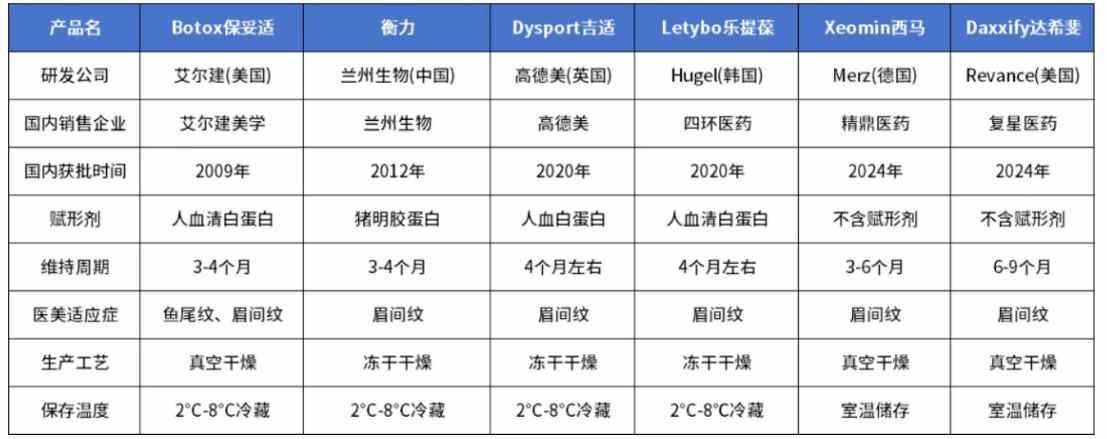
According to research by QYResearch's leading enterprise research center, global botulinum toxin producers mainly include AbbVie, Galderma, Ipsen, Daewoong, Lanzhou biological products, etc. In 2024, the top four global manufacturers will have about 90.0% of the market share. Domestically, up to now, only six botulinum toxin products approved for marketing in China are Botox, Hengli, Jixi, Lotivo, Xeomin (Xeomin), and Daxxify (Daxxify). Five of these are imported products, and the overall market pattern is beginning to take shape.
However, from the perspective of market penetration, considering the large domestic population, the penetration rate is far lower than that of mature markets such as the US. In 2019, the US botulinum toxin penetration rate was 4.3%, and China's botulinum toxin penetration rate was 0.2%. If you convert the amount of injections to the number of injections per 1,000 people, 17.2 people in the US injected botulinum toxin per 1,000 people in 2020, and only 2.8 people per 1,000 people in the country injected botulinum toxin. Judging from this point of view, there is probably still a lot of room for improvement in the domestic botulinum toxin penetration rate.
For Haohai Biotech, despite short-term performance pressure, its layout in the botulinum toxin field is still progressing. The topical botulinum toxin product developed by the company mentioned above in cooperation with Eirion of the United States has completed phase II clinical trials in May of this year. Currently, preparations are being made to simultaneously carry out phase III clinical trials in China and the US. If progress goes well, it is expected that the 7th domestic botulinum toxin registration certificate will be obtained and simultaneously marketed in China and the US.
Although performance is under pressure and difficult to reverse in the short term, given the company's undervaluation and continued repurchase performance, Haohai Biotech's “cigarette stock” attributes may continue to expand in the future or are expected to continue to expand, and it is worth investors' long-term attention.