
HCL Technologies (NSE:HCLTECH) Seems To Use Debt Rather Sparingly
David Iben put it well when he said, 'Volatility is not a risk we care about. What we care about is avoiding the permanent loss of capital.' So it might be obvious that you need to consider debt, when you think about how risky any given stock is, because too much debt can sink a company. We note that HCL Technologies Limited (NSE:HCLTECH) does have debt on its balance sheet. But is this debt a concern to shareholders?
What Risk Does Debt Bring?
Generally speaking, debt only becomes a real problem when a company can't easily pay it off, either by raising capital or with its own cash flow. Ultimately, if the company can't fulfill its legal obligations to repay debt, shareholders could walk away with nothing. While that is not too common, we often do see indebted companies permanently diluting shareholders because lenders force them to raise capital at a distressed price. Having said that, the most common situation is where a company manages its debt reasonably well - and to its own advantage. The first thing to do when considering how much debt a business uses is to look at its cash and debt together.
What Is HCL Technologies's Net Debt?
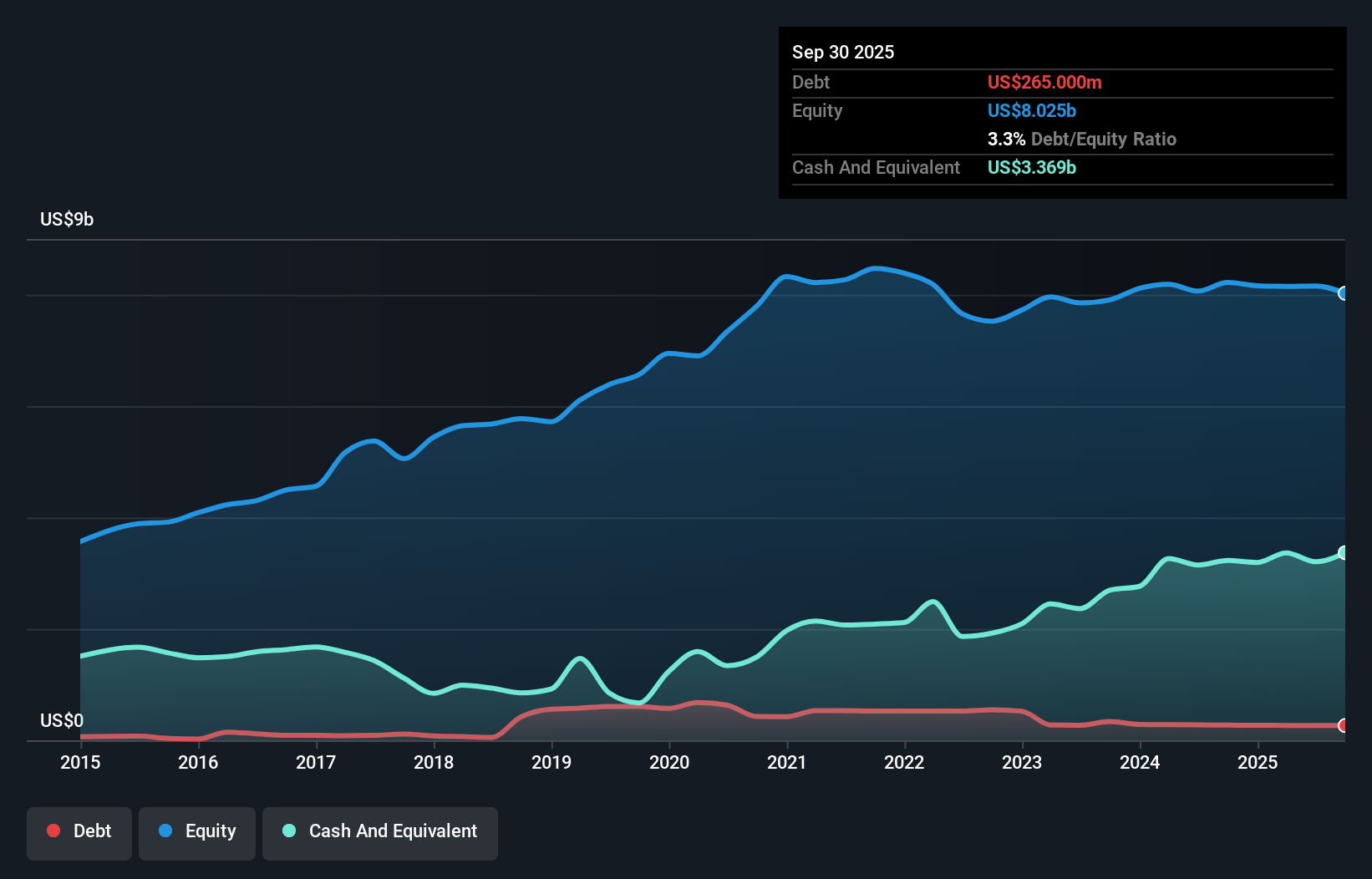
The chart below, which you can click on for greater detail, shows that HCL Technologies had US$265.0m in debt in September 2025; about the same as the year before. But on the other hand it also has US$3.37b in cash, leading to a US$3.10b net cash position.
A Look At HCL Technologies' Liabilities
According to the last reported balance sheet, HCL Technologies had liabilities of US$3.25b due within 12 months, and liabilities of US$952.0m due beyond 12 months. On the other hand, it had cash of US$3.37b and US$3.40b worth of receivables due within a year. So it can boast US$2.57b more liquid assets than total liabilities.
This short term liquidity is a sign that HCL Technologies could probably pay off its debt with ease, as its balance sheet is far from stretched. Succinctly put, HCL Technologies boasts net cash, so it's fair to say it does not have a heavy debt load!
Check out our latest analysis for HCL Technologies
HCL Technologies's EBIT was pretty flat over the last year, but that shouldn't be an issue given the it doesn't have a lot of debt. There's no doubt that we learn most about debt from the balance sheet. But it is future earnings, more than anything, that will determine HCL Technologies's ability to maintain a healthy balance sheet going forward. So if you're focused on the future you can check out this free report showing analyst profit forecasts.
Finally, a company can only pay off debt with cold hard cash, not accounting profits. HCL Technologies may have net cash on the balance sheet, but it is still interesting to look at how well the business converts its earnings before interest and tax (EBIT) to free cash flow, because that will influence both its need for, and its capacity to manage debt. Over the last three years, HCL Technologies actually produced more free cash flow than EBIT. There's nothing better than incoming cash when it comes to staying in your lenders' good graces.
Summing Up
While we empathize with investors who find debt concerning, you should keep in mind that HCL Technologies has net cash of US$3.10b, as well as more liquid assets than liabilities. The cherry on top was that in converted 102% of that EBIT to free cash flow, bringing in US$2.5b. So is HCL Technologies's debt a risk? It doesn't seem so to us. There's no doubt that we learn most about debt from the balance sheet. However, not all investment risk resides within the balance sheet - far from it. For example - HCL Technologies has 1 warning sign we think you should be aware of.
When all is said and done, sometimes its easier to focus on companies that don't even need debt. Readers can access a list of growth stocks with zero net debt 100% free, right now.
Have feedback on this article? Concerned about the content? Get in touch with us directly. Alternatively, email editorial-team (at) simplywallst.com.
This article by Simply Wall St is general in nature. We provide commentary based on historical data and analyst forecasts only using an unbiased methodology and our articles are not intended to be financial advice. It does not constitute a recommendation to buy or sell any stock, and does not take account of your objectives, or your financial situation. We aim to bring you long-term focused analysis driven by fundamental data. Note that our analysis may not factor in the latest price-sensitive company announcements or qualitative material. Simply Wall St has no position in any stocks mentioned.