
One R&D investment is equal to the sum of the three major car companies! How does BYD (002594.SZ) achieve fault leadership
Recently, BYD (002594.SZ) has been intensively releasing high-quality development signals.
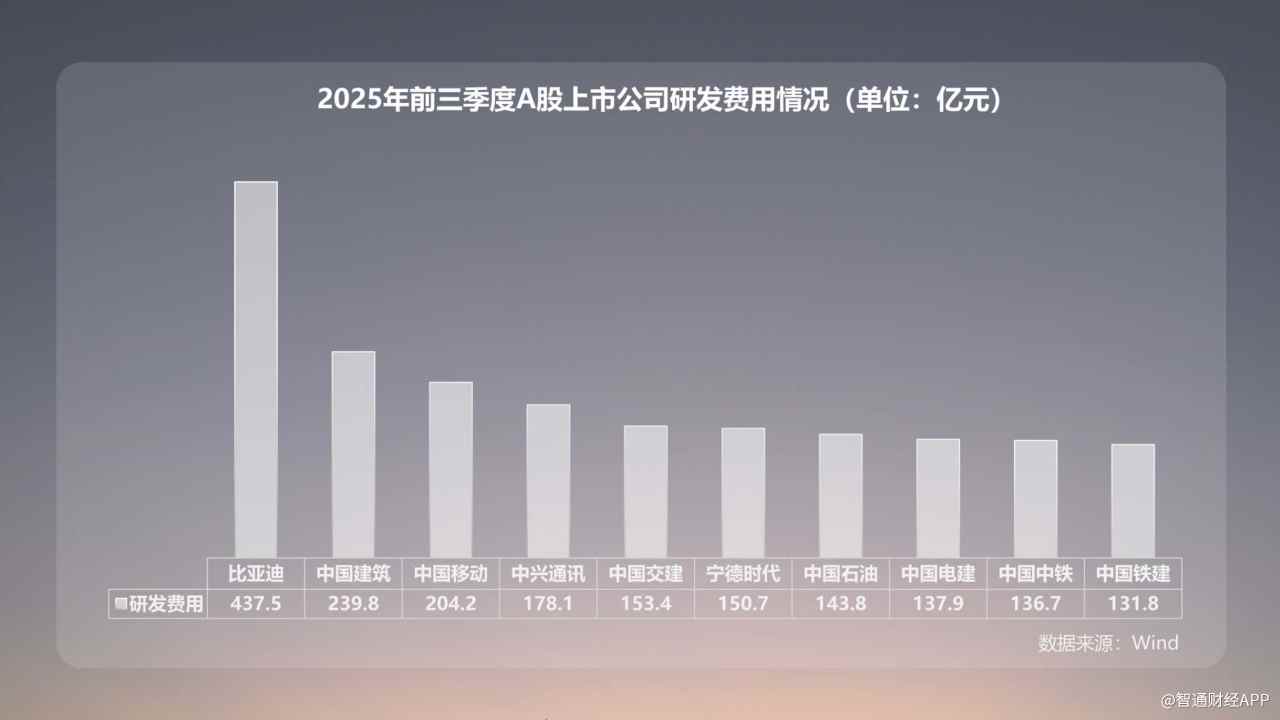
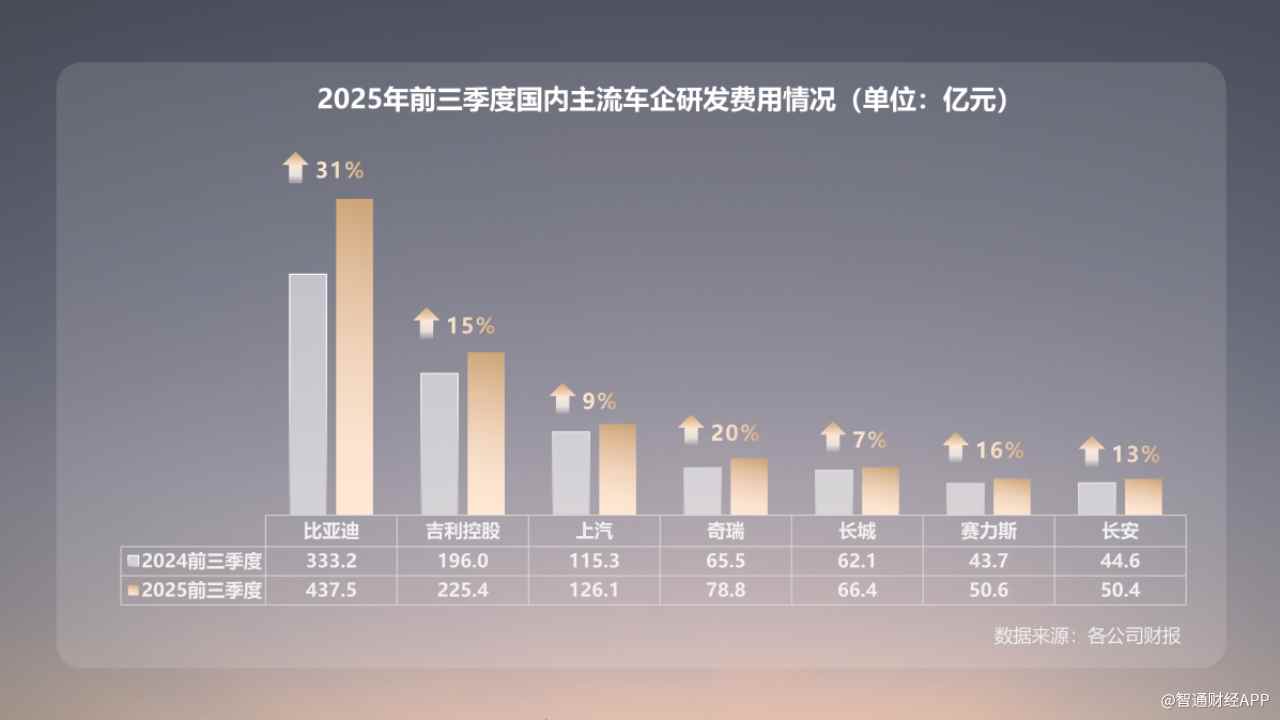
On October 31, the results announcement for the first three quarters of 2025 released by BYD showed that the company achieved revenue of 566.27 billion yuan (RMB, same below) during the period, an increase of 13% over the same period, and hit a new high for the same period. The positive trend in core business indicators is obvious. R&D expenses in the first three quarters reached 43.75 billion yuan, a year-on-year increase of 31%, far exceeding the net profit of 23.33 billion yuan during the same period; this investment not only led nearly 20 billion yuan from China Construction, which ranked second in A-shares, but also surpassed the sum of R&D expenses of the three leading car companies Geely Holdings, SAIC Motor Group, and Chery Automobile. The 31% growth rate was also significantly ahead of major competitors, directly establishing the position of the A-share+ automotive industry's dual R&D champion.
According to the Zhitong Finance App, the leading position in R&D investment is the result of BYD adhering to the core development concept of “technology is king, innovation is the foundation” for more than 20 years. As of the third quarter of 2025, the company's cumulative R&D investment exceeded 220 billion yuan, and in the past 15 years from 2011 to 2025, 14 years of R&D investment exceeded that year's net profit. It is worth noting that this long-term approach is being intuitively transformed into market competitiveness through the deep expansion of the “fish pond” of technology and terminal sales and global layout.
Specifically, since 2025, BYD has continued to make breakthroughs in core technology fields, and technologies such as the Eye of Tenjin Assisted Driving System and Megawatt Flash Charge on the Super e platform have been implemented one after another, leading the direction of change in the industry. As of September, the cumulative sales volume of models equipped with this system exceeded 1.7 million units, accounting for 91.3% of the domestic market. Relying on a closed loop of 100 million kilometers of assisted driving data per day, BYD dared to promise “safe coverage of smart parking scenarios”, demonstrating absolute confidence in its own technology.
The implementation of the hard power of R&D is directly reflected in the hot performance of the terminal market. As of October 2025, the cumulative sales volume of BYD's new energy vehicles has surpassed the milestone of 14 million units. According to the production and sales report released by BYD on November 2, sales of new energy vehicles were about 441,700 units in a single month in October, breaking the record for the new year and driving cumulative sales volume to exceed 3.7 million units in January-October. Among them, about 84,000 vehicles were exported in October, a year-on-year surge of 155.5%; a total of 781,000 vehicles were exported in the first 10 months.
Regarding the rapid growth of overseas markets, Minsheng Securities gave a clear explanation in the research report: on the one hand, benefiting from the continuous increase in actual demand in Turkey, Brazil, Europe, etc., and on the other hand, benefiting from improved logistics efficiency brought about by improvements in self-built Ro-Ro shipping capacity, combined with the completion and commissioning of Brazilian passenger car factories, and the accelerated layout of overseas factories in Uzbekistan, Hungary, Brazil, etc., BYD is expected to usher in faster growth in the future, further increasing profits.
If sales data is a quantitative expression of market recognition, then the Tokyo Motor Show, which opened on October 29, is a global showcase of BYD's technical strength and localization capabilities. At this auto show, with “ONE BYD” as the core theme, BYD set up double booths for passenger cars and commercial vehicles for the first time, fully showcasing its ability to innovate locally and comprehensively.
The highlight of the passenger car booth was the “pure electric+hybrid” dual line breakthrough. The world's first K-EV, the BYD RACCO, customized for the Japanese market, is BYD's first pure electric model for the Japanese light automatic vehicle (K-Car) market. Also launched at the same time was the first plug-in hybrid model in the Japanese market, the Sea Lion 06DM-i. In addition, popular pure electric models such as the newly upgraded YuanPLUS, Dolphin, and Seal, as well as the supercar U9, which million-level high-end brands look up to, all debuted, fully presenting BYD's technical matrix in the field of electrification and high performance, and expanding the model layout in the Japanese market. By 2027, BYD plans to establish a product layout for 7 to 8 pure electric and hybrid models in Japan and improve the localized product and channel system.
The commercial vehicle booth, with “customization+globalization” as the core idea, launched the world's first pure electric truck T35 and small pure electric bus J6 living car concept car, and showcased the J7 medium-sized pure electric bus and K8 large pure electric bus. Among them, the pure electric truck T35 is designed in strict accordance with Japanese market regulations and size requirements, is equipped with a blade battery, takes into account stable battery life and practical performance, and is scheduled to be launched in Japan in 2026. This layout is not only a key step for BYD to expand into the Japanese market, but also to add core products to its global commercial vehicle matrix.
Currently, the NEV industry is undergoing a deep transformation from “electrification” to “intelligence”. Continued high R&D investment has become BYD's core strategy for dealing with changes in the industry. It has now formed a virtuous cycle of “R&D investment - technological breakthroughs - market feedback - further R&D”. Looking forward to the future, with the optimization of intelligent driving algorithms, breakthroughs in battery technology, and the continued expansion of overseas markets, BYD's technical moat will be further broadened; for the global automotive industry, BYD's “pangasius effect” is driving the transformation of the entire industry at an accelerated pace, providing more practical and innovative solutions for sustainable global travel.