
Say goodbye to the “free money” era! Overseas borrowing by Japanese companies soared to US$132 billion, shaking up the global market in a record wave
The end of Japan's “free money” era, a series of trading boom, and the boom in artificial intelligence have jointly driven the scale of overseas borrowing by Japanese companies to record levels. This renewed vitality is stirring up the global market.
So far in 2025, Japanese companies have raised US$132 billion through foreign-currency bond and loan transactions arranged by banks, an increase of 56% over the same period last year. Highlighting this unprecedented shift to the global stage, annual overseas bond issuance is expected to surpass the issuance of yen bonds for the first time in history. All of this prompted brokerage firms to increase their staffing, private credit giants tried to enter the loan business for Japanese companies, and spawned a new important index.
There is no better explanation of how Japan is reshaping global finance and markets than emerging from decades of deflation. Japanese companies that hoarded cash during the economic downturn are now increasing spending and acquisitions, making them one of the most active drivers of global transactions this year. The new prime minister, Sanae Takaichi, met with Trump last week, raising hopes that the trade war might ease further.
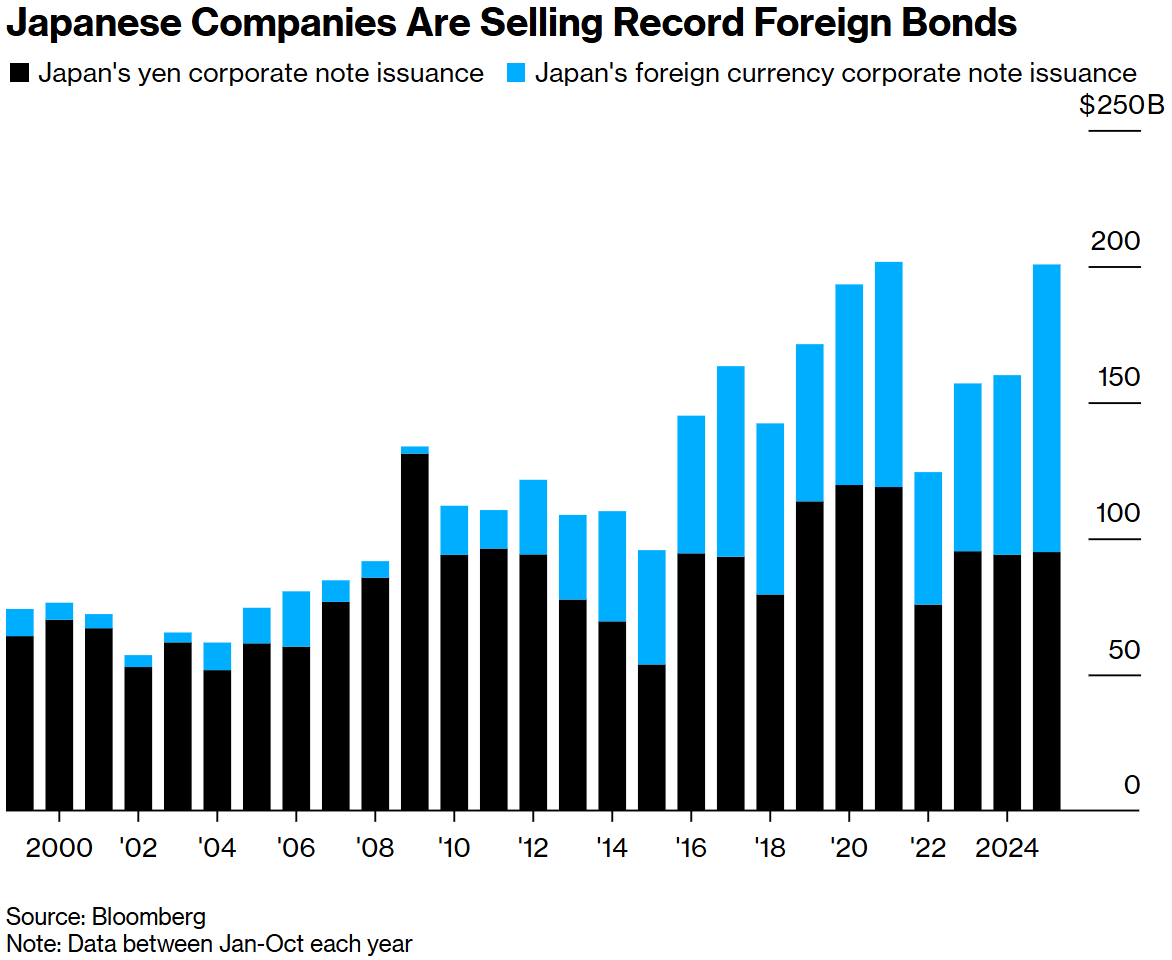
Japanese companies issue record overseas bonds
As the cost of borrowing in yen rises to the highest level since the late 2000s, financing overseas rather than domestically is becoming more attractive. Although the Bank of Japan kept its benchmark interest rate unchanged last week, inflationary pressure has prompted it to raise interest rates three times since March 2024, while other major central banks are cutting interest rates at this time.
“We have specifically increased the staffing of foreign currency bonds and are strengthening this area,” said Kazuhiro Yamauchi, head of global debt capital markets at Mizuho Securities, the largest underwriter for Japanese corporate bond transactions. Publishers who weren't interested before are also starting to want to know more.”
This series of events brought about another major shift: Japan has become the largest source of dollar bonds in the Asia-Pacific region. This position was previously held by China and is mainly driven by real estate developers.
Tatsuya Maruyama, head of Japanese debt capital markets at Barclays Bank, said that for Japanese borrowers, the cost of financing in dollars and euros is at a “competitive level” compared to yen, and in some cases even lower, which provides a smooth flow for overseas transactions. Barclays is the largest European underwriter for foreign currency transactions in Japan.
Japanese companies that are now re-entering the international debt market are also causing a stir when it comes to loans. SoftBank Group's $15 billion bridge loan to finance an artificial intelligence investment earlier this year is one of its largest loans.

Japan's recovery has also excited private lenders around the world. Alternative asset managers like KKR are increasingly looking to compete with banks to launch loans in Japan, and many companies are already raising capital for global private credit funds in Japan.
After years of the Tokyo Stock Exchange's push to increase shareholder returns, trading and company privatization have become a major force. Japan has become a hotbed of mergers and acquisitions, so much so that the country has become KKR's largest market in Asia.
The data shows that so far this year, the volume of ongoing or completed mergers and acquisitions of Japanese companies has increased by 129% to reach US$262 billion. Among them, SoftBank's huge investment in artificial intelligence and the privatization of NTT Data Group is one of the biggest deals.
As Japan's declining population forces companies to seek growth overseas, many of these acquisitions directly fueled overseas financing.
Makiko Yoshimura, director of S&P Global Ratings and senior credit analyst, said, “For many Japanese companies, seeking overseas investment is not a trend; it is almost inevitable,” and cross-border borrowing to this end reduces the “mismatch” between financing and business operations.
Japanese companies are now also leading the issuance of foreign currency junk bonds in the Asian region, which was unimaginable in the past. To date, the issuance of such bonds has been around $14 billion since 2025.
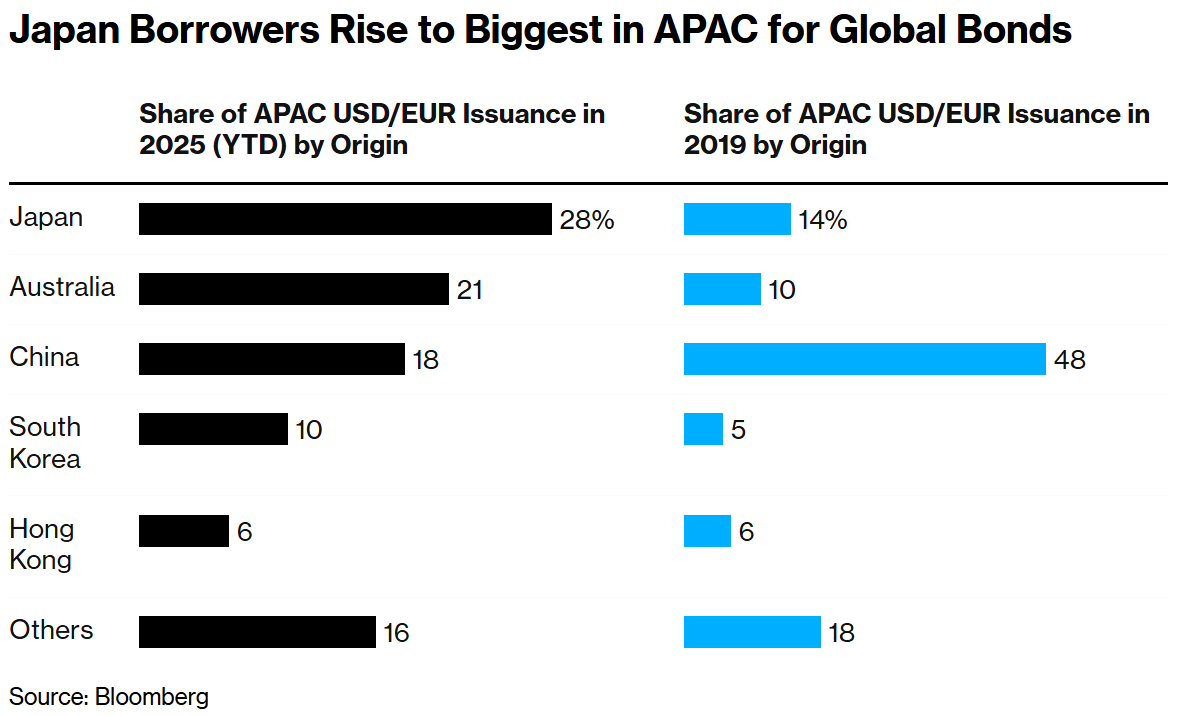
Japanese borrowers became the largest group of global bond borrowers in the Asia-Pacific region
Take Rakuten Group, which is rated speculative by S&P Global Ratings. The company has issued billions of dollars in bonds overseas in recent years, and the outstanding dollar and euro bonds are over $7 billion. SoftBank and Nissan are also two of Japan's most active junk bond issuers.
But junk bonds are only a small part of the Japanese bond issue. What really changed the face of Asian dollar bonds was a large number of investment-grade transactions, transforming the asset class from being viewed as an investment target in emerging markets for a long time to one that no longer fits this description.
This was reflected when J.P. Morgan Chase launched a bond index that included Japanese and Australian dollar bond issues in 2023, providing a broader benchmark for the region's credit market.
“The core of any good credit market should be investment grade,” said Owen Gallimore, head of credit analysis for Asia Pacific at Deutsche Bank. The Asian market is now in much better shape, and both breadth and depth have improved.”
According to the comprehensive credit score, more than 70% of Japan's overseas issuances this year had an A grade or higher, which raised the average rating of Asian dollar bonds.
In fact, Japan's most prominent deal this year came from an investment-grade giant.
Nippon Telegraph and Telephone Company (NTT Inc.) — the world's most valuable company at the peak of Japan's bubble economy in the late 1980s — sold $17.7 billion in dollar and euro bonds in July. This is the largest global launch ever by an Asian company. The funds raised were used to fund the privatization of NTT Data, its artificial intelligence division, which is one of the world's largest data center operators.
 Of the 386 billion US dollars and Eurobonds issued in the Asia-Pacific region this year, Japanese borrowers accounted for about 28%, and the annual share is expected to set a record. This ratio is up from 18% five years ago, while the combined share of Chinese and Hong Kong bonds plummeted from 49% to 24%.
As far as investors are concerned, they prefer foreign-currency bonds issued in Japan over yen bonds in view of better performance.
This year, yen corporate bonds fell 0.5%. In contrast, the data shows that both Asian and US investment-grade dollar securities have returned at least 7.2%.
“Within Japan, we love the diversity of issuers,” said Omar Slim, Asia's co-head of fixed income at PineBridge Investments. If you're an investor in the Asia Pacific region, you have to focus on Japan.”