
There Is A Reason Ninety One Group's (LON:N91) Price Is Undemanding
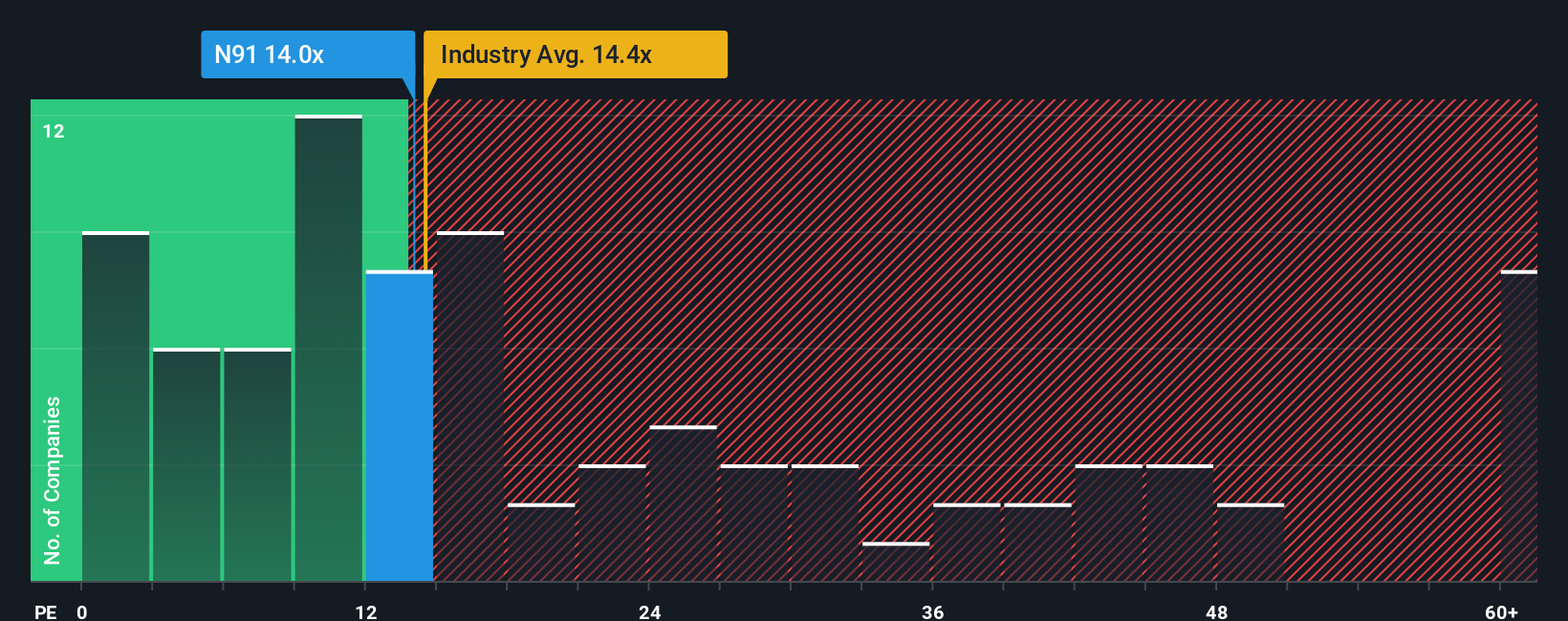
With a price-to-earnings (or "P/E") ratio of 14x Ninety One Group (LON:N91) may be sending bullish signals at the moment, given that almost half of all companies in the United Kingdom have P/E ratios greater than 17x and even P/E's higher than 30x are not unusual. Although, it's not wise to just take the P/E at face value as there may be an explanation why it's limited.
Ninety One Group could be doing better as its earnings have been going backwards lately while most other companies have been seeing positive earnings growth. The P/E is probably low because investors think this poor earnings performance isn't going to get any better. If this is the case, then existing shareholders will probably struggle to get excited about the future direction of the share price.
See our latest analysis for Ninety One Group
How Is Ninety One Group's Growth Trending?
There's an inherent assumption that a company should underperform the market for P/E ratios like Ninety One Group's to be considered reasonable.
Retrospectively, the last year delivered a frustrating 6.7% decrease to the company's bottom line. This means it has also seen a slide in earnings over the longer-term as EPS is down 25% in total over the last three years. Therefore, it's fair to say the earnings growth recently has been undesirable for the company.
Shifting to the future, estimates from the six analysts covering the company suggest earnings should grow by 6.0% per year over the next three years. With the market predicted to deliver 17% growth each year, the company is positioned for a weaker earnings result.
With this information, we can see why Ninety One Group is trading at a P/E lower than the market. Apparently many shareholders weren't comfortable holding on while the company is potentially eyeing a less prosperous future.
The Final Word
While the price-to-earnings ratio shouldn't be the defining factor in whether you buy a stock or not, it's quite a capable barometer of earnings expectations.
We've established that Ninety One Group maintains its low P/E on the weakness of its forecast growth being lower than the wider market, as expected. Right now shareholders are accepting the low P/E as they concede future earnings probably won't provide any pleasant surprises. Unless these conditions improve, they will continue to form a barrier for the share price around these levels.
The company's balance sheet is another key area for risk analysis. Take a look at our free balance sheet analysis for Ninety One Group with six simple checks on some of these key factors.
If P/E ratios interest you, you may wish to see this free collection of other companies with strong earnings growth and low P/E ratios.
Have feedback on this article? Concerned about the content? Get in touch with us directly. Alternatively, email editorial-team (at) simplywallst.com.
This article by Simply Wall St is general in nature. We provide commentary based on historical data and analyst forecasts only using an unbiased methodology and our articles are not intended to be financial advice. It does not constitute a recommendation to buy or sell any stock, and does not take account of your objectives, or your financial situation. We aim to bring you long-term focused analysis driven by fundamental data. Note that our analysis may not factor in the latest price-sensitive company announcements or qualitative material. Simply Wall St has no position in any stocks mentioned.