
US stocks calm the “rift” in the market: VIX is surprised to see a “one-day surge”, and leveraged ETFs may become a new hidden danger in the market
The Zhitong Finance App learned that the US stock market is currently not particularly volatile, yet it appears vulnerable. Over the past two weeks, even though the trend of the S&P 500 index was relatively stable, the volatility index showed a sharp rise and rapid decline. This has reignited discussions about market fragility — long periods of calm interrupted by sudden and excessive fluctuations.
The most recent example appeared on October 16. On the same day, the S&P 500 index fell only 0.6% due to market concerns about regional bank loan losses, but the Chicago Options Exchange Volatility Index (VIX) soared to a six-month high. According to an analysis by UBS strategists, the increase of VIX compared to the S&P 500 this time even surpassed the August 2024 fluctuation event, the “end of volatility in February 2018 (Volmageddon)”, and the situation after the collapse of Lehman Brothers in 2008. By October 17, VIX quickly fell back to the level of a few days ago — that is, before US President Trump threatened to impose higher tariffs on China, causing market unease.
UBS strategist Kieran Diamond and others pointed out that on October 16, the volatility positions held by S&P 500 index options market makers became “shorted” when the market fell. When these positions were made up, they may have further amplified VIX's sharp rise. In addition, traders may also hold short positions with VIX bullish options, and hedging these positions has also boosted the increase in volatility.
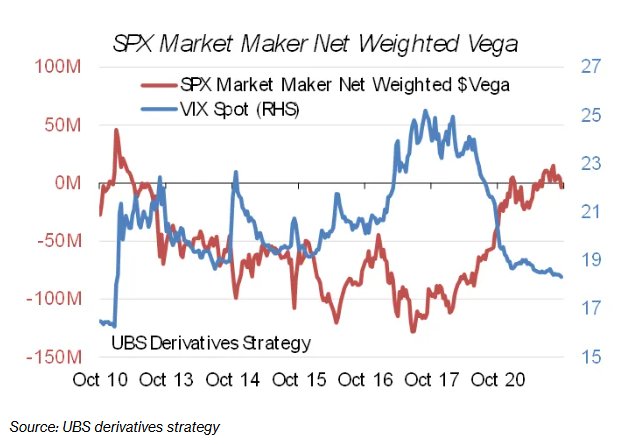
Bank of America strategists said in a report that the day's fluctuations were more technologically driven. VIX-related transactional products (ETPs) may not have played a major driving role because investors settled profits when VIX rose, while market makers made up for the bears. The strategist pointed out that with VIX futures rising 10 points in the previous month, only about 17% of volatile long investors needed to sell their positions to offset traders' rebalancing behavior.
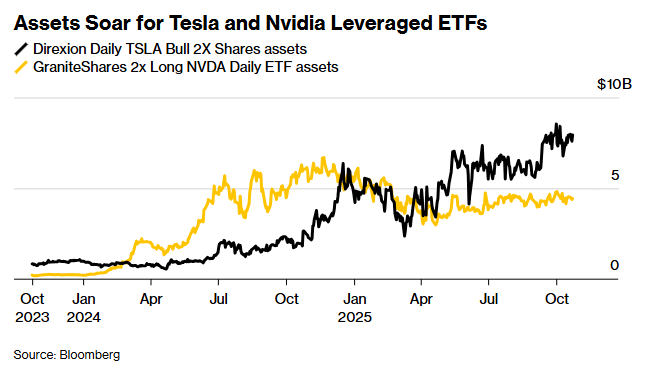
This pattern of “a period of calm suddenly interrupted by fluctuations” also highlights the phenomenon of market “pull” caused by large-scale growth in transactional products. On the one hand, there are funds that earn premium by selling options to suppress volatility; on the other hand, they are leveraged ETFs that use swaps (swaps) to track earnings from the S&P 500 and NASDAQ 100 indices, or recently introduced leveraged funds that concentrate on individual stocks that have the greatest influence on the index.
Garrett DeSimone, head of quantification at OptionMetrics, said of the October 16 VIX surge: “When I think about the sharp fluctuations in VIX and the broader liquidity pressure associated with leveraged products, my biggest concern is the potential risk of a negative feedback loop caused by rebalancing 2x and 3x leveraged ETFs.”
Leveraged stock ETFs have become a hot topic of discussion, especially on individual stocks such as Nvidia (NVDA.US) and Tesla (TSLA.US) — these stocks are highly sought after by retail investors. The discussion focused on the market impact of these funds' daily rebalancing transactions, which usually take place around the close, particularly during periods of high volatility and scarce liquidity.
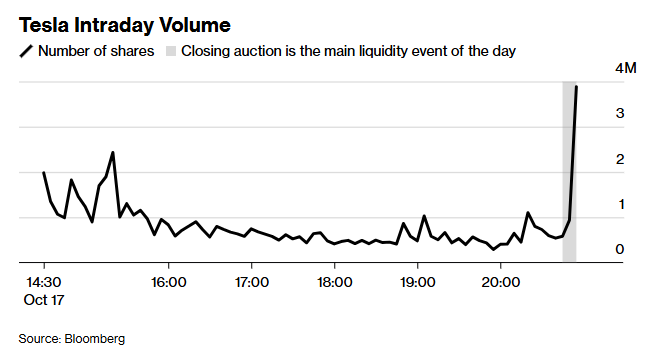
According to estimates by Antoine Porcheret, Citigroup's head of institutional structuring in the UK, Europe, Middle East and Africa, the nominal size of global leveraged ETFs is about US$160 billion, of which the top ten stocks account for about 65%. In a situation where the market fluctuates greatly, the trading volume of some single stock funds can account for 100% or even 200% of the “closing market price trading volume”. “This will obviously affect the price.” He said that banks, as the ultimate counterparty to these funds through swap transactions, face stock risk exposure of about 300 billion US dollars due to leveraged funds.
But this isn't the only risk banks face. They are also exposed to what is known as “gap risk” (gap risk), that is, the possibility of losing money when facilitating these transactions. For example, if a company declared bankruptcy, its stock price could theoretically be close to zero, causing a 2x leveraged ETF to lose 100%. In this case, the bank's hedging position would actually lose twice that amount.
Banks usually hedge this gap risk by selling hybrid or standard derivatives to institutional clients. Unlike past crises, this type of risk does not occupy bank balance sheets for a long time, as in past crises, the large-scale exposure created by holding derivatives such as variance swaps.
Today's risk is more like a “one-day vulnerability.” Under the current market pattern, the long-term calm phase is often interrupted by flash crashes and rapid rebound, and some participants may be hurt as a result. Garrett DeSimone said, “I've seen several potential transmission risk channels. Leveraged ETFs now manage a huge amount of assets, a large part of which is concentrated in the technology sector, and technology stocks themselves account for a significant share of the S&P 500 index.”