
The “super cycle long logic” has been recognized by the mainstream, and the aviation sector ushered in a valuation repair market?
In the past two or three years, due to the pandemic and the stagnation of international routes, aviation stocks have been at the bottom of historical valuation for a long time. Recently, along with the continued rise in the aviation sector, this “value depression” seems to have clearly recovered.
Zhitong Finance has observed that since October 9, the aviation stock sector of the Hong Kong stock market has gradually risen sharply. On October 9, October 15, and October 20, the sector recorded increases of 3.47%, 5.68%, and 5.38% respectively. The cumulative increase in the sector is 15.14% so far. Among them, China Eastern Airlines shares (00670) had a cumulative increase of 37.42%, and China Southern Airlines shares (01055) had a cumulative increase of 22.57%.
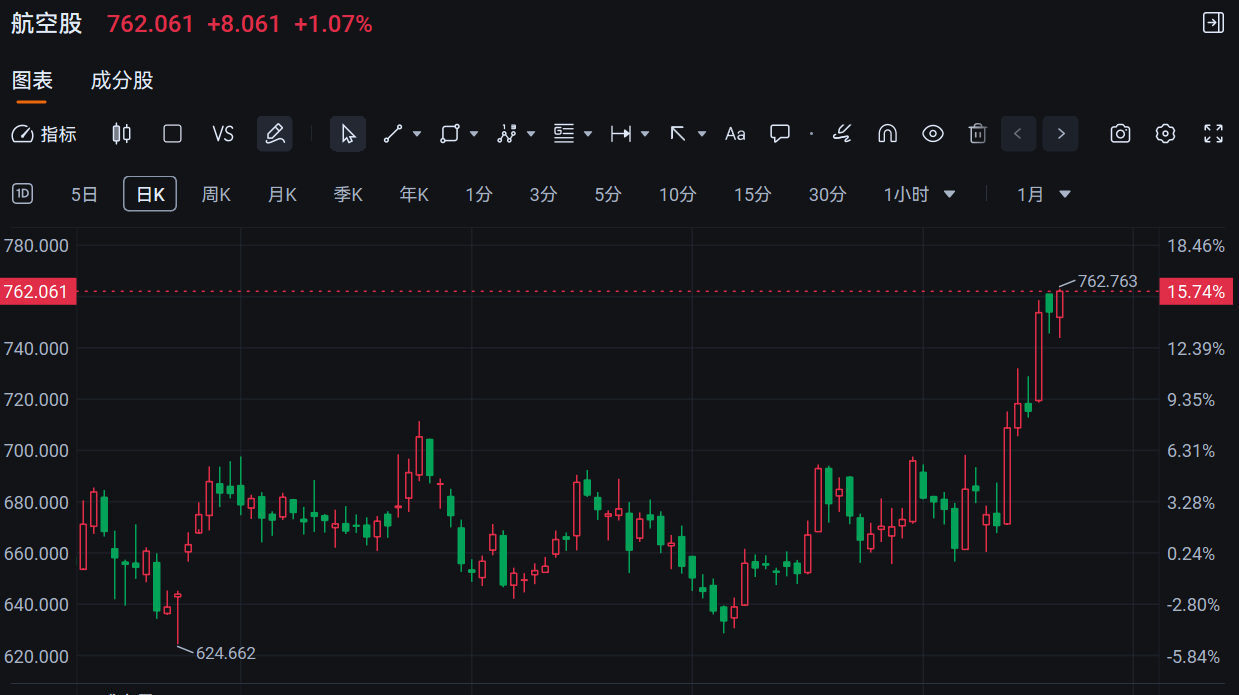
(Market source: Futu)
The aviation sector ushered in a strong recovery market. Why on earth is this?
Passenger traffic growth+fare recovery, industry prosperity improved significantly
There is no doubt that the National Day and Mid-Autumn Festival holidays and convenient “holiday fighting” methods have had a strong driving effect on the desire to travel during the holidays.
According to data from the Ministry of Transport, from October 1 to 8, 2025 (National Day Mid-Autumn Festival holiday), the total number of people moving across regions is expected to reach 2,432 billion, a record high for the same period, with an average daily increase of 6.2%. Among them, the actual passenger volume of civil aviation was 19.138 million, an average of 2.392 million passengers per day. The average number of passengers carried per day increased by 4.1% and 26.9%, respectively, compared with 2024 and 2019. Guosheng Securities said that the record high holiday personnel turnover data and the year-on-year increase in civil aviation passenger traffic showed the resilience of civil aviation demand.
In terms of flight volume, as of October 14, 2025, the number of civil aviation flights carried out in 2025 was 15,539 flights per day, compared with 14,980 flights per day in the same period in 2024, an increase of 3.73% over the previous year, and the number of flights increased steadily. From the perspective of passenger occupancy rate, from July to September 2025, the passenger occupancy rates of civil aviation were 84.5%, 87.5%, and 85.8% respectively, all higher than the passenger occupancy level for the same period in 2019; in September 2025, the average passenger occupancy rate of the three major airlines was 85.7%, an increase of 5 percentage points over the same period in 2019, which is better than the industry average increase.
The flight volume structure was dismantled, and the number of international flights executed in Hong Kong, Macao and Taiwan regions of China increased significantly. As of October 14, 2025, the average number of international civil aviation flights and the Hong Kong, Macao and Taiwan regions of China reached 2,154 flights per day in 2025, an increase of 16.70% over the previous year; in 2025, the average number of domestic flights carried out was 13,885 flights per day, an increase of 1.91% over the previous year. As the scope of visa-free visas continues to expand, the demand for international travel and communication is constantly being activated. By the end of June 2025, international flight volume had recovered to 88% of the same period in 2019.
Along with the steady increase in flight volume, passenger occupancy rates have been rising steadily, and ticket prices have continued to recover.
In September 2025, the average domestic economy class ticket price of civil aviation was 697 yuan, up 0.6% year on year, from -5.0% year on year in September 2019; the average domestic economy class fare for civil aviation during the 2025 National Day Mid-Autumn Festival holiday was 849 yuan, an increase of 0.3% year on year. Compared with -1.4% year on year during the 2019 holiday season, ticket prices continued to recover.
At a time when rising demand is unleashing the vitality of the aviation industry, oil prices may enter a downward cycle, which is also expected to drive the increase in the profitability of the industry.
As of September 2025, after 5 months of increasing production, OPEC+ has completely withdrawn from the agreement to cut crude oil production by 2.2 million b/d in early 2024. On September 7, the eight major oil producers in OPEC+ decided to further increase production by 137,000 b/d from October, which means that the organization has initiated the second phase of the production increase plan, corresponding to a total production reduction of about 1.66 million b/d in 2023 (this part of the production reduction plan was originally scheduled to expire at the end of 2026). From January to September 2025, the average customs value of China's aviation kerosene imports was about 5,713 yuan/ton, 13% compared with the same period last year. On September 5, 2025, the price of Brent crude oil was 65.50 US dollars/barrel. As major oil producers increase production and oil prices may continue to decline, aviation fuel costs per airline are expected to continue to fall, helping to release profits.
Based on this, it is easy to see that with the help of these multiple factors, the prosperity of the aviation industry has increased significantly, which has also had a certain positive feedback effect on the secondary market.
The aviation industry may welcome a “supercycle”; everything is ready, only Dongfeng owes
In the short term, the National Day holiday data exceeded expectations, clearly verifying the resilience of the industry's demand, but in the medium to long term, the aviation industry may be expected to launch a “super cycle long logic.”
On the one hand, the scissor gap between supply and demand forms long-term support.
From the demand side, demand structure optimization is the key. Specifically, in the context of consumption upgrading and the development of experiential consumption,
The proportion of leisure travelers has increased dramatically, and the ability to resist cycles has increased. At the same time, public business demand gradually recovered, and domestic public and commercial passenger traffic continued to grow sequentially in Q3 2025, driving up ticket prices. In the long run, the number of flights per capita in China is only 0.47 (2019), less than 1/5 of the US. Urbanization and consumption upgrades will continue to unleash demand potential. The number of flights per capita is expected to reach 0.8 in 2030, corresponding to an average annual growth rate of 6.5% in passenger traffic.
On the other hand, on the supply side, rigid constraints are difficult to resolve.
From the supply side, global aircraft manufacturing capacity is slowly recovering. The production capacity of Airbus and Boeing in 2025 was only 60% to 70% of 2019, and the backlog of orders reached 17,000. The average delivery waiting period for China Airlines was extended from 2 years to 3.5 years. Domestically, the average annual growth rate of passenger capacity from 2025 to 2028 is expected to be only 3.1%, far lower than 8.5% in 2010-2019, mainly suppressed by insufficient new aircraft (less than 120 per year) and the retirement of the old fleet (300 aircraft expected to be retired in the next 5 years). In addition, airspace bottlenecks and “anti-internal circulation” industry self-regulation further limit supply release, and the Civil Aviation Administration's strict control of seasonal growth during the 2025/26 winter season will continue to optimize the supply and demand structure.
Furthermore, market-based reforms and industry self-discipline have also activated the airline industry's profit elasticity.
After the 2017 fare reform, the pricing power of airlines increased significantly. Against the backdrop of high passenger occupancy rates, domestic main line ticket prices have also increased year-on-year since 2025. Among them, Cinda Securities pointed out that fuel deduction ticket prices in the National Day Mid-Autumn Festival holiday industry were corrected year on year, and ticket prices continued to rectify in early October. The fourth quarter entered a low season dominated by public and commercial travel. When the base figure was low last year, there may be significant improvements over the same period last year, driving airline unit seats to continue to recover.
At the same time, with “anti-corruption” measures and the implementation of the Convention, the phenomenon of malicious low prices in the industry is expected to be reduced, or may lead to a restoration of ticket prices, further promoting a recovery in airline unit seat take-back. Coupled with the reduction in costs brought about by falling oil prices, airline profits may be able to grow further. Among them, Cathay Pacific Haitong Securities estimates that if public business demand continues to recover, the airline's profit center will rise significantly, and Q3 earnings in 2025 are expected to once again surpass the same period in 2019, showing an initial upward trend in the cycle.
In view of this, the “super cycle long logic” for the aviation industry has also received mainstream recognition. Agencies such as Cathay Pacific Haitong and Zhongtai Securities all believe that China's aviation industry already has the conditions to launch a supercycle: ticket price marketization guarantees transmission of high passenger occupancy rates to ticket prices, a slowdown in fleet growth to eliminate pressure to increase investment in the third and fourth tier, compounded by the recovery in public business demand, and the upward trend in the airline's profit center is sustainable. International investment banks such as Goldman Sachs and Citibank raised the ratings of leading airlines, believing that supply constraints will continue until 2027, and rising ticket prices are the core driving factor.
Based on the above, it is easy to see that China's aviation industry is in a resonance cycle of “high demand, low supply, and strong policies,” and the conditions for starting the supercycle are basically ripe. It is expected that the scissor gap between supply and demand will continue to widen in 2025-2028. The double rise in ticket prices and passenger occupancy rates will drive the airline's profit flexibility to be realized, and the industry is expected to shift from “strong cyclical fluctuations” to a “stable profit period driven by supply and demand.” Investors can pay attention to the hub advantages of full-service airlines (such as Air China and China Southern Airlines) and the flexibility of international routes, as well as the low cost and high turnover model of cheap airlines (such as Spring Airlines).