
Japan's physical gold ETF premium has soared! The fervent pursuit of investors raises concerns about a sharp pullback
The Zhitong Finance App learned that investors' crazy pursuit of gold drove the price of Japan's largest physical gold ETF to soar to record levels, even exceeding the value of the underlying assets it holds. This highlights the potential risks investors face in a volatile market.
At the beginning of this week, Japan's physical gold ETF — Japan's only fund backed by locally stored gold — had a premium of up to 16% over its net asset value (NAV). Although investors paid attention to the ETF's net worth on Friday on the Tokyo Stock Exchange, the ETF continues to trade at a high premium.
Market concerns were heightened by the fact that spot gold prices recorded their biggest one-day decline in more than 12 years on Tuesday, prompting some analysts to issue warnings that the ETF's upward trend may reverse. Satoru Yoshida, a commodity analyst at Rakuten Securities, said that if the gold market continues to weaken, “retail investors may sell off collectively,” increasing the risk of major losses. Following a 6.3% drop in spot gold prices on Tuesday, the ETF price fell 11% on Wednesday.
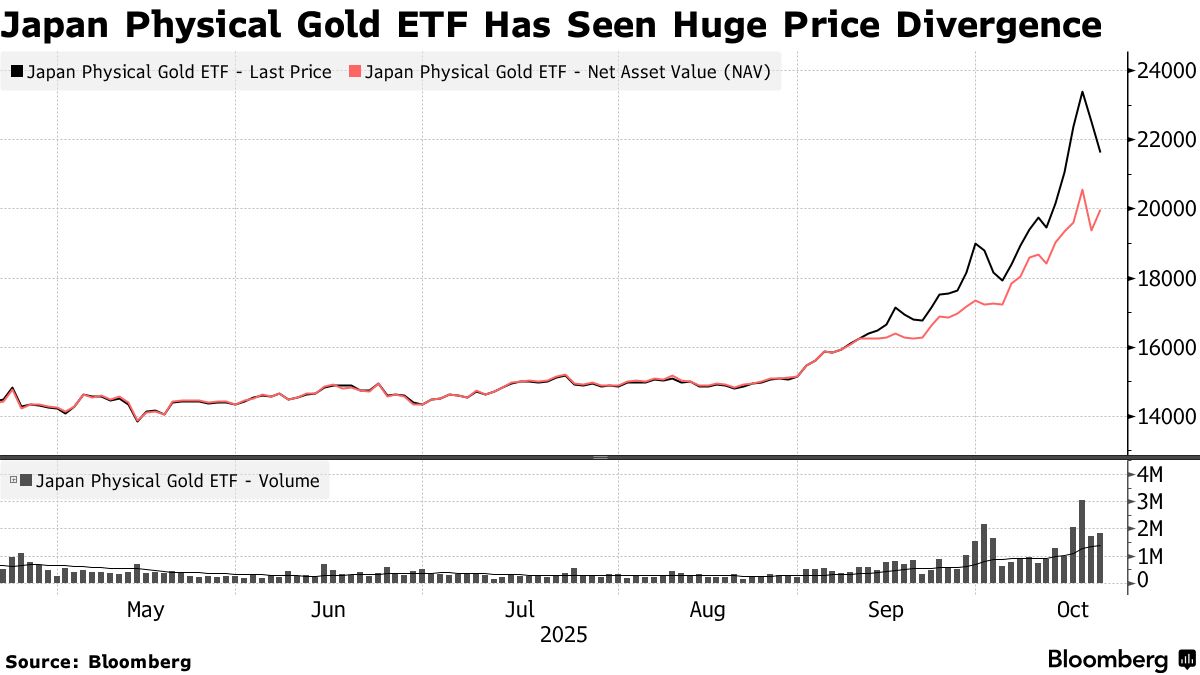
According to the data, the premium of this Japanese physical gold ETF of about 1.25 trillion yen (about 8.2 billion US dollars) has expanded to the highest level among similar funds in the world. Meanwhile, other international physical gold ETFs with similar structures — such as Goldman Sachs physical gold ETF, ABRDN physical gold ETF, and BlackRock iShares physical gold ETF — have never deviated more than 4% from their trading price in the past ten years.
Kei Okazaki, senior manager of the ETF Market Development Department of the Tokyo Stock Exchange, said, “The decline in the linkage between ETF prices and the gold market, combined with the phenomenon of investors buying at high prices, is really worrying.”
Some analysts believe that in the longer term, the overall bullish trend in gold will continue to support the performance of Japanese physical gold ETFs. In fact, as of Wednesday afternoon, the fund's decline had narrowed rapidly to around 7%.
This unusual trading activity reflects a recent surge in interest in gold among Japanese retail investors, and is also driven by the depreciation of the yen and the suspension of gold sales by domestic retailers. Some analysts pointed out that these factors have accelerated the flow of capital into gold ETFs. Satoru Yoshida of Rakuten Securities said that the depreciation of the yen made investors expect the price of gold in dollars to bring higher returns.
Notably, part of the fund's popularity is due to the fact that investors can exchange their ETF shares for physical gold by paying a fee. When the trading price of a Japanese gold ETF is higher than the net value, the issuer Mitsubishi Corporation buys physical gold, while securities companies sell shares of the newly established fund on the market, which usually results in a narrowing of the premium.
However, a representative of a Mitsubishi Corporation subsidiary responsible for purchasing precious metals said that although the company is purchasing gold from both home and abroad, it is currently “difficult to keep up with soaring demand and rapidly rising prices.” Satoshi Harada, a researcher at NLI Research (NLI Research), pointed out: “Since it is still difficult for retail investors to directly obtain physical gold, the ETF has shown no signs of rapidly closing the gap between price and net worth.”