
Counterpoint: The global second-hand smartphone market is transforming
The Zhitong Finance App learned that according to Counterpoint's latest research, the overall performance of mature used equipment markets in Europe, the US, and Japan was flat in the first half of 2025, with an average annual increase of about 1% over the previous year. Factors such as market fragmentation, rising costs, and extended switching cycles have all affected both the supply and demand sides of used smartphones. In contrast, emerging markets such as Africa, India, Southeast Asia, China, and Latin America continued to be active, growing at an average annual rate of about 4% year over year, which is significantly higher than the global average.
Used smartphone sales growth by region
First half of 2025 vs first half of 2024
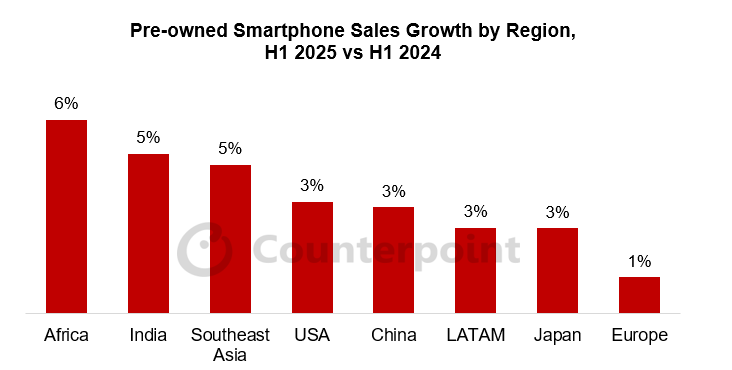
Data source: Counterpoint Global Used Smartphone Market Report
In the first half of 2025, driven by multiple factors from the entire value chain, the used smartphone market in Africa grew 6% year over year, making it the fastest growing region in the world. An increasing number of authorized retailers are absorbing sales that were originally from informal channels. Government-led projects such as “Bridge by Digital Africa” (“Africa Digital Bridge”) provide funding and resources to support the construction of local refurbishment ecosystems and promote regionalization. Imported used iPhones continue to sell well in many countries, mainly due to economic pressure and people's perception that their reliability and longevity are superior to new local models.
Key growth factors in the African market:
Apple led the refurbished smartphone market with 7% year-on-year growth, mainly due to cooperation with high-end retailers and consumer preference for new iPhone 13 and above models.
Samsung ranked second with a 4% year-on-year increase. Benefiting from active recycling promotions of up to 50% off for the Galaxy S and Z series, strong trade-in demand continued to drive sales.
Popular models include Apple iPhone 11, 12, and Samsung Galaxy S20.
In the first half of 2025, the second-hand smartphone market in India grew 5% year-on-year under the leadership of Apple. Authorized retailers are speeding up the deployment of online and offline recycling programs, and are actively building a “high-end” brand image, positioning refurbished machines — especially flagship and high-end models — as reliable and cost-effective alternatives. Market demand continues to shift to newer models due to retailer-driven recycling and exchange programs, extended warranty services, and consumer preferences for the latest high-end models.
Key growth factors in the Indian market:
Supported by stable demand for the Galaxy S22 and S23 series, Samsung steadily topped the list with a slight decline of 1% month-on-month. Meanwhile, the Samsung Galaxy S22 and S21 are also among the best-selling models in India.
Due to consumer preference for high-end models such as the iPhone 13 and 14 series, Apple ranked second with a 19% year-on-year increase.
In the first half of 2025, the Southeast Asian second-hand smartphone market grew 5% year-on-year, mainly due to the huge informal channel system and the steady inflow of used equipment and components from China. However, over the past 1-2 years, countries in the region have gradually developed local supply systems to reduce their dependence on imports. C2C (consumer-to-consumer) transactions driven by online platforms have become an important growth engine for the used equipment market. Its expansion stems from increased consumer trust, supply chain improvements, and the convenience of digital transactions.
Key growth factors in the Southeast Asia market:
With the best-selling models iPhone 12 and iPhone 13, Apple excelled in Indonesia and other Southeast Asian countries, leading the market with 15% year-on-year growth and accounting for about half of the market share. Most imported products still come from China, and the retailer's recycling and exchange programs are strengthening the local supply system.
Samsung's overall decline was 3% year over year, but through recycling and exchange programs in cooperation with platforms such as Laku6 (Carousell Group), it is actively promoting sustainable development while increasing after-sales participation.
The overall performance of mature markets such as the US, Europe, and Japan was stable, and tight supply and declining exports to emerging markets affected sales.
In the US, market sentiment fluctuates greatly. Retailers and OEMs reserve large quantities of parts in advance to cope with potential policy changes. Operators, OEMs and retailers continue to strengthen recycling and exchange programs and collaborate with upstream and downstream partners in the industry chain to ensure the smooth flow of inventory.
Profit pressure in Europe is further increasing due to rising operating costs and stricter regulations. At the same time, tariff uncertainty brought about by US policies has further curtailed the activity of the second-hand smartphone market. Competition among retailers is becoming more intense, and recycling activities are becoming more frequent.
In Japan, recognition of officially certified used smartphones sold by major operators such as NTT Docomo and SoftBank continues to increase, while OEM certification programs for Apple and other brands are also supported by the government's promotion of transparent and affordable pricing policies, further enhancing consumer trust and accessibility.
Overall, the iPhone 12 and 13 series are still the main models for refurbished sales in mature markets, and as demand heats up, the Samsung S series is expected to perform more strongly in specific markets such as the US in the coming months.