
When rare earth control was popular, ASML.US (ASML.US) tenaciously held up the “AI bull market narrative”
The Zhitong Finance App learned that the latest results announced by lithography giant ASML Holding NV (ASML Holding NV) show that Q3 lithography machine orders have exceeded market expectations, and the AI infrastructure arms race is still in full swing under the catalyst of an unprecedented global AI boom. The company's management is optimistic about the impact of rare earth regulations and performance growth expectations from 2026 to 2030. Asmat's Chief Financial Officer (CFO) said the company is fully prepared for China's policy to restrict exports of rare earth products and related technology and equipment.
With the opening of the stock market earnings season, Asma's outstanding performance has undoubtedly greatly strengthened the “AI long-term bull market” narrative logic of the global stock market and the “AI investment belief” of technology stock believers. This also means that this round of “super bull market” of the global AI computing power industry chain led by Nvidia, TSMC, Broadcom, and Micron Technology is far from over, and the industry chain will remain the most popular investment sector for some time to come. After Asmack's results were released, Asmack's US stock ADR (ASML.US) rose more than 4% after hearing pre-market news, and the European stock market rose similarly.
According to the latest results, Asmack's third-quarter orders totaled 5.4 billion euros, higher than the market's general forecast of 4.9 billion euros, with orders for extreme ultraviolet lithography machines (EUV) reaching the highest level in nearly seven quarters; Asmack CEO Christophe Fouquet (Christophe Fouquet) reiterated in the performance statement that with the help of the AI boom, the company will increase its annual net sales volume sharply from €28.3 billion last year to €60 billion in the long-term performance growth target of 60 billion euros by 2030.
CEO Fukai said in the performance statement: “We have indeed seen continued positive growth in AI spending and investment, and this trend has extended to larger customers. Our more advanced, cutting-edge lithography equipment is expected to grow even more strongly.”
Michael Roeg (Michael Roeg), a senior analyst from Degroof Petercam, said after Asmai's latest results were announced that Asmat's management's latest guidelines were “much more enthusiastic” than previous comments. “The outlook remains cautious,” Rogge said in an email, “This is definitely because they expect a sharp drop in lithography machine sales to the Chinese market in 2026. This must be compensated by a stronger increase in sales in 2026 for the most advanced AI logic chip and memory chip customers.”
What does Asmai think of “rare earth control”?
During the much-anticipated Wednesday results conference call, Asma's management further released optimistic expectations. At the conference, Asmack CEO Fukai predicted that Asmack's net sales in 2026 will not fall below the strong level of 2025; regarding the impact of rare earth regulations focused on global investors, Chief Financial Officer Roger Dassen (Roger Dassen) said on Wednesday that even though the impact on the broader chip manufacturing ecosystem is difficult to assess, the company has made “thorough preparations” for China's important export restrictions related to rare earths.
According to the new regulations announced last week, the Chinese side will require overseas companies to obtain official approval from Beijing before exporting related products containing even trace amounts of specific rare earths from China.
Needless to say, Asmat uses some rare earth materials from China in its magnet and battery supply systems. Last week, some media quoted a person familiar with the company's situation as reporting that due to these restrictions, Asmack's lithography machine shipments may face delays of up to several weeks. However, CFO Dasson downplayed related concerns during a performance call with analysts.
“Our lithography machines have a long lead time, so in our supply chain, we will also ensure that we have the important materials we need in the next few months. We are fully prepared for all of this. The company's supply chain has enough materials to secure our customer orders.” Darson said after the company announced its third-quarter results.
Some analysts said that the short-term impact of this round of rare earth and magnetic material export regulations is manageable and is mainly reflected in “weekly” disturbances at the time of individual shipments; based on the Trump administration's need to establish close ties with the Chinese market, the probability of a substantial drag on Asmack's mid-term (2026-2028) is not high; it is more like a supply chain execution risk rather than a “fundamental event” that interrupts the growth curve.
This new policy is the first time that Beijing has used external jurisdiction to target the global chip industry chain, in particular a major regulatory measure for foreign companies. The move comes after US President Donald Trump's series of measures further escalated the trade war between China and the US, and last Friday threatened to impose an additional 100% tariff on China and implement export controls on critical software.
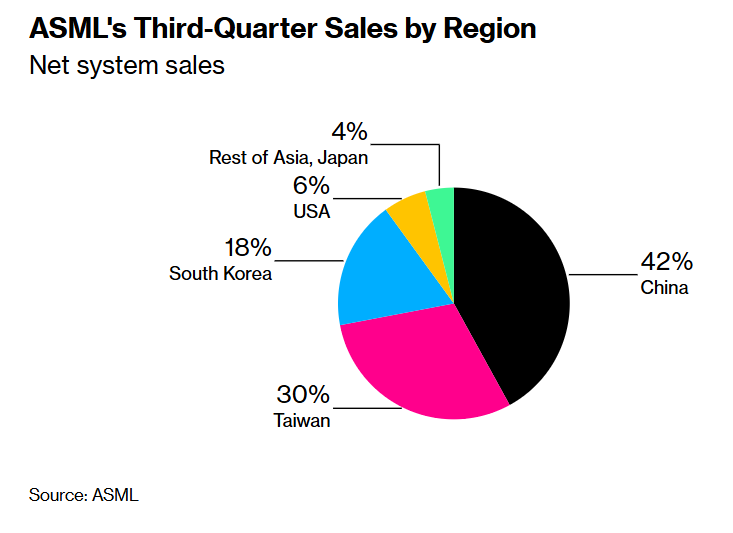
The lithography equipment built by Asmack is critical to global chip manufacturing, yet the company has long been in the middle of trade tension between Beijing and Washington. According to statistics, net system sales in the Chinese market in the third quarter accounted for 42% of its total sales, up from 27% in the previous three months, making it the company's largest market for the quarter.
Furthermore, the Trump administration may increase sales restrictions on Asmack in the Chinese market. Last week, the US House of Representatives committee said that Asmack and other semiconductor equipment manufacturers such as applied materials are promoting the development of the Chinese chip industry chain. The committee called for tighter control over lithography machine sales.
Due to restrictions led by the United States, the company has never been able to sell its more advanced EUV lithography machines to China, and sales to China have basically focused on lithography equipment that supports mature manufacturing processes. Last year, under pressure from the US government, the Dutch government also blocked the sale of an immersive deep UV lithography system to China — the company's second-most advanced model.
The “pinnacle of human technology” sends a signal of optimism, and the AI bull market carnival continues to sweep the global stock market
Asmack's latest strong performance, which has the title of “the pinnacle of human technology,” and its optimistic outlook for the future — in particular, Asmack's reaffirmation of strong growth expectations until 2030 has greatly strengthened the market expectation that “the boom in the AI computing power industry chain continues strongly”.
Since September, Asma's stock price has significantly entered an upward trajectory as “a new generation of more expensive EUV lithographers — high-NA lithographers move from laboratory verification to deployment at the chip manufacturing side” and investment in Mistral AI. In September, ASML.US stock ADR (ASML.US) recorded its best monthly performance in 20 years, with an increase of 45% since 2025, with a sharp rise of more than 40% since September. The core logic behind it is that investors expect that the accelerated construction of artificial intelligence infrastructure will drive chip makers such as TSMC to drastically expand the production capacity of advanced AI chips at 3nm and below, which in turn will drive a surge in semiconductor equipment orders.
Recently, the prices of DRAM and NAND series high-performance storage products around the world have risen sharply. In addition, cloud computing giant Oracle, which recently announced a contract reserve of 455 billion US dollars far exceeding market expectations, and OpenAI, the most highly valued AI startup in the world, have reached an AI computing power infrastructure deal of more than 1 trillion US dollars. It has greatly strengthened the “long-term bull market narrative” of AI computing power infrastructure sectors such as AI GPUs, ASICs, and HBM, data center SSD storage systems, liquid cooling systems, and core power equipment. The demand for AI computing power brought about by generative AI applications and inference terminals dominated by AI agents can be called a “sea of stars”, which is expected to drive the AI computing power infrastructure market to continue to show exponential growth. “AI inference systems” are also Hwang In-hoon's biggest source of future revenue for Nvidia.
According to Wall Street financial giants Morgan Stanley, Citi, Loop Capital, and Wedbush, the global wave of AI infrastructure investment centered on AI computing power hardware is far from over and is only at the beginning. Driven by an unprecedented “AI computing power demand storm,” the scale of this round of AI investment is expected to reach 2 trillion to 3 trillion US dollars. Nvidia CEO Hwang In-hoon also predicted that by 2030, AI infrastructure spending will reach 3 trillion to 4 trillion US dollars, and the scale and scope of the project will bring significant long-term growth opportunities to Nvidia.
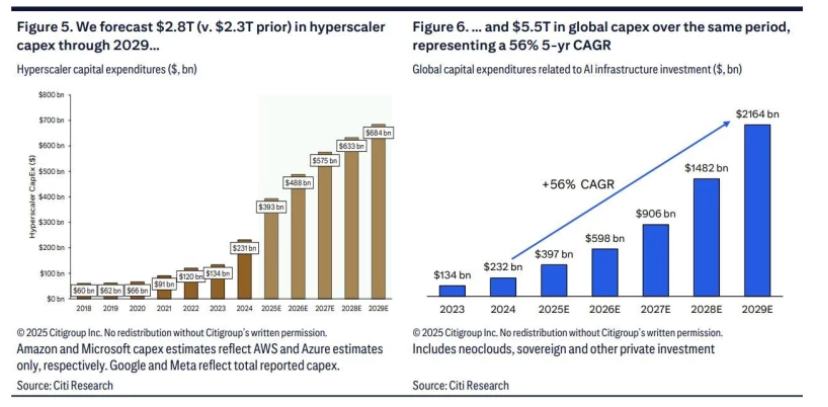
Citigroup's senior analysts recently raised their AI infrastructure spending forecasts for the world's largest tech giants, including Microsoft, Google, Amazon, Meta, and SAP, and raised the AI infrastructure spending forecast for 2026 from US$420 billion to US$490 billion. At the same time, Citi expects the tech giants' cumulative AI infrastructure spending forecast to be raised from the previous forecast of 2.3 trillion US dollars to 2.8 trillion US dollars by 2029, and the compound annual growth rate of global AI infrastructure is expected to reach 56%. Furthermore, according to estimates in this research report, global demand for AI computing power will add 55 gigawatts of power capacity by 2030, which is expected to translate into incremental AI computing power-related spending of up to 2.8 trillion US dollars, of which the US market will account for 1.4 trillion US dollars.
Wall Street financial giant Wells Fargo (Wells Fargo) recently released a bullish research report on the semiconductor equipment industry. The agency said that as the global AI infrastructure construction process led by tech giants such as Microsoft, Google, and Meta becomes more intense, comprehensively helping the expansion of advanced process chips at 3nm and below and the expansion of advanced packaging production capacity, the long-term bull market logic in the semiconductor equipment sector is still very strong. Asmaine is one of the semiconductor equipment stocks that Wells Fargo has been optimistic about for a long time.
Wells Fargo said that all the news about catalyzing AI chip production capacity for advanced processes is positive and positive for semiconductor devices. The CPU/GPU package heterogeneity (based on NVLink interconnection and advanced chiplet packages such as COWos/Emib/FoverOS) will greatly boost the structural requirements for EUV/high-NA lithographs, advanced packaging equipment, and inspection and measurement, which is beneficial to semiconductor equipment manufacturers such as Asmack, Applied Materials, and Kelei.