
The Analyst Verdict: Kadant In The Eyes Of 5 Experts
In the preceding three months, 5 analysts have released ratings for Kadant (NYSE:KAI), presenting a wide array of perspectives from bullish to bearish.
The table below provides a concise overview of recent ratings by analysts, offering insights into the changing sentiments over the past 30 days and drawing comparisons with the preceding months for a holistic perspective.
| Bullish | Somewhat Bullish | Indifferent | Somewhat Bearish | Bearish | |
|---|---|---|---|---|---|
| Total Ratings | 0 | 4 | 1 | 0 | 0 |
| Last 30D | 0 | 1 | 0 | 0 | 0 |
| 1M Ago | 0 | 1 | 0 | 0 | 0 |
| 2M Ago | 0 | 0 | 0 | 0 | 0 |
| 3M Ago | 0 | 2 | 1 | 0 | 0 |
Analysts have recently evaluated Kadant and provided 12-month price targets. The average target is $364.0, accompanied by a high estimate of $380.00 and a low estimate of $300.00. Surpassing the previous average price target of $359.00, the current average has increased by 1.39%.
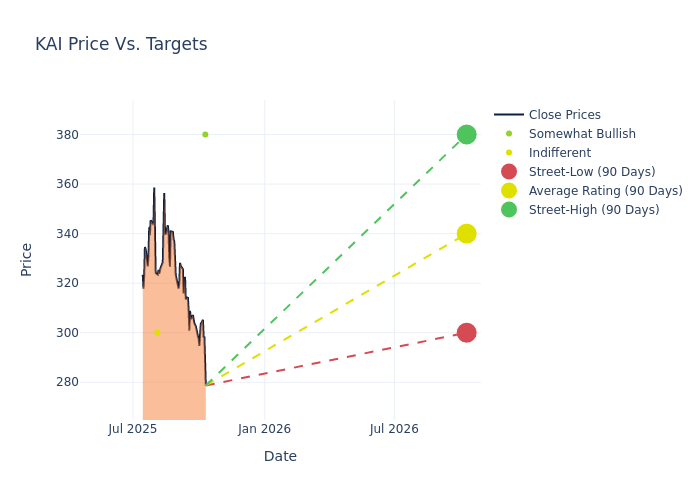
Deciphering Analyst Ratings: An In-Depth Analysis
In examining recent analyst actions, we gain insights into how financial experts perceive Kadant. The following summary outlines key analysts, their recent evaluations, and adjustments to ratings and price targets.
| Analyst | Analyst Firm | Action Taken | Rating | Current Price Target | Prior Price Target |
|---|---|---|---|---|---|
| Gary Prestopino | Barrington Research | Maintains | Outperform | $380.00 | $380.00 |
| Gary Prestopino | Barrington Research | Maintains | Outperform | $380.00 | $380.00 |
| Kurt Yinger | DA Davidson | Raises | Neutral | $300.00 | $275.00 |
| Gary Prestopino | Barrington Research | Maintains | Outperform | $380.00 | $380.00 |
| Gary Prestopino | Barrington Research | Maintains | Outperform | $380.00 | $380.00 |
Key Insights:
- Action Taken: Analysts adapt their recommendations to changing market conditions and company performance. Whether they 'Maintain', 'Raise' or 'Lower' their stance, it reflects their response to recent developments related to Kadant. This information provides a snapshot of how analysts perceive the current state of the company.
- Rating: Analysts unravel qualitative evaluations for stocks, ranging from 'Outperform' to 'Underperform'. These ratings offer insights into expectations for the relative performance of Kadant compared to the broader market.
- Price Targets: Analysts navigate through adjustments in price targets, providing estimates for Kadant's future value. Comparing current and prior targets offers insights into analysts' evolving expectations.
Analyzing these analyst evaluations alongside relevant financial metrics can provide a comprehensive view of Kadant's market position. Stay informed and make data-driven decisions with the assistance of our Ratings Table.
Stay up to date on Kadant analyst ratings.
All You Need to Know About Kadant
Kadant Inc. supplies process and engineering equipment for papermaking, recycling, lumber manufacturing, and related industries. The company's three reportable segments are the Flow Control segment which consists of the fluid-handling and doctoring, cleaning, & filtration product lines; the Industrial Processing segment which consists of the wood processing and stock-preparation product lines; and Material handling systems, which provides conveyor-belt equipment for industries such as mining, food processing, and packaging. The company has a geographic presence in the U.S., China, Asia, Germany, Canada, and Others.
Understanding the Numbers: Kadant's Finances
Market Capitalization Analysis: Positioned below industry benchmarks, the company's market capitalization faces constraints in size. This could be influenced by factors such as growth expectations or operational capacity.
Decline in Revenue: Over the 3M period, Kadant faced challenges, resulting in a decline of approximately -7.1% in revenue growth as of 30 June, 2025. This signifies a reduction in the company's top-line earnings. As compared to competitors, the company encountered difficulties, with a growth rate lower than the average among peers in the Industrials sector.
Net Margin: The company's net margin is a standout performer, exceeding industry averages. With an impressive net margin of 10.25%, the company showcases strong profitability and effective cost control.
Return on Equity (ROE): Kadant's ROE stands out, surpassing industry averages. With an impressive ROE of 2.9%, the company demonstrates effective use of equity capital and strong financial performance.
Return on Assets (ROA): Kadant's ROA surpasses industry standards, highlighting the company's exceptional financial performance. With an impressive 1.79% ROA, the company effectively utilizes its assets for optimal returns.
Debt Management: With a below-average debt-to-equity ratio of 0.27, Kadant adopts a prudent financial strategy, indicating a balanced approach to debt management.
What Are Analyst Ratings?
Experts in banking and financial systems, analysts specialize in reporting for specific stocks or defined sectors. Their comprehensive research involves attending company conference calls and meetings, analyzing financial statements, and engaging with insiders to generate what are known as analyst ratings for stocks. Typically, analysts assess and rate each stock once per quarter.
Some analysts publish their predictions for metrics such as growth estimates, earnings, and revenue to provide additional guidance with their ratings. When using analyst ratings, it is important to keep in mind that stock and sector analysts are also human and are only offering their opinions to investors.
If you want to keep track of which analysts are outperforming others, you can view updated analyst ratings along withanalyst success scores in Benzinga Pro.
Breaking: Wall Street's Next Big Mover
Benzinga's #1 analyst just identified a stock poised for explosive growth. This under-the-radar company could surge 200%+ as major market shifts unfold. Click here for urgent details.
This article was generated by Benzinga's automated content engine and reviewed by an editor.