
SoftBank (SFTBY.US) is rumored to use Arm (ARM.US) shares as collateral to borrow $5 billion and invest more in OpenAI
The Zhitong Finance App learned that according to people familiar with the matter, SoftBank Group (SFTBY.US) is negotiating a margin loan (margin loan) of 5 billion US dollars with several banks around the world to use its chip subsidiary Arm Holdings Plc. (ARM.US) shares are used as a guarantee, and this capital will be used for additional investment in OpenAI this year. As it involved a private matter, the person concerned requested anonymity. Margin loans are a form of borrowing using investment products (such as stocks) as collateral, and SoftBank declined to comment on this.
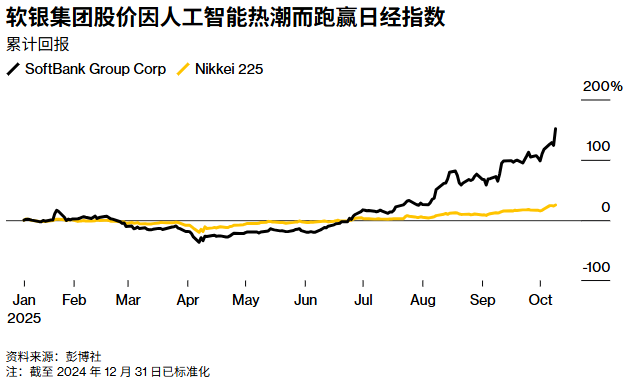
Founder Sun Zhengyi promoted investment in artificial intelligence this year in an attempt to position SoftBank as a core participant in the global AI boom. Recently, he promised to invest up to $30 billion in OpenAI and buy ABB Ltd's robotics division for $5.4 billion. Arm's stock price has risen 38% this year, providing support for SoftBank to expand the scale of financing.
According to SoftBank's earnings report, as of March 2025, it has raised a total of 13.5 billion US dollars in margin loans through Arm shares, of which 5 billion US dollars have not yet been withdrawn; if the current loan of 5 billion US dollars is reached, the total amount will increase to 18.5 billion US dollars.
Looking back at history, before Arm's initial public offering (IPO) in 2023, SoftBank received about $8 billion in margin loans, which were provided by 11 banks including J.P. Morgan Chase, Barclays, BNP Paribas, Crédit Agricole, and Goldman Sachs Group by linking the IPO authorization to the loan. Earlier this year, SoftBank also raised $15 billion in one-year loans to finance its investment in artificial intelligence in the US, one of the largest loans in its history.
Sun Zhengyi's ambitions don't stop there. Its most notable projects include the $500 billion “Stargate” program with OpenAI and Oracle to build data centers across the US. In addition, SoftBank is also exploring the feasibility of establishing a large-scale industrial manufacturing center in the US, which may cover artificial intelligence industrial robot production lines.
Bloomberg industry research analyst Sharon Chen pointed out that SoftBank's $5.4 billion acquisition of ABB's robotics division highlights its strong merger and acquisition intentions, which increased credit and bond supply risks. Combined with its $22.5 billion second investment in OpenAI, the acquisition of Ampere Computing, and investment in the Stargate project, SoftBank is likely to approach its 25% loan value ratio limit, although the increase in tech stock valuations may be partially offset. Its financing requirements may exceed $30 billion, but reliance on the bond market may be reduced through asset sales and asset-backed financing.
Currently, SoftBank is joining this wave of capital set off by large technology companies and investors, investing huge sums of money into artificial intelligence technology that could reshape the industry and economy. However, its series of complex transaction networks involving Nvidia, OpenAI, etc., have also raised market concerns — whether this interconnected commercial network is artificially overfunding this trillion-dollar AI boom.
J.P. Morgan estimates that the size of debt associated with artificial intelligence has rapidly swelled to $1.2 trillion, making it the largest component of the investment-grade market.