
Is there a bubble in US tech stocks? Goldman Sachs refutes: It's too early to worry!
The Zhitong Finance App learned that Goldman Sachs strategist Peter Oppenheimer said that it is still too early to worry about a bubble in US high-tech stocks. He pointed out that the record rise in technology stocks was accompanied by strong profit growth, while during the previous bubble period, the rise in the market was mainly driven by speculation.
Oppenheimer and his team wrote in a report: “The tech industry's valuation is beyond normal, but it hasn't reached a level consistent with the historical bubble period.”
However, the strategist once again emphasized his suggestion that investors should diversify their investments to avoid the risks brought about by the narrow rise in the US stock market and increasing competition in the field of artificial intelligence.
Several tech giants, including Nvidia (NVDA.US), Broadcom (AVGO.US), and Microsoft (MSFT.US), have driven the US stock market to record highs as investors are optimistic about its continued profit growth and productivity improvements brought about by artificial intelligence.
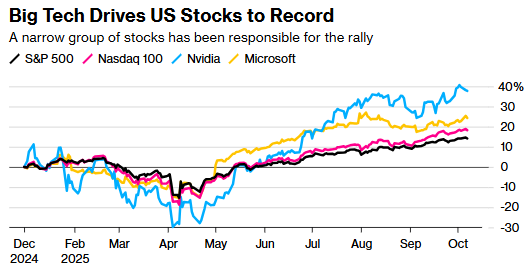
Although relevant indicators recently released by financial institutions such as Goldman Sachs and Barclays Bank show that investors are still optimistic about the prospects for further stock growth, some market participants have become cautious about the returns brought about by large-scale investment in the field of artificial intelligence.
On Tuesday, the Nasdaq 100 index, which is dominated by technology stocks, fell after reports said that the profit margin of Oracle's (ORCL.US) cloud computing business fell short of market expectations. Meanwhile, data shows that the number of references to “technology” and “bubbles” in news reports has increased dramatically in recent weeks.
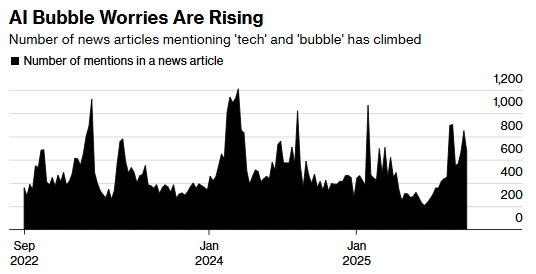
Valuations are also rising. The Nasdaq 100 has a price-earnings ratio of 28 times future earnings, while its 10-year average price-earnings ratio is 23 times. The price-earnings ratio of the Global Composite Index excluding the US is 15 times.
Oppenheimer said a bubble occurs when the average value of a company exceeds the expected value of its future cash flow. He pointed out that the best-performing tech stocks this time “have unusually strong balance sheets.” Furthermore, he wrote that the general rise in stock and credit market valuations means “this is not just about a bubble in the tech sector, but more about overall conditions such as low interest rates, high global savings rates, and long-term economic cycles.”
Oppenheimer said, “This will indeed put them under pressure to adjust when confidence in expectations of economic growth falters, but it is unlikely that this situation is simply due to the bursting of the tech bubble.”
The strategist took a position contrary to mainstream views in 2024, advising investors to shift capital from expensive US stocks to underperforming international markets. This year, the performance of the S&P 500 Index lags behind the MSCI Global Index (excluding the US market).