
Eli Lilly Stock: A Deep Dive Into Analyst Perspectives (11 Ratings)
Analysts' ratings for Eli Lilly (NYSE:LLY) over the last quarter vary from bullish to bearish, as provided by 11 analysts.
Summarizing their recent assessments, the table below illustrates the evolving sentiments in the past 30 days and compares them to the preceding months.
| Bullish | Somewhat Bullish | Indifferent | Somewhat Bearish | Bearish | |
|---|---|---|---|---|---|
| Total Ratings | 4 | 5 | 2 | 0 | 0 |
| Last 30D | 0 | 1 | 0 | 0 | 0 |
| 1M Ago | 0 | 1 | 1 | 0 | 0 |
| 2M Ago | 3 | 2 | 1 | 0 | 0 |
| 3M Ago | 1 | 1 | 0 | 0 | 0 |
Analysts have set 12-month price targets for Eli Lilly, revealing an average target of $934.09, a high estimate of $1135.00, and a low estimate of $700.00. A negative shift in sentiment is evident as analysts have decreased the average price target by 5.9%.
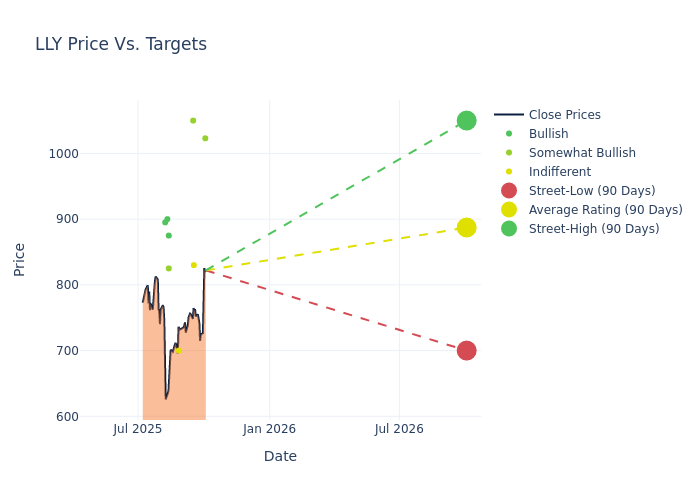
Understanding Analyst Ratings: A Comprehensive Breakdown
The analysis of recent analyst actions sheds light on the perception of Eli Lilly by financial experts. The following summary presents key analysts, their recent evaluations, and adjustments to ratings and price targets.
| Analyst | Analyst Firm | Action Taken | Rating | Current Price Target | Prior Price Target |
|---|---|---|---|---|---|
| Terence Flynn | Morgan Stanley | Lowers | Overweight | $1023.00 | $1028.00 |
| Kerry Holford | Berenberg | Lowers | Hold | $830.00 | $970.00 |
| Chris Schott | JP Morgan | Lowers | Overweight | $1050.00 | $1100.00 |
| Rajesh Kumar | HSBC | Raises | Hold | $700.00 | $675.00 |
| Carter Gould | Cantor Fitzgerald | Lowers | Overweight | $825.00 | $975.00 |
| Seamus Fernandez | Guggenheim | Lowers | Buy | $875.00 | $942.00 |
| James Shin | Deutsche Bank | Lowers | Buy | $900.00 | $1010.00 |
| Chris Schott | JP Morgan | Maintains | Overweight | $1100.00 | $1100.00 |
| Trung Huynh | UBS | Lowers | Buy | $895.00 | $1050.00 |
| Seamus Fernandez | Guggenheim | Raises | Buy | $942.00 | $936.00 |
| Terence Flynn | Morgan Stanley | Raises | Overweight | $1135.00 | $1133.00 |
Key Insights:
- Action Taken: Analysts adapt their recommendations to changing market conditions and company performance. Whether they 'Maintain', 'Raise' or 'Lower' their stance, it reflects their response to recent developments related to Eli Lilly. This information provides a snapshot of how analysts perceive the current state of the company.
- Rating: Gaining insights, analysts provide qualitative assessments, ranging from 'Outperform' to 'Underperform'. These ratings reflect expectations for the relative performance of Eli Lilly compared to the broader market.
- Price Targets: Analysts provide insights into price targets, offering estimates for the future value of Eli Lilly's stock. This comparison reveals trends in analysts' expectations over time.
Assessing these analyst evaluations alongside crucial financial indicators can provide a comprehensive overview of Eli Lilly's market position. Stay informed and make well-judged decisions with the assistance of our Ratings Table.
Stay up to date on Eli Lilly analyst ratings.
Discovering Eli Lilly: A Closer Look
Eli Lilly is a drug firm with a focus on neuroscience, cardiometabolic, cancer, and immunology. Lilly's key products include Verzenio for cancer; Mounjaro, Zepbound, Jardiance, Trulicity, Humalog, and Humulin for cardiometabolic; and Taltz and Olumiant for immunology.
A Deep Dive into Eli Lilly's Financials
Market Capitalization: Surpassing industry standards, the company's market capitalization asserts its dominance in terms of size, suggesting a robust market position.
Revenue Growth: Eli Lilly displayed positive results in 3M. As of 30 June, 2025, the company achieved a solid revenue growth rate of approximately 37.64%. This indicates a notable increase in the company's top-line earnings. As compared to its peers, the company achieved a growth rate higher than the average among peers in Health Care sector.
Net Margin: Eli Lilly's financial strength is reflected in its exceptional net margin, which exceeds industry averages. With a remarkable net margin of 36.38%, the company showcases strong profitability and effective cost management.
Return on Equity (ROE): Eli Lilly's ROE surpasses industry standards, highlighting the company's exceptional financial performance. With an impressive 33.26% ROE, the company effectively utilizes shareholder equity capital.
Return on Assets (ROA): The company's ROA is a standout performer, exceeding industry averages. With an impressive ROA of 5.95%, the company showcases effective utilization of assets.
Debt Management: The company faces challenges in debt management with a debt-to-equity ratio higher than the industry average. With a ratio of 2.18, caution is advised due to increased financial risk.
How Are Analyst Ratings Determined?
Benzinga tracks 150 analyst firms and reports on their stock expectations. Analysts typically arrive at their conclusions by predicting how much money a company will make in the future, usually the upcoming five years, and how risky or predictable that company's revenue streams are.
Analysts attend company conference calls and meetings, research company financial statements, and communicate with insiders to publish their ratings on stocks. Analysts typically rate each stock once per quarter or whenever the company has a major update.
Some analysts publish their predictions for metrics such as growth estimates, earnings, and revenue to provide additional guidance with their ratings. When using analyst ratings, it is important to keep in mind that stock and sector analysts are also human and are only offering their opinions to investors.
Breaking: Wall Street's Next Big Mover
Benzinga's #1 analyst just identified a stock poised for explosive growth. This under-the-radar company could surge 200%+ as major market shifts unfold. Click here for urgent details.
This article was generated by Benzinga's automated content engine and reviewed by an editor.