Embodied AI opens up $402 billion market opportunity! UBS explains “Beyond AI” investment strategy in detail
The Zhitong Finance App learned that UBS recently released a research report saying that artificial intelligence (AI) is driving the rapid development of autonomous systems, such as humanoid robots, advanced driver assistance systems (ADAS), robotaxis (robotaxis), and is transforming traditional industries including aerospace, agriculture, smart glasses, and healthcare. Notably, the advent of vision-language-action (VLA) models represented a transformative turning point for robots and ADAS, as they enabled systems to directly translate sensory input and natural language instructions into motor behavior.
According to UBS, an aging population and shrinking workforce provide scalable opportunities for embodied AI (embodied AI) applications, such as humanoid robots and other forms of autonomous automation. The current backflow trend is reshaping the global manufacturing industry. Against the backdrop of anti-immigrant sentiment, high labor costs coexist with labor scarcity. According to the bank, this has accelerated the need for rapid adoption of physical AI solutions that require almost no human intervention.
UBS predicts that market opportunities driven by the AI vertical industry will reach US$402 billion. The bank believes that the highest growth opportunities are in humanoid robots, ADAS, robotic taxis, and segments such as industrial automation, agricultural technology, smart glasses, robotic surgery, and drones. Humanoid robots and automation can largely operate independently, and can be a new, complementary source of alpha that has not yet been captured by existing TRIO investment strategies.
The embryonic stage of high-growth market opportunities
Historically, Moore's Law believed that chip processing capacity would double every 18-24 months. However, at present, the progress of AI is doubling every seven months, triggering an “AI in motion” trend across industries. Investors should consider broadly deploying “embodied AI” vertical industries driven by AI acceleration.
UBS sees the highest growth opportunities in humanoid robots, ADAS, and robotic taxis, as well as segments such as drones, agricultural technology, smart glasses, and robotic surgery. The bank conservatively estimates that the total target market (TAM) for humanoid robots and automation will reach US$402 billion within ten years, with a compound annual growth rate of 11%.
Specifically, UBS predicts that by 2035, the global humanoid robot TAM will reach 40 billion US dollars, global automation hardware TAM will reach 100 billion US dollars, ADAS (including fully autonomous FSD) TAM will reach 88 billion US dollars, and robot taxi TAM will reach 40 billion US dollars. In addition, other AI-driven industries, including agricultural technology, robotic surgery, electric vertical take-off and landing vehicles (EVTOL), and smart glasses, are expected to grow at a compound annual rate of 23%, and TAM will reach US$134 billion in 2035.
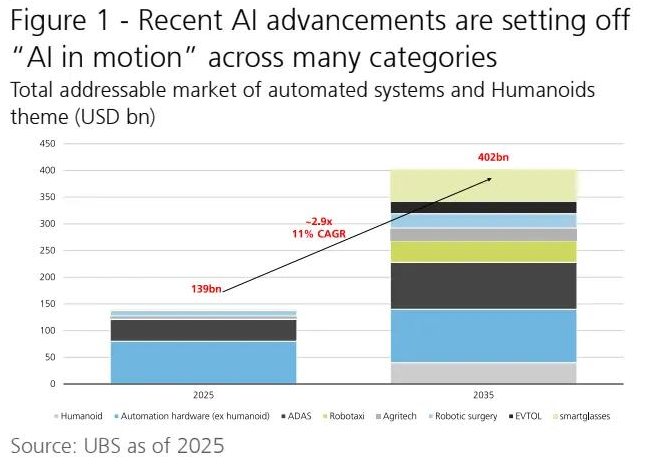
Advances in AI catalyze the development of autonomous systems
Industrial robotics and advanced industrial automation have been around for decades. However, at the beginning of the 21st century, autonomous drones and other forms of autonomous driving mobile tools appeared, and major breakthroughs in processing power and AI have recently been achieved. Today, these autonomous systems vertical industries share many characteristics: overlapping hardware and software supply chains (relying on advanced semiconductors), reliance on training and data collection, and the need for evolving regulatory frameworks to maximize commercialization.
Electrification drives autonomous driving
UBS expects the revenue pool for private vehicle ADAS to reach $88 billion by 2035, mainly driven by China — its electric vehicle penetration rate has reached 50%. This forecast is based on advances in L4 technology, lower vehicle costs, and increased consumer adoption. In China, the high penetration rate of electric vehicles has driven the rapid adoption of ADAS — the L2+ smart driving penetration rate rose from 24% in 2021 to 35% in 2022, and further to 52% in 2023. Given the low penetration rate of electric vehicles around the world, it is expected that ADAS popularity outside of China will be slower, so China will still dominate the global ADAS market in 2035. Furthermore, the bank expects a long-term TAM of $40 billion for robotic taxis, which may be an area of slow progress in autonomous systems due to reliance on mature L4 ADAS and regulatory frameworks.
Humanoid robots are nearing an inflection point in growth
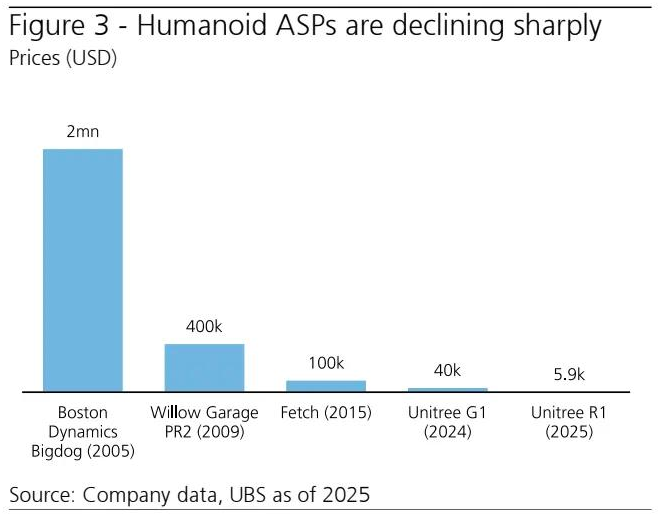
UBS predicts that by 2035, the number of human-like robots worldwide will exceed 2 million, and by 2050, the corresponding TAM will be 40 billion US dollars and 1.4-1.7 trillion US dollars, respectively, covering the complete ecosystem of parts and machine manufacturers, software and data, production and services. Humanoid robots can walk, sense, and complete simple tasks, but to be commercially viable, they must be more efficient than human workers — the bank believes this development is expected to be realized in this decade.
Simple “2B” robots can be used in factory assembly lines, such as sorting items and handling parts. Tesla CEO Elon Musk intends to use Optimus robots in factories to replace blue-collar workers on “boring, repetitive, or dangerous tasks,” and then sell them to third parties. In addition to factories, 2B robots can also perform simple tasks in fast food chains, restaurants, logistics, security, or surveillance. More advanced “2C” general-purpose humanoid robots will be able to understand instructions and make decisions. They are expected to become the core of global TAM growth after 2035. Application scenarios include hospitals, healthcare, retail, and homes.
Integration of autonomous system supply chains
UBS believes that a comprehensive understanding of the development of different autonomous systems is necessary to evaluate the value and growth prospects of related supply chains. The trend from electrification to intelligent/autonomous driving at the beginning of this decade triggered an increase in demand for in-vehicle electronics (such as autonomous driving domain controllers, high-performance chips, lidars, etc.). “Vision-Language-Movement” (VLA) technology is being applied to ADAS and humanoid robots, driving demand for high-performance chips, power management chips, motion control chips, communication ICs, and lidars. 80% of robot joint components (harmonics, planetary reducers) are produced by auto parts companies, making the hardware supply chains of automobiles and human-like robots highly overlapping. Both have also become important demand drivers for smart glasses. Intelligent autonomous systems also require data collection and training. For example, FSD vehicles and humanoid robot training all use simulation data to create requirements for computational models and AI algorithms.
From edge AI to sensor fusion: semiconductor opportunities
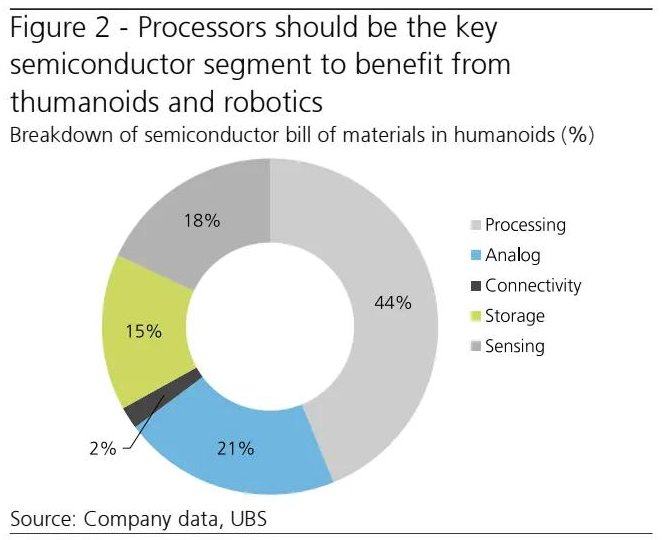
UBS said that semiconductors will be the biggest beneficiaries of the increased computational strength of humanoid robots. Humanoid robots rely on edge SoCs (system-level chips), combined with CPUs, GPUs, and NPUs to support real-time sensing, planning, and control. The next-generation design incorporates device-side language models for natural command and reasoning; advanced sensor fusion (multi-camera, LiDAR, IMU) enables target recognition and dynamic navigation capabilities. The SoC market is dominated by Nvidia, Qualcomm, Huawei, AMD/Xilinx, and MediaTek, Horizon, and Alchip are emerging companies. Tesla, on the other hand, used car hardware and the self-developed Grok model for the Optimus. In addition to processors, robots require extensive DRAM and SSD execution models and telemetry, as well as motor control units (MCUs). Overall, the bank estimates that each high-end humanoid robot would require about $1,400 worth of semiconductors.
Smart glasses: near the inflection point
Smart glasses previously remained on the edge for a long time, but benefiting from mature technology, rising consumer interest, and cross-border cooperation, the market will enter a new phase in 2025. The mature supply chain drove the average selling price (ASP) of smart glasses to about 400 US dollars, down 70% from when Google Glass was released in 2013. Additionally, tech companies are collaborating with fashion brands (such as Meta+Ray-Ban, Google+Warby Parker) to accelerate popularity. Generative AI expands application scenarios, including real-time translation, virtual assistants, and location identification. The bank expects Meta, Google, Snap, and Apple to launch products in 2026. The market size is 1 billion US dollars in 2025, and is expected to reach 60 billion US dollars by 2035, and the number of users will reach 320 million.
Investing in the next agricultural revolution: AI and future agriculture
According to UBS, more than half of the world's habitable land is already used for agriculture, but by 2050, grain production needs to be increased by 60% to feed about 10 billion people. At that time, it is estimated that there will be a 1.4 billion ton food gap, equivalent to 23% of global demand. Therefore, it is necessary to rely on autonomous machines, AI, and digital platforms to increase productivity. Fully automated equipment such as harvesters can be operated without manual operation to optimize operation and reduce costs; AI-driven spraying systems and robot units provide accurate application and reduce chemical use; data platforms integrate satellite, drone, and sensor data to guide efficient farming. AI can also help accelerate crop protection research and development, and model molecular interactions to achieve faster, more sustainable solutions.
AI-enhanced robotic surgery
Robotic surgery has expanded from urology and gynecology to cardiac, digestive, and neurosurgery, improving doctors' accuracy and flexibility. According to data from the International Federation of Robotics, 6,200 new medical robots will be shipped in 2024, an increase of 36% over the previous year. Generative AI promotes wider adoption: personalized 3D models can be generated before surgery, real-time error detection and process guidance can be performed during surgery, and tissue deformation and hemodynamics can also be predicted. Patient demand for minimally invasive surgery is rising, and robot-assisted surgery has the advantages of small incisions, less pain, less bleeding, fewer complications, and faster recovery. AI can also accelerate doctors' learning through immersive virtual training.
The future of urban air mobility
Electric vertical take-off and landing vehicles (EVTOL) are nearing commercialization, particularly in China, receiving policy support. Technological breakthroughs (high-density batteries, autonomous flight, distributed electric propulsion) have enabled it to operate safely, quietly, and at low cost. The initial application is expected to be in air travel, which may be 65% cheaper than helicopter tours by 2030. As the infrastructure matures, it will expand to urban air travel, emergency response, and regional logistics. UBS expects the global EVTOL market to reach 23 billion US dollars in 2035.
Invest in “Beyond Al”
An aging population and labor shortage are creating an unprecedented gap in global manufacturing and service industries, which has accelerated the demand for human-like robots and other physical AI. The VLA model acts as a catalyst, enabling the system to directly transform sensory and language input into action. In addition to humanoid robots, technological maturity in fields such as ADAS, robotic taxis, EVTOL, and robotic surgery is also driving regulatory inflection points and becoming a growth engine.
UBS advises investors to lay out a broad range of AI vertical industries, including humanoid robots, ADAS, robotic taxis, and segments such as industrial automation, agricultural technology, smart glasses, robotic surgery, and drones. The humanoid robot ecosystem includes chip vendors, software developers, component manufacturers, automakers, automobile companies, ADAS developers, battery manufacturers, and end users. System integrators in agriculture, healthcare, smart glasses, and drones also offer high-risk, high-reward opportunities. In the medium term, industries using these technologies are expected to experience significant productivity gains and profit improvements, particularly in labor-scarce developed economies, where services and healthcare will be the first to benefit.
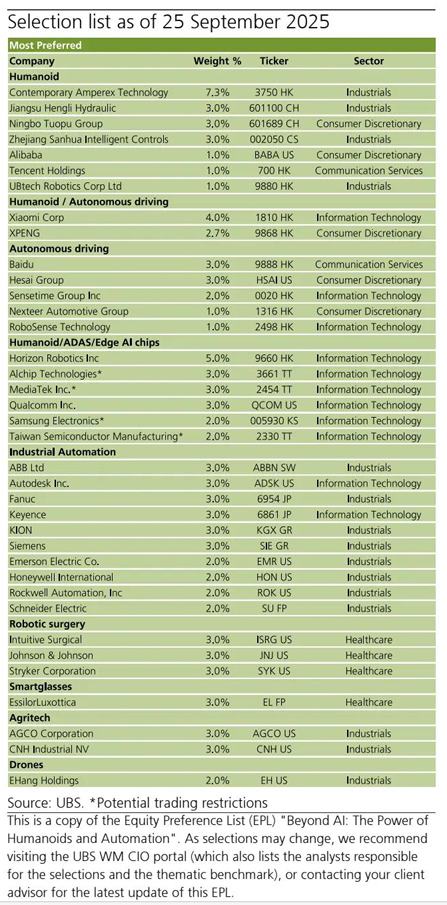
UBS indicated that its theme portfolio includes 38 stocks, including American listed companies such as Alibaba (BABA.US), HSAI.US, Autodesk (ADSK.US), Emerson Electric (EMR.US), Honeywell (HON.US), Rockwell Automation (ROK.US), Intuitive Surgery (ISRG.US), Johnson & Johnson (JNJ.US), and SYK.US (SYK.US).
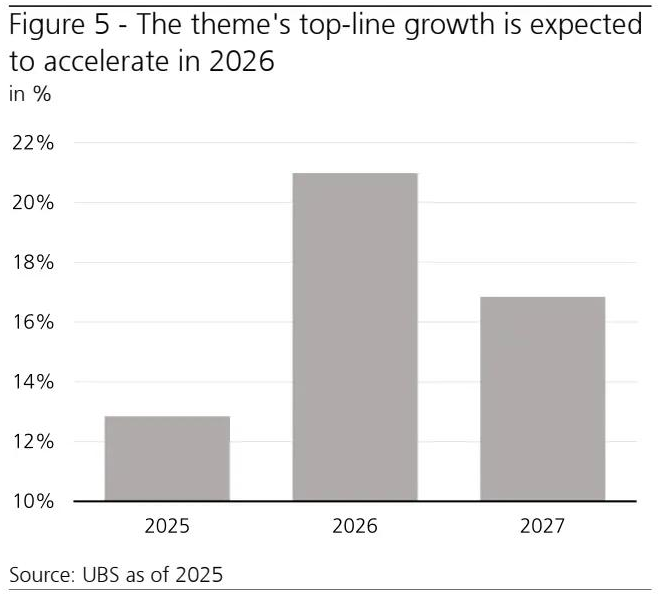
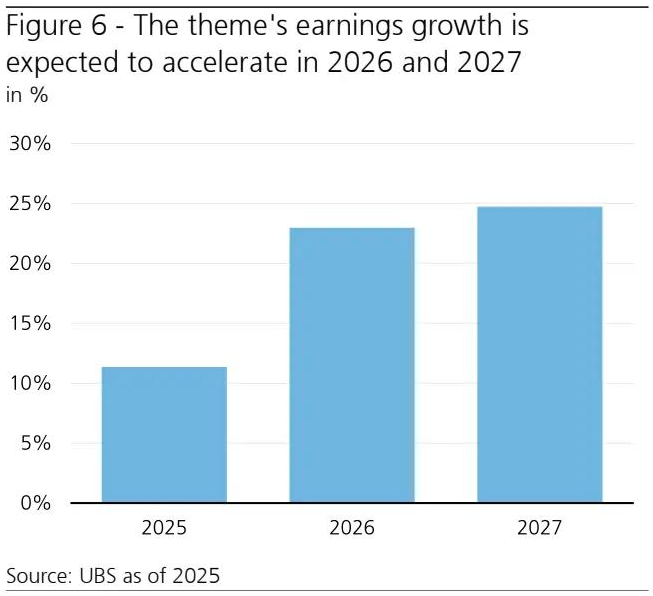
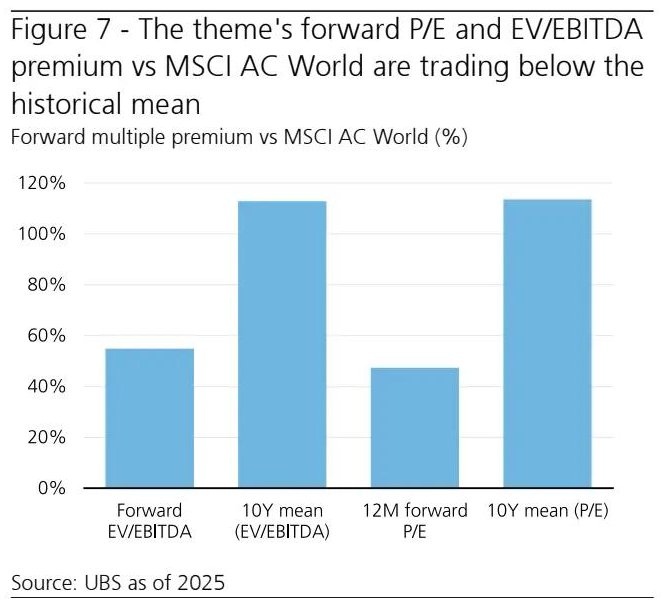
UBS added that this theme combination is different from other global theme strategies, and the tracking error is higher than MSCI ACWI, reflecting an intentional differentiated configuration. The bank expects that the stock portfolio's revenue and profit growth will accelerate again next year, achieving two consecutive years of accelerated profits. In terms of valuation, the expected price-earnings ratio premium of the stock portfolio compared to global stock markets is below the ten-year average. At the macro level, the Federal Reserve's continued interest rate cuts also constituted a supporting factor.