
The AI boom spread from HBM to traditional storage, and South Korea's chip stocks ushered in a “supercycle”?
The Zhitong Finance App learned that the stock prices of South Korea's two major chipmakers rose sharply this month, and their market capitalization increased by more than 100 billion US dollars. This rise is expected to continue, as the AI boom is spreading to the lesser areas of the tech sector. Analysts raised the target value of the won exchange rate by about 30% this quarter. Morgan Stanley predicts that the memory market will enter a “supercycle” due to an imbalance between supply and demand that will occur next year. Despite this, these stocks are still considered relatively low in price, and investment activity with overseas capital is also expected to increase.
As SK Hynix achieved significant growth due to its dominant position in the HBM chip field (these chips are a key component of artificial intelligence applications), its larger competitor Samsung Electronics also stepped up to catch up. At the same time, in addition to Nvidia (NVDA.US), demand from more and more AI processor manufacturers is also increasing, and the knock-on effect is spreading to the field of old technology chips that were previously thought to have no market.
Gary Tan, portfolio manager at Allspring Global Investments, said, “We expect foreign capital to continue to flow into Korean chip stocks. The fundamental reason why these stocks are so promising is that large-scale AI infrastructure construction in the US is progressing, and this process is supported by huge capital expenditure announcements issued by major technology companies.”
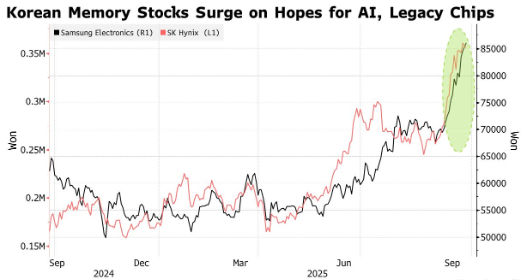
Leading artificial intelligence processor manufacturer Nvidia continues to buy the most advanced HBM chips in large quantities. Meanwhile, Nvidia's ADI.US (ADI.US) and Broadcom (AVGO.US) are also expected to increase procurement efforts as their accelerators win more customers. According to Tan, China's growing demand should bring additional “favorable” factors as domestic artificial intelligence chips increasingly use HBM technology.
Meanwhile, pessimism about “old” DRAM and NAND chips is gradually fading away. Just earlier this year, when the AI boom was driving chip stocks to rise sharply, cautious experts warned that other semiconductor sectors were being hit by the weakness of the smartphone and car markets.
However, these general-purpose storage products are expected to be in short supply in 2026 as chipmakers shift production capacity to more profitable HBM products. This will help drive up DRAM and NAND prices. Furthermore, the Federal Reserve's interest rate cuts may help support the growth of the world's largest economy, thereby boosting sales.
Jung In Yun, CEO of Fibonacci Asset Management Global, said, “As the Federal Reserve has begun a cycle of interest rate cuts, the rise in artificial intelligence chip stocks is recovering. It is expected that Korean companies will continue to attract foreign capital inflows because their valuation is lower than that of American companies.”
Even though the stock price rose by 24% this month, Samsung's stock price-earnings ratio is still 14 times (based on expected future earnings). While SK Hynix's share price soared 33% in September, the price-earnings ratio was only 7 times. By contrast, the price-earnings ratio of major US chipmakers is about 26 times.
The influx of foreign investors enabled the two Korean memory makers to record their biggest monthly capital inflows in more than 13 years. However, their market capitalization is still considered low, partly because overseas traders think the Korean market is unfriendly to shareholders.
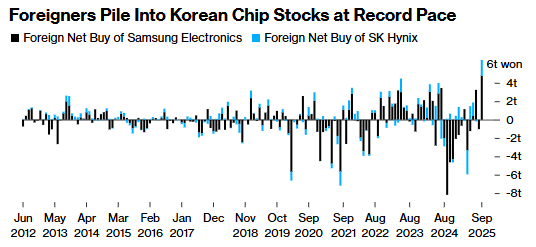
Sanjeev Rana, an analyst at CLSA Securities Korea, said, “Samsung's foreign shareholding ratio is still 7 percentage points below the previous high level (58%). Given that the strong increase in demand for artificial intelligence is occurring at the same time as the rise in demand and prices for traditional storage products, and Samsung's market-leading position in such products, we think there is still room for further improvement.”
After missing the early AI boom, Samsung's stock price is now moving towards its best monthly performance since 2001, as the market is optimistic about its HBM business in partnership with Nvidia. Analysts at 20 companies, including J.P. Morgan Chase, Citigroup, and Nomura Holdings, now expect Samsung's stock price to surpass its all-time high of 91,000 won in 2021 over the next 12 months.
Analysts have also raised their share price targets for SK Hynix. Rana anticipates that the company will maintain its market dominance in the highly profitable HBM product segment. “Memory is a key element in building artificial intelligence infrastructure, and we expect that Korean memory vendors will all benefit from the increase in capital expenditure of US cloud hyperscale enterprises, as well as the development of other companies,” said Rana.