
IPOs have become a new favorite in the market: the US IPO sector has risen by an average of 41% this year, outperforming the benchmark index by a large margin
Stock bulls seeking the next Wall Street hotspot are turning their attention to the busiest corner of the US market this year — the IPO market.
The Zhitong Finance App notes that the stock price performance of newly listed companies has significantly outperformed the benchmark index. In 2025, the weighted average performance of companies listed on the US exchange (excluding financial carriers such as blank check companies) soared by 41%. This figure is more than double the increase in the S&P 500 index and the Nasdaq 100 index.
This strong performance is generating intense interest from banks and asset management companies. Goldman Sachs Group launched a liquid IPO basket this month, which allows investors to track portfolios of companies that have been listed for more than 30 days.
The biggest IPOs are the most profitable. IPOs that raised more than $1 billion surged 77% on average, highlighting investors' preferences for scale and liquidity. High-performing companies include Circle (CRCL.US), which rose 324%, CoreWeave (CRWV.US), which rose more than 233%, and Bullish (BLSH.US), which rose 83% since listing.
Will Brautigam, head of US capital market transactions at Deloitte, said: “The performance of this year's IPO has benefited from many supporting factors, but perhaps the most important one is that success will bring more success.” He cited the positive returns of newly listed companies since 2024, the rise in retail interest, and the relative maturity of current listed companies.
Since this year, companies have raised 32 billion US dollars on the US exchange. This is a strong rebound after tariffs in April caused market turmoil due to market uncertainty. September alone became the busiest month for IPOs since 2021, as the general rise in the stock market encouraged a wave of issuance.
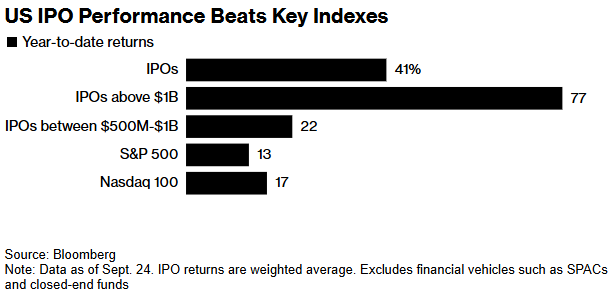
US IPOs outperformed major indices
Stefan Gruffert, global head of Deutsche Bank's equity capital market syndication group, said that capital inflows from stock funds boosted the rise in IPO stocks, which is one of a series of macro and micro factors driving the strong performance of IPOs in 2025.
“Most of the newly listed companies are in high-growth, disruptive and innovative industries,” said Gruffert. In some cases, the presence of cornerstone investors also helped. The so-called cornerstone investors agreed to buy shares during the marketing period prior to the IPO pricing.
According to Gruffat, the initial size and valuation of the release was another factor. Circle's listing is just one example. In the marketing process, as the number of stocks and price ranges increase, so does market enthusiasm. The stablecoin issuer eventually sold more shares during the IPO, and the price was higher than the already raised range. This momentum helped drive the 168% surge on the first day.
Although IPOs related to cryptocurrencies and artificial intelligence increased the most this year, the market is expanding, and companies in various industries such as fintech, defense and aerospace, education and software are going public.
What is certain is that most IPOs end up disappointing in the long run. According to research released by NASDAQ in 2021, nearly two-thirds of traditional IPO companies listed between 2010 and 2020 did not perform as well as the market after three years of listing. Of these, 64% of companies outperformed the market by more than 10 percentage points.
Despite this, IPO-focused exchange-traded funds are regaining demand. The Renaissance IPO ETF and First Trust US Equity Opportunities ETF both outperformed the S&P 500 this year, with increases of 16% and 37%, respectively.
However, capital inflows into these ETFs are still below their pre-pandemic peak. First Trust's FPX attracted $70 million in 2025. This was a reversal after four consecutive years of capital outflows, but still lower than the $145.5 million inflow in the year before the pandemic. Renaissance's IPO ETF has absorbed 3.6 million US dollars since this year, while the inflow in 2020 was 586 million US dollars.
“As IPO-focused ETFs outperform the S&P 500, we expect more capital to flow into these products,” said James Seyfat, an ETF analyst at Bloomberg Industry Research.