
The “new favorite” of US stocks suddenly changed: “Unpopular in the past” hard drives and memory stations are on the AI cusp, and the commercial performance and stock prices of established storage companies are flying in tandem
The Zhitong Finance App learned that previously, US stocks were still rising furiously for the future of high-tech artificial intelligence (AI) full of limitless imagination. Now, the “popular circuit” of the market has quietly turned to a “retro” field in the technology industry. Established technology vendors such as Seagate Technology (STX.US) and Western Digital (WDC.US) have also emerged, sparking a buzz in the market.
Established storage vendors lead US stocks with impressive gains
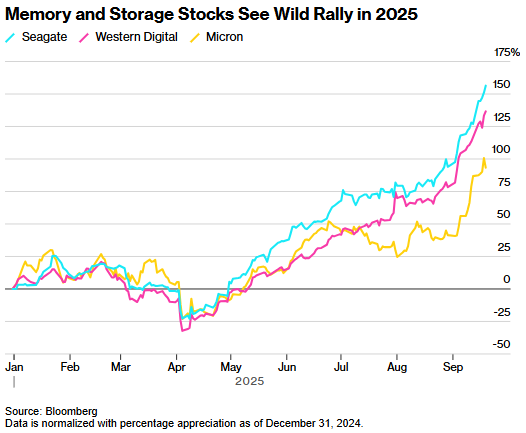
Seagate Technology, which produces computer hard disk drives (HDDs), has soared 156% since this year, making it the best-performing individual stock in the S&P 500 index. Its competitor Western Digital followed, ranking third with a 137% increase. Meanwhile, after setting a record of 12 consecutive trading days of growth, Micron Technology (MU.US), the largest memory chip maker in the US, has increased its stock price by 93% since 2025, ranking in the top five in the index.
Most of these companies have a long history and have always “kept a low profile” in the marketplace; they were founded long before Mark Zuckerberg (founder of Facebook) and Sam Ultrman (CEO of OpenAI) were born. Now, their stock prices have soared sharply. In the eyes of bullish players, this just shows that demand for AI computing devices is strong and is benefiting a wider range of business groups; however, in the view of bearers, this is the latest sign that the stock market has fallen into a bubble and is bound to burst.
“This kind of market performance is a typical characteristic of the bubble period.” Michael O'Rourke, chief market strategist at Jonestrading (Jonestrading), said. He worked as a trader in the era of the internet bubble and is familiar with such market rules: “When leading sector valuations are prohibitively high and investors begin to switch to tier 2 and 3 concept stocks, in my opinion, this means that the market is already at the very end of the cycle.”
Demand for AI infrastructure explodes, and the “unpopular track” unexpectedly benefits
Nearly three years since the introduction of ChatGPT and the global AI boom, infrastructure investment to support this technology has continued to pour in. Tech giants such as Microsoft (MSFT.US) and Alphabet (GOOGL.US) spend tens of billions of dollars every year to purchase semiconductors, network equipment, and provide power support for data centers that run AI workloads and train large-scale language models (LLM).
This huge investment has fueled the rise of chipmakers such as Nvidia (NVDA.US) and TSM.US — their market capitalization has now surpassed trillion dollars, attracting the attention of global investors. However, companies such as Seagate and Western Digital are in the midst of the AI boom, but they are in the most “inconspicuous” category.
The history of hard drives dates back to the 1950s: at the time, products could only store 5 megabytes of data, but weigh more than 2,000 pounds (about 907 kg); today, personal computers have a hard drive capacity of up to 2 terabytes, yet weigh only 1.5 pounds (about 0.68 kg) or even less. Although product forms have been iterated, the core direction of these vendors has always been to develop storage solutions — and this has become the key to training large-scale language models: the training process for such models requires processing massive amounts of data.
The same is true in the field of memory chips. The high-bandwidth DRAM memory produced by Micron is an essential component of AI computing, yet it is difficult for the company to arouse “excitement” for ordinary investors. “Every time I talk about these companies on the phone, I can imagine the other person's eyes getting sluggish.” Kim Forrest, founder of Bokeh Capital Partners (Bokeh Capital Partners), admits, “People prefer to talk about cool topics like flying cars and robot dogs.”
Is AI being overhyped? more “Unpopular sectors” are being set on fire
Forrest, a former software engineer with 20 years of asset management experience, said that her ownership of Micron shares favors its competitive advantage in the memory market; however, from a broader perspective, she believes that AI is currently being “overhyped” — similar to the development path of the Internet, and the time required to implement this technology's application scenarios will far exceed most people's expectations.
“If investors buy targets that are completely tied to AI or data centers and are betting that their performance will 'grow linearly, 'then this type of investment is bound to become a 'warning case'.” Forrest reminded.
The AI boom has also spurred other previously “silent” sectors of the stock market. Electricity producer Vistra Energy (VST.US)'s stock price rose 66% in 2023, surged 258% in 2024, and has risen 53% since 2025; chipmaker AVGO.US (AVGO.US) rose by about 100% in 2023 and 2024, rose 49% in 2025, and now has a market value of 1.6 trillion US dollars; digital storage and memory manufacturer Sandisk Corp (SNDK.US) is trending even more “crazy” this month. The stock price has risen more than 100% since September 2.
Furthermore, the established software manufacturer Oracle (ORCL.US), famous for its slow-growing database business, has now become the tenth highest company by market capitalization in the S&P 500 index due to the surge in demand for cloud computing services. On September 9, the day after Oracle released its earnings report, its stock price skyrocketed 36% in a single day, and the valuation rose to the highest level since the Internet bubble era, further sparking debate about “whether there is a bubble in the market.”
In contrast, Seagate, Western Digital, and Micron have always been the lowest-valued individual stocks in the S&P 500 index due to their cyclical nature of business and relatively low interest in the investment community. Currently, all three companies are profitable, but in the past three years, each has experienced annual losses according to US GAAP (GAAP).
At the beginning of 2025, Western Digital's expected price-earnings ratio (ratio of stock price to estimated profit) was less than 6 times, and Seagate and Micron were only about 10 times. Although valuations have increased since then, the current price-earnings ratio of the three is still lower than the S&P 500 index (the expected price-earnings ratio for the next 12 months is 23 times).
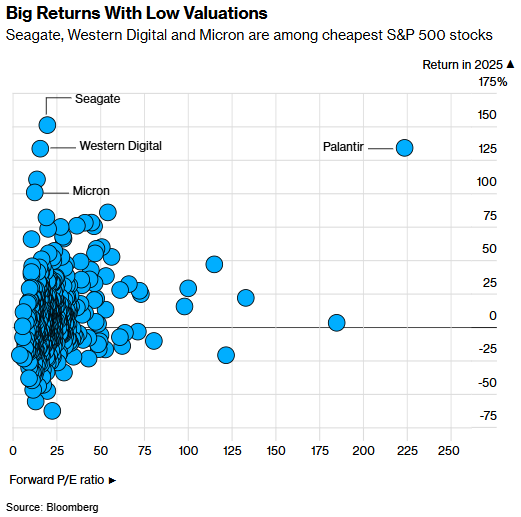
Among them, Seagate has the highest valuation, with an expected price-earnings ratio of 20 times, but Benchmark Co. analyst Mark Miller believes that considering the strong demand prospects for its products, this valuation is still very attractive. Last week, he raised Seagate's target share price to the highest level on Wall Street — $250, which means the stock still has room to rise by more than 13% compared to Friday's closing price of $221.
“We expect Seagate hard drives to continue to rise in price and profit margins, which will support a further increase in their valuation compared to historical levels.” Miller wrote in a research report last week.
According to data compiled by Bloomberg, Seagate's revenue for fiscal year 2026 (ending June of the following year) is expected to increase by 16%, lower than the 39% increase in fiscal year 2025; in line with Seagate's earnings cycle, sales for fiscal year 2025 fell 27%, and revenue for the current fiscal year is expected to increase 16%; of the three, Micron's sales prospects are the strongest. This year's revenue is expected to grow 48%, and next year's increase is expected to increase 33%.
Wall Street attitudes are divided: is it time to take profit, or is there still room?
Wall Street is generally optimistic about Seagate, Western Digital, and Micron, but since these stocks are rising too fast, analysts are too late to raise target share prices at the same time. Currently, Seagate's stock price is more than 20% higher than analysts' average target price, Western Digital is more than 10% higher, and Micron is also slightly higher than average expectations.
According to some Wall Street professionals, these signals may mean that it is time for investors to profit from these stocks.
“Judging from historical experience, the valuation of any cyclical company is usually low at peak performance and hits rock bottom when losses occur.” Jon Stredding's O'Rourke explained, “Therefore, the time to buy should be when the industry cycle is reversed and the company falls into loss; when the valuation seems' healthy ', it is often a sign of selling.”