
The rise of TSM.US helped Taiwan surpass South Korea's wealth for the first time in 20 years, and is expected to lead in GDP per capita in 2025
The Zhitong Finance App learned that the total wealth of Taiwan Province of China is expected to surpass South Korea this year. This is the first breakthrough in more than 20 years, marking the reshaping of the Asian economic landscape with the rise of TSM.US. According to the latest forecast on Thursday, Taiwan's GDP growth rate will reach 4.55% in 2025, a further increase from the statistics department's estimate of 4.45% in August. According to this growth trajectory, Taiwan Province is expected to surpass South Korea's per capita GDP one year ahead of schedule in 2025 (one year ahead of the IMF's April forecast) — the core indicator for measuring living standards. Currently, Taiwan's per capita GDP is estimated to be about 38,000 US dollars. Although it is only half of Singapore's level, it is already ahead of Japan, and the gap with South Korea is narrowing at an accelerated pace.
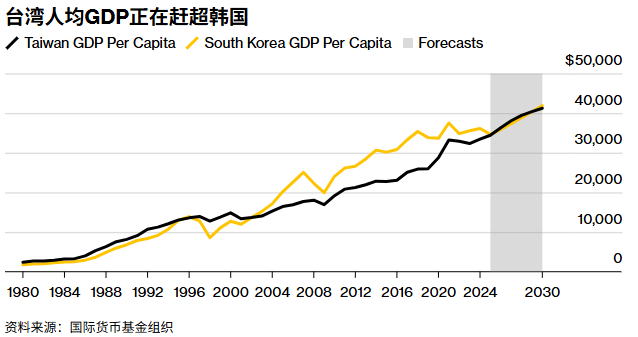
Figure 1
Behind this transformation is the strong driving force of the artificial intelligence consumption boom on the semiconductor industry in Taiwan Province. The global chip shortage during the pandemic has caused the status of Taiwanese companies to soar. From European and American politicians to corporate executives, they are looking for semiconductors to keep the economy running. Since the launch of ChatGPT, companies such as TSMC and Foxconn have experienced explosive growth. They have contracted the assembly of most of the world's key AI chips and servers.
On the other hand, South Korea's economic pillar Samsung Electronics accounts for 11% of the Korean economy, but it is gradually declining in advanced process competition. South Korea's economy grew by less than 1% year on year in the second quarter, and is expected to grow at 0.9% for the whole year. Central Bank Governor Lee Chang-yong has repeatedly warned that structural problems such as low fertility and aging have dragged the potential growth rate into the 1% range.
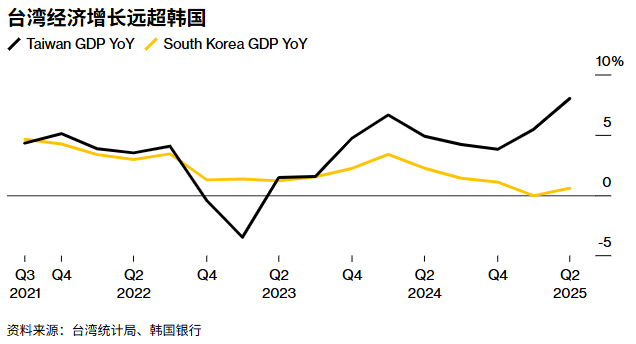
Figure 2
According to Bloomberg Economic Research, South Korea has a large industrial span and traditional sectors such as petrochemicals are sluggish, while Taiwan's high concentration of science and technology is benefiting even more from the AI boom, while South Korea is plagued by sluggish traditional industries such as petrochemicals and a deteriorating population structure. In August of this year, Taiwan surpassed South Korea's exports for the first time — a milestone that is particularly prominent, as South Korea's population and overall GDP are more than twice that of Taiwan Province.
Exporters were the first to settle settlements and market speculation that the authorities were willing to let the local currency appreciate in exchange for trade negotiations with the US and push the Taiwan dollar to appreciate about 9% against the US dollar during the year, while the won rose by only 6% during the same period, further widening the gap in GDP per capita between the two sides of the Strait.
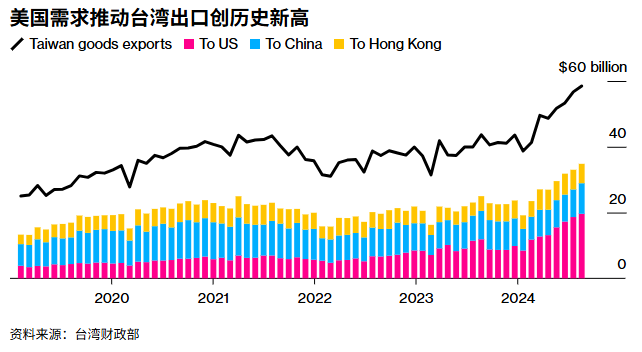
Figure 3
However, Taiwan's economy is also facing hidden worries. Overreliance on a single industry — particularly the continued expansion of America's share of exports in Taiwan Province — may turn an advantage into vulnerability, particularly in the context of Taiwan's geographical risks and strained relations with China.
Chen Woods, chief economist at Taipei Yuanda Securities, pointed out that limited resources make it difficult to diversify industries in Taiwan Province. It is necessary to promote the transformation of traditional industries into high-tech supply chains. At the same time, the government needs to explore revenue redistribution mechanisms for technology enterprises to balance development.