
The AI “money burning war” is still in full swing! AI startups swallow $122 billion to drive VC recovery on their own
The Zhitong Finance App learned that according to the latest data from market research firm BestBrokers, since the beginning of this year, global artificial intelligence startups have raised an astonishing amount of US$122 billion in venture capital capital, including US$104.3 billion in US market transactions, accounting for 85.5% of the total amount raised so far this year. “It can be said that this battle over artificial intelligence continues to heat up.” Paul Hoffman, financial expert and editor-in-chief of BestBrokers.com, said in a recent research report.
According to statistics from Dealroom, a data provider focusing on startups, global AI startups raised about 110 billion US dollars in 2024. In contrast, under the strong impetus of the increasingly heated global AI money war, AI startups such as OpenAI and Anthropic have raised more than last year since 2025.
According to investment trends compiled by BestBrokers, the total financing of global AI startups reached 50 billion US dollars in the second quarter, accounting for nearly half of the total investment of venture capital (VC) companies of about 101.5 billion US dollars during the same period.
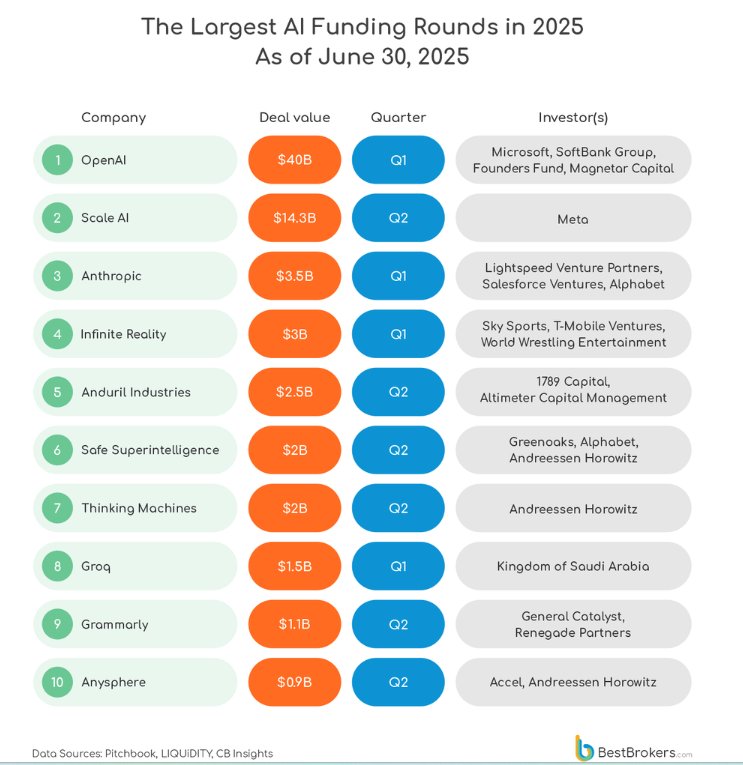
The picture above shows the largest AI startup financing round since 2025. Regarding this unprecedented global AI investment boom, the relatively cautious data is that BestBrokers analysis shows that the total investment amount associated with AI startups has dropped slightly from a record peak of US$73.1 billion in the previous quarter to US$50 billion. Despite this, it is still at an all-time high compared to previous years.
AI dominates the venture capital pattern
“The scale of AI-driven venture capital continued to expand against the trend during the two years under pressure from global venture capital. Quarterly AI financing achieved a 7.28% year-on-year increase from the same period in 2023 to the same period in 2024, up 9.26% year-on-year to the same period in 2025, and 17.22% for the two years combined.” Hoffman display.
The biggest round of funding this quarter was Facebook's and Instagram parent company Meta (META.US)'s investment of up to $14.3 billion in Scale AI. This also enabled Meta founder and CEO Mark Zuckerberg to take 49% of the company's shares, and Zuckerberg personally hired Scale AI CEO Alexandr Wang as the company's chief AI officer and appointed Alexandr Wang to lead the newly formed Meta superintelligence team ( (Meta Superintelligence Labs), a small group of Scale AI employees have also joined Meta.
Other notable startup venture capital investments include: Anduril's $2.5 billion funding round led by Peter Thiel's Founders Fund, which jumped the startup's valuation from $14 billion to $30.5 billion; and Safe Superintelligence, led by Greenoaks, Alphabet's Google Andre, and Essen Horowitz's $2 billion funding round.
According to BestBrokers's analytical report, there is a significant shift towards AI-related projects with “intensive infrastructure,” and both the public and private sectors are undertaking numerous investment plans related to artificial intelligence.
“What we are seeing is not the collapse of venture capital interest shown in previous years, but a superwave of AI investment centered on long-term construction of AI underlying infrastructure and advanced AI applications.” Hoffman display.
This trend is further supported by US President Donald Trump's $92 billion US investment package for AI and power systems, which is expected to bring larger investments in these two major areas.
Despite this, as the Federal Reserve maintains high interest rates for a long time and long-term yields on US bonds continue to be near historic highs, the overall venture capital market still faces challenges: total venture capital fell slightly to US$101.5 billion in the second quarter of 2025, slightly lower than the record US$128.4 billion in the first quarter.
“Another key factor behind the slowdown is the ongoing IPO drought: no open market exit to drive it, and venture capital institutions' ability to raise capital for new funds has also been limited.” Hoffman display.
Major AI startups such as Databricks and OpenAI chose to remain private, relying on late-stage financing and active secondary market support.
According to the BestBrokers research report, the competitive landscape shows that capital is being concentrated in the world's leading AI startups, and the world's largest advanced technology startups such as OpenAI, Anthropic, Scale AI, and Infinite Reality each received billions of dollars in financing in 2025.
This centralization has also created an uneven financing environment. Hoffman said, “For smaller AI startups, this capital concentration makes it quite difficult to obtain financing, because in the current economic environment where long-term US bond yields and benchmark interest rates are high, and capital is still tight, VCs are increasingly inclined to bet on safer choices rather than focus on potentially high-risk, high-return companies.”
Large venture capital institutions such as SoftBank Group, Andreessen Horowitz, Tiger Global, and Sequoia and Lightspeed Venture Partners continue to dominate the global AI startup financing landscape with their multi-billion dollar portfolios.
AI intelligence is sweeping the world, and will the US stock market value increase by another 16 trillion US dollars?
On August 15, Sam Altman, CEO of OpenAI, the leader of the global artificial intelligence superunicorn, said in an interview with the media that OpenAI will invest trillions of dollars in the “near future” to the core infrastructure of AI, including AI chips, high-performance data center network equipment, advanced power systems, etc., to support the operation of increasingly huge AI training/inference systems. Altman believes that in the long run, AI will be the most important thing in the world, and it is impossible for the whole society as a whole to regret investing heavily in AI.
Analyst estimates compiled by Bloomberg Intelligence show that Wall Street analysts generally expect the four major tech giants Google, Microsoft, Facebook parent company Meta, and Amazon to spend more than 350 billion US dollars this year on expanding or building new data centers centered on AI computing power infrastructure — which means they are expected to grow close to 50% year-on-year based on strong growth in 2024, and are expected to exceed 450 billion US dollars in 2026.
Morgan Stanley (Morgan Stanley) strategists recently stated that the boom in profit growth, productivity increases, and cost reduction brought about by the boom in artificial intelligence (AI) investment will add another 13 to 16 trillion dollars in value to the S&P 500 index. According to the highest value forecast given by Wall Street financial giant Morgan Stanley, this means that the market value of this benchmark index will increase by a full 30%.
Since the annual low on April 8, the S&P 500 index, the benchmark for US stocks, has soared 25% and is still hovering near its all-time high. Much of the increase was due to the frenzied rise driven by the AI boom, which propelled two tech giants — NVDA.US (NVDA.US) and Microsoft (MSFT.US) — to a record market capitalization of $4 trillion. Furthermore, steady corporate profits in the S&P 500 index also supported the optimism that Trump's chaotic trade policies did not damage previous market expectations.
The agency's strategists wrote in their latest report that their predictions don't have a specific timeline, but only assume that AI capabilities will continue to “rapidly improve” and that businesses will widely adopt artificial intelligence. On an annual basis, this could increase the net profit of large-cap companies by about $920 billion, mainly due to large-scale layoffs, cost reduction, and help generate new revenue.
According to predictive data from Daimo strategists, artificial intelligence agents (Agentic AI, which is a more advanced artificial intelligence operating system that can make decisions and actions with less supervision than generative artificial intelligence) may contribute up to 490 billion US dollars in net profit value.
Judging from the current technological trajectory, the development direction of AI application software is focused on “generative AI application software” (such as DeepSeek, ChatGPT, Sora, and Claude launched by Anthropic), and on the basis of generative AI, AI functions are shifting from chatbox-style question-and-answer to “AI agents that independently perform various complicated and complex tasks.” The urgent need for companies to improve efficiency and reduce operating costs can be described as vigorously promoting the two core categories of AI application software — generative AI applications and the widespread application of AI agents. Among them, AI agents are most likely a major trend in AI applications before 2030. The emergence of AI agents means that artificial intelligence is beginning to evolve from an information support tool to a highly intelligent productivity tool.