
Saudi Aramco is snubbed by Wall Street! Since the IPO, returns have been at the bottom, and the stock price has fallen to a five-year low
The Zhitong Finance App learned that when Saudi Aramco was on the eve of its 2019 initial public offering (IPO), senior members of the Saudi royal family said, “Those who have not subscribed will gnaw their fingers with regret”, implying that they will either buy now or miss it.
Wall Street wasn't buying it at the time. As it turns out, Wall Street didn't miss anything either. Since its IPO, the Saudi oil giant has lagged behind other oil giants, even when counting the generous dividends. According to the data, since the IPO, Saudi Aramco's total return when dividends are reinvested is only 16%, the lowest among the world's largest companies, and even lower than the sanctioned Russian oil company Rosneft. Meanwhile, ExxonMobil (XOM.US), Chevron (CVX.US), and Shell (SHEL.US) all had a total return of over 50%.
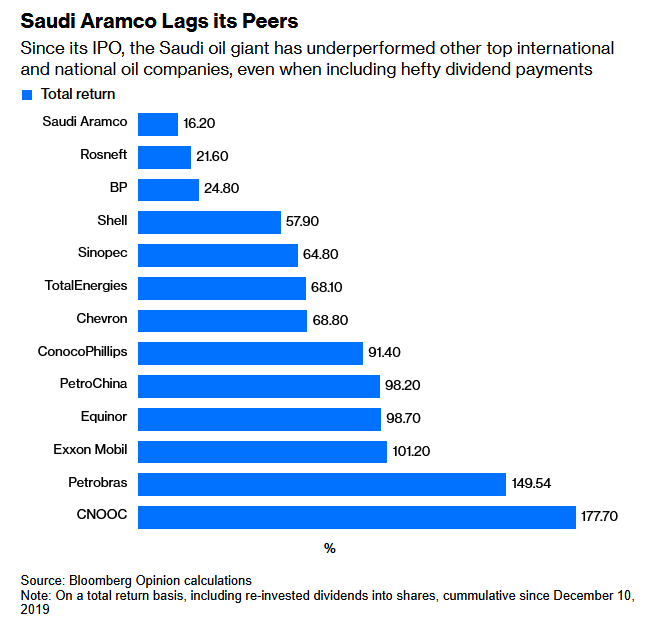
Over the past five and a half years, Saudi Aramco's stock performance has lagged behind all of its peers. Today, the company is borrowing to pay dividends, the stock price has fallen to a five-year low, and trading volume is falling, which indicates that domestic and foreign investors are shunning this stock.
The problem is that investors around the world generally believe that Saudi Aramco lacks plans to revive stock prices. After the recent shareholders' conference call, people may even feel that the company says “everything is going well.” Saudi Aramco Chief Financial Officer Ziad Al-Murshed told investors earlier this month: “We believe we present a very attractive investment opportunity.” This statement was particularly bold when the stock price fell to its lowest point since March 2020.
In the first six months of 2025, Saudi Aramco reported free cash flow of US$34.4 billion, which was insufficient to pay the dividend of US$42.7 billion for the same period. To close the gap, the company issued bonds. However, due to the low debt ratio, financing is not difficult.
Notably, Saudi Aramco claims to be the “world's lowest-cost oil producer,” but even when the average price of Brent crude oil exceeds $70 per barrel from January to June of this year (which is not low by any historical standard), it still cannot cover dividends. Imagine if oil prices fall further, Saudi Aramco's problems will be even greater. Since the second half of this year, the average price of Brent crude oil has been $69 per barrel. Admittedly, Saudi Aramco is increasing production to offset some of the price weakness, but it is still difficult to see an upward path in its stock price.
To thrive, Saudi Aramco needs higher oil prices and greater production, while cutting operating costs. But when Shell and Chevron announced thousands of layoffs to cut expenses, Saudi Aramco was increasing expenses. Ten years ago, it employed around 65,000 people. Today, according to the company's annual report, the number of employees has grown to about 75,000. The company is also spending heavily on new projects, especially given that it has abandoned plans to increase maximum production capacity over the next few years.
The Saudi oil giant's problem has always been about valuation. At the time of its 2019 IPO, Saudi Aramco was looking for a valuation of $2 trillion. After the Russian-Ukrainian conflict broke out in 2022, the company's market capitalization peaked at $2.42 trillion, but now it has fallen back to around $1.5 trillion — a massive scale, still a quarter below its original target.
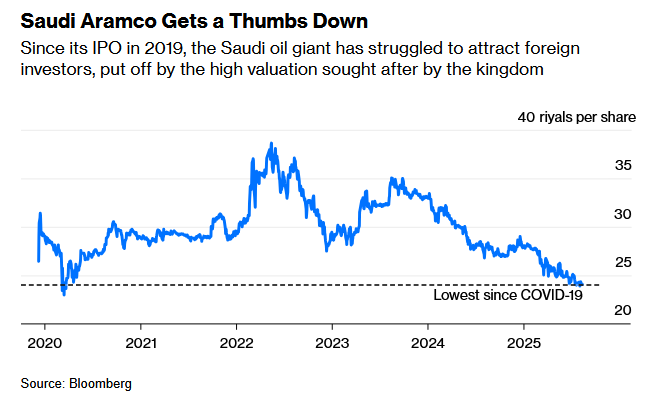
Investors who participated in the second public offering last year bought 27.5 riyals per share and now have a book loss of more than 12%. By any measure, Saudi Aramco is more of a “credit investment” opportunity — through its bonds, particularly long-term bonds of 10 and 30 years — rather than a compelling stock investment story.
Investors have learned the lesson now — it may be difficult for the Saudi authorities, as the largest shareholder, to continue selling more shares in the future. This would be a major setback for the Saudi royal family. Prior to the IPO, the Saudi authorities had discussed selling a small portion of Saudi Aramco shares every few years to raise capital. Today, it seems that the Saudi authorities may only be satisfied with financing through debt issuance.