
“Stock God” Buffett's report card will soon be revealed. UBS sings a lot: optimistic about Berkshire crossing the “August Curse”
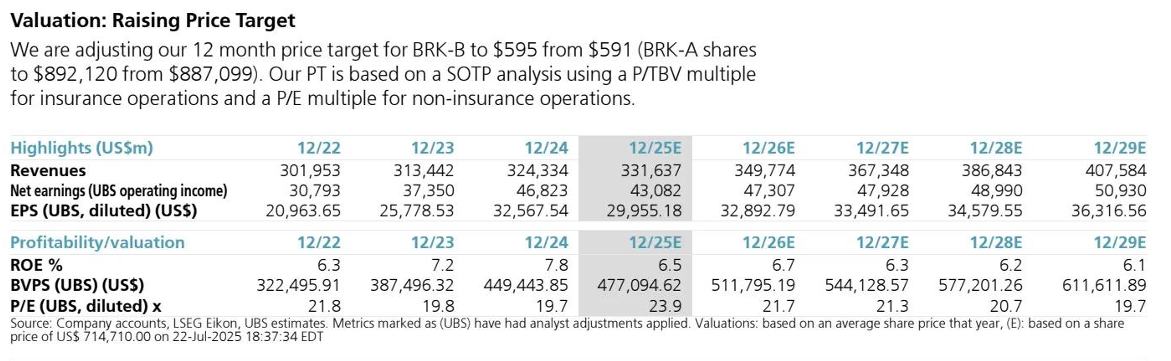
The Zhitong Finance App learned that Berkshire Hathaway (BRK.A.US) under Warren Buffett, which has the title of “stock god”, will release a performance report on Saturday. The international bank UBS (UBS) will post bullish research reports to promote the company before the results, and is betting that the investment giant headed by Buffett may break the so-called “August Curse” — it is expected that the S&P 500 index will buck the trend during the August weakness due to heavy valuation pressure, blurred economic prospects due to tariffs, and seasonal sell-offs upward. In the latest research report, UBS slightly raised Berkshire's target share price for 12 months to 595 US dollars (B shares), corresponding to about $892,120 for A shares, and reaffirmed Berkshire's “buy” rating. As of Thursday's close, Berkshire B shares closed at $471.88.
UBS said that the Berkshire Hathaway GEICO insurance business will show resilience in excess of expectations, while the BNSF railway operating margin is expected to reverse the trend. The energy and manufacturing twin engines will drive long-term stability in Berkshire's non-insurance business, and more importantly, record cash reserves — UBS expects the company's cash flow figure to rise further from an unprecedented $340 billion to about US$346 billion by the end of the year, bringing huge prospects for mergers and acquisitions, the expansion of investment scale in the stock and bond market, and room for stock buyback imagination. The outlook also fully highlights Berkshire's strong safe-haven investment attributes as a “safe haven.”
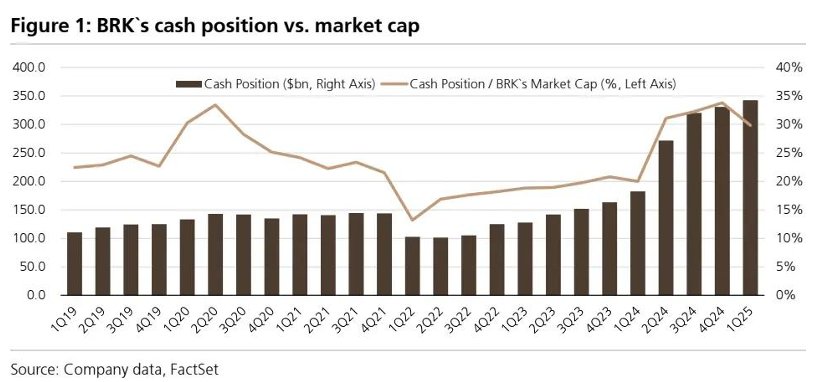
In the US stock market and even the MSCI global stock market, which has repeatedly reached new highs and entered the “August Curse” time window, which has traditionally fluctuated greatly, does Berkshire, which has record cash flow, have the potential to buck the trend and outperform the market? UBS's valuation analysis model and outlook on fundamental factors suggest that the answer tends to be positive.
Berkshire, where “stock god” Buffett is at the helm, has not only achieved huge profits in the stock market investment field for a long time, but also currently has huge cash flow to enhance safe-haven attributes, and also has a unique diversified business portfolio: on the one hand, cyclical businesses such as BNSF railways, manufacturing, and retail provide strong growth impetus when the US economy expands and improves; on the other hand, defensive sectors such as insurance, utilities, and utility energy act as a “profit ballast stone” when the economy slows down or the market declines.
In terms of the valuation model, the UBS Research Report shows that Berkshire's expected price-earnings ratio and net price-earnings ratio are in the historically low range and the overall margin of safety is sufficient, making Berkshire expected to have better anti-decline and safe-haven properties and prominent relative returns in a high valuation environment and seasonal sell-off environments. In contrast, the overall valuation of the S&P 500 index constituent stocks is already near the highest level in history due to the sharp rise in the stock prices of large technology giants such as Nvidia and Microsoft, and the pricing trend of these tech giants, which have accumulated more than 35% weight, implied that investors are overly optimistic about rising expectations. Once sentiment reverses, there will be a lot of room for fluctuation and stock price decline.
Profits in the insurance sector are expected to exceed expectations, and the steady railway business and potential merger and acquisition of CSX have attracted attention
According to the UBS Research Report, the Berkshire insurance business is expected to completely reverse the decline and usher in a strong quarter, mainly due to the recovery in GEICO's profitability and low disaster losses in the reinsurance business. After system upgrades and pricing adjustments, GEICO's comprehensive cost ratio is expected to drop to about 83% in the second quarter of 2025 (far below its target level of 96%), which will indicate a significant improvement in underwriting profits. At the same time, the number of insurance policies and premium income are expected to return to a growth trajectory (policy volume +6.5%, premium +10%). Financial reinsurance and Primary Group are also expected to benefit from low disaster claims losses, and overall underwriting profits may exceed market expectations. As a result, UBS expects the outstanding performance of the insurance sector to be the core driving force behind Berkshire's performance exceeding expectations.
The railway business is expected to run steadily, and the potential merger and acquisition of CSX has attracted attention. Berkshire's BNSF Railway has maintained stable operating efficiency in an environment of economic slowdown. Although the growth rate of freight volume in the second quarter of 2025 may slow from +5.2% in the first quarter to about +1.6% (partly affected by the decline in coal transportation), UBS expects BNSF's operating profit margin to increase by about 1.2 percentage points year on year due to lower fuel costs and layoffs and increased efficiency.
Recently, there have been major signs of consolidation in the railway industry: US rail transport leaders United Pacific (UNP.US) intend to acquire Norfolk Southern (NSC.US). UBS analysts believe this may prompt Berkshire to take defensive steps to consider buying another Eastern Railway giant, CSX. CSX currently trades at a price-earnings ratio of about 20 times the 2026 revenue. If a 25% to 35% acquisition premium is given, the transaction size is estimated to be US$82-88 billion, which is equivalent to about 24% to 26% of Berkshire's cash reserves. UBS estimates that this merger and acquisition will have a clear effect on Berkshire's profit in 2026 — assuming a reasonable synergetic growth effect, it will increase net operating profit by about 8% for the year. This potential deal will not only help BNSF expand into the US intercontinental rail network, but also effectively use Berkshire's record cash reserves to achieve a stronger business growth curve.
For “stock god” Buffett, waiting for suitable “elephant-level” acquisition opportunities to seek strong growth by leaps and bounds with huge amounts of cash is one of his investment purposes. The potential acquisition of CSX is typical of this path: if the transaction price is reasonable and there is a synergy effect, Berkshire's huge financial strength will come into play to expand the market without diluting shareholder value. At the same time, the company also maintains a high level of financial flexibility. Once there is a drastic adjustment or valuation depression in the market, Berkshire can quickly deploy cash to buy back its own stocks or bottom up high-quality global assets. This “aggressive, retractable” capital strategy is the key to Buffett's long-term success, and the UBS analyst team also highly appreciates this.
Berkshire vows to break the “August Curse”
With “stock god” Buffett at the helm, the market is expecting this investment giant ship to break the seasonal curse of the market with long-term solid fundamentals, potential mergers and acquisitions, and huge record cash flow.
Historical data shows that the biggest stock market fluctuations often occur in August. To make matters worse, August is also usually one of the two worst performing months of the year for the stock market. After setting the strongest consecutive rise since 2020, the S&P 500 index, which is valued near its highest level in history, is about to enter the “hardest period of the year” in the traditional sense.
Statistics show that in the past 30 years, the benchmark index had the lowest performance in August and September, with an average decline of 0.7%, while the average increase in other months was 1.1%. Analysts generally believe that part of this seasonal sell-off is due to fund managers usually re-evaluating their portfolios throughout the year during this period. This year, during the sensitive August-September window, Trump's tariff news, economic data, the Federal Reserve's interest rate path, or any havoc at the level of corporate earnings could trigger a sharp sell-off in the stock market.
In the current environment where US stocks are extremely high and concerns about volatility are gradually rising, Berkshire, where Buffett is at the helm, is expected to show attributes that are relatively resistant to falling and surpassing market performance with long-term stable fundamentals, undervaluation premiums, defensive asset allocation, and extremely abundant strategic cash reserves and a merger and acquisition market with huge room for imagination. As market sentiment shifts from bliss to prudence, this “Omaha giant whale” may swim more calmly through turbulent waves with deep intrinsic value and flexible financial and capital operations.
Berkshire's long-term diversified layout means that regardless of whether the macro environment is good or bad, Berkshire's business sectors benefit, thus showing steady profitability throughout the economic cycle. As UBS said, if the US economy is booming, manufacturing and railway businesses take off smoothly; if the economy slows down, record cash flow, insurance business, and huge balance sheets become defensive shields, underpinning the company's performance. This kind of offensive and defensive physique makes Berkshire relatively calm under different market conditions. In particular, the “safe haven” attribute has the fundamental foundation to outperform the market during times of sharp market fluctuations and weakness.
Berkshire's stock portfolio and wholly-owned subsidiary business are biased towards industry leaders with steady cash flow and deep moats. For example, the top ten holding companies, such as Apple, Coca Cola, and American Express, have strong profitability, high risk resistance, and huge cash reserves; core assets such as insurance, utilities, energy pipelines, and railway transportation have stable income characteristics. This investment style and diversified business layout determine that Berkshire's overall volatility is far lower than the market, and often has excess alpha investment returns during periods of market weakness.