
The health insurance cost dilemma is difficult to solve United Health (UNH.US) profit guidelines “dive” and stock prices fall
The Zhitong Finance App learned that UnitedHealth (UNH.US) announced annual profit guidelines that fell short of expectations in its second-quarter earnings report, which caused the healthcare giant to once again suffer setbacks in its efforts to regain investor confidence.
The company currently expects adjusted earnings per share in 2025 to be no less than $16, far below the analysts' average forecast of $20.40; revenue will be between $44.5 billion and $448 billion, and analysts' expectations of US$449.16 billion.
This medical giant, known for its steady growth in performance, was shocked by Wall Street when it unexpectedly withdrew its performance guidelines at the beginning of this year due to surging medical costs. However, the lower-than-expected performance indicators reflect the current difficulties faced by UnitedHealth: the failure to accurately predict the upward trend in costs in the first half of the year may result in its adjusted earnings per share falling for the first time since 2008.
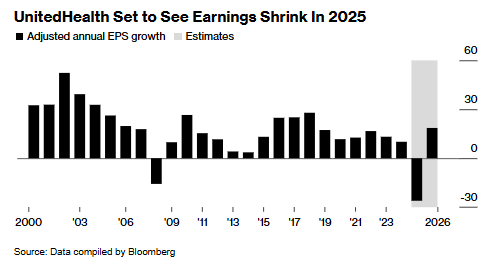
According to information, the company expected adjusted earnings per share of 26 to 26.50 US dollars in April this year, but the guidelines were completely withdrawn the following month. This range has been drastically reduced from the original target for 2025 ($29.50-$30) set at the end of last year.
The company had an emergency change of command in May, and former CEO Stephen Hemsley, the current chairman of the board of directors, was taken back in charge. Management promised at the time that growth would resume in 2026 and return to the long-term target of an average annual increase of 13%-16% in earnings per share. In this financial report, UnitedHealth once again reiterated expectations for a recovery in 2026 performance.
However, UnitedHealth's decline in the first quarter actually already predicted the impact the entire health insurance industry was about to face. Competitors such as Elevance Health (ELV.US), Consigo (CNC.US), Molina Healthcare (MOH.US), and Oscar Health (OSCR.US) have lowered or withdrawn their performance guidelines, blaming them on problems with Medicaid (Medicaid), the Affordable Care Act market, and government health insurance programs such as federal Medicare (Medicare).
The current medical needs of Americans far exceed the expectations of insurance companies when they set premiums last year. Meanwhile, some government health insurance programs are tightening subsidy eligibility criteria and squeezing insurers' profit margins through payment formulae adjustments.
In the future, the outlook for the industry will become more serious: the Affordable Care Act will expire next year (unless extended by Congress); the Republican-backed budget passed this month will cut Medicaid funding by nearly a trillion dollars, which is expected to increase the number of people without health insurance by 10 million over the next ten years.
At a time when insurers were already facing cost forecasting difficulties, the US government's policy shocks followed one after another. According to the data, UnitedHealth, ConsiCo, and Molina Healthcare all ranked among the five worst performing companies in the S&P 500 index during the year.
Although management says the current predicament is only temporary, they are convinced that the industry will return to its historical profit growth trajectory. But Wall Street is concerned about whether the US government's policy shift to lower medical costs and reduce health insurance coverage will pose a more lasting threat to the profitability of the industry.
The latest financial report shows that UnitedHealth is also facing the Affordable Care Act business issues plaguing the entire industry. The company calculated reserves related to “speeding up confirmation of future losses” for the second half of the year. Second-quarter results were also unsatisfactory. Earnings per share of $4.08 were lower than analysts' estimates of $4.59, and revenue was US$111.62 billion, which was only slightly higher than market expectations of US$111.52 billion. However, the much-publicized medical reimbursement rate indicators are generally in line with expectations.
Looking at the breakdown, the profit of Optum Health's clinic and home care business declined significantly year-on-year, mainly due to increased medical treatment volume, pricing errors, and cuts in federal health insurance funding. This business has previously been the Group's fastest-growing source of profit.
Also worth noting is that just a few days before the report was released, UnitedHealth confirmed that it was cooperating with the US Department of Justice's investigation into its federal health insurance billing operations.
After the financial report was announced, the company's stock price fell sharply by 6.7% before the market on Tuesday. Since this year, due to factors such as the Ministry of Justice's investigation and suspension of performance guidelines, UnitedHealth's stock price has fallen by more than 44% cumulatively.