
The leveraged financing sign faded: Deutsche Bank (DB.US)'s market share shrunk to 3.6%, falling out of the top five in the world during the year
The Zhitong Finance App notes that Deutsche Bank (DB.US) is losing its advantage in leveraged financing transactions. When the bank attempted to underwrite $4.3 billion in debt for a private equity firm that bought two gaming companies, investors reacted lukewarm.
The German bank eventually had to improve terms to facilitate the deal — not only providing investors with more favorable pricing, but also adding risk protection mechanisms. The deal aims to support Apollo Global Management and gambling machine company Everi Holdings Inc.'s joint acquisition of a division of International Game Technology Plc (International Game Technology Plc). This is not the only troubled leveraged financing deal recently overseen by Deutsche Bank.
People familiar with the matter revealed that this financial institution, which was once in the top five in the industry, has continued to decline in market share over the past few years due to CEO Christian Zewin's strategic adjustments and regulatory contraction requirements, and is mired in many problematic transactions.
According to the data, the bank's ranking in the field of leveraged financing has fallen to eighth place this year, dominating only 3.6% of global transactions, which is far from the peak period of accounting for 9% of the market share in 2014.
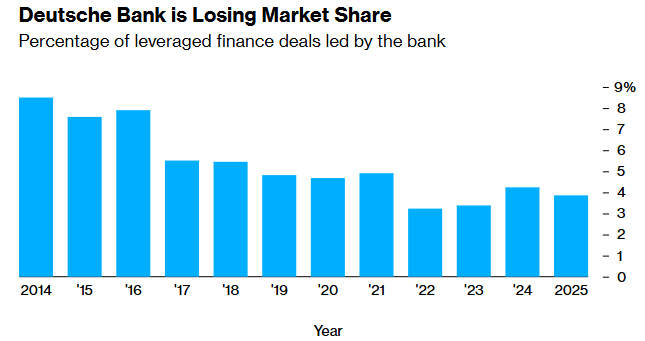
Deutsche Bank is losing market share
The revenue trajectory is also declining — estimated revenue in Europe plummeted 35% to 74 million euros (86 million US dollars) in the first half of 2025, and the US market fell 27% to 145 million US dollars.
In the recently released financial report, the decline in leveraged financing revenue is in stark contrast to impairment losses due to failure to sell bonds.
Chief Financial Officer James von Moltke confessed during the analysts' conference call, “This is a quarter where the performance of the debt capital market is weak, and it is also a particularly difficult quarter for the leveraged debt capital market.” He revealed that the bank is adjusting its strategy, particularly for high-risk transactions.
Past Glory
As a leader in leveraged finance for decades, Deutsche Bank's decline was due to multiple factors: Zewin's strategic contraction, regulatory pressure, and drastic changes in the market ecology.
The scarcity of mergers and acquisitions has led to a decrease in high-rate projects, and the current mainstream debt restructuring business is not of interest to management. More seriously, the rise of new competitors such as private equity and credit institutions has completely changed the industry landscape.
A series of senior separations further weakened his strength: Ludovic Anglar, who had been working for 25 years, switched to Citigroup; Daniel Stevenson, managing director of leveraged debt capital markets, joined Heffen Capital Management; veteran bankers Alexandra Bass and Celine Catherine both joined Wells Fargo; and Anastasia Chernetskaya switched to Barclays.
The sales transaction department is also losing talent, including Brad Duncan, the head of US non-performing debt sales, to Morgan Stanley, and Greg Driscoll, a former high-profit sales executive, who left his job in December last year.
According to people familiar with the matter, Deutsche Bank is actively filling the gap. This year, high-yield trader Peter Ewen was taken from Bank of America, and Jackson McChant, the former head of leveraged loan capital markets at Mizuho Financial Group, was recalled.
Michael Nielsen, head of the US marketing business at headhunting company Sheffield Haworth, commented, “They have had a world-class leveraged financing business for more than 20 years.” “Although they have faced talent challenges in recent years, they are actively solving them.”
Problem transactions
The Apollo gaming deal is just one of the “tricky” junk debt projects recently underwritten by Deutsche Bank. Market participants also pointed out that casino operator Mohegan Tribal Gaming Authority's $1.2 billion high-yield bond was priced in March after revising the terms and structure, and two particularly challenging offerings last year: 1440 Foods and Oyo Hotels
The US$732 million term loan for 1440 foodstuffs (involving the acquisition of protein bar brand FitCrunch) was slow to sell and was eventually digested by a syndicate; the US$830 million capital raised by Singaporean booking platform Oyo to acquire Motel 6 was also barely completed after many twists and turns.
Of course, the bank undertook loans of more than 1 billion US dollars each from fire protection equipment company Minimax Viking, pay-TV supplier Sunrise Financing Partnership, and medical device company WS Audiology, which have successfully and quickly completed pricing.
Deutsche Bank's chief financial officer said on Thursday that although the bank has recently increased investment in areas such as equity capital markets and high-grade debt, the leveraged debt capital market (LDCM) is still important.
“When it comes to the broader LDCM business, we're very good at this business, so it's strategic for us,” von Moltke said. “This is one of our strengths in starting and consulting businesses.”