
Cloud business surged 32%! Google (GOOGL.US) is spending 85 billion dollars to increase AI infrastructure and predicts that spending will rise in 2026
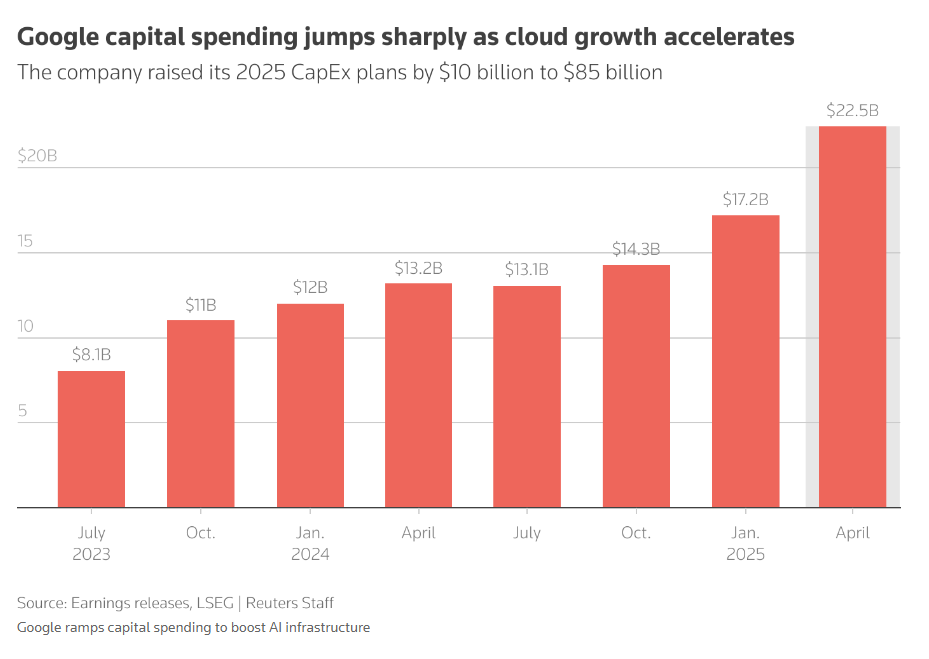
The Zhitong Finance App learned that in the financial report released on Wednesday EST, Google (GOOGL.US) announced that it would raise its annual capital expenditure plan to about 85 billion US dollars and predicted that it would continue to increase investment next year. The company said this decision stemmed from strong demand for its cloud computing services. With new artificial intelligence (AI) features and a stable digital advertising market, the search giant's quarterly revenue and profit far exceeded Wall Street expectations.
For the second quarter ending June 30, Google's total revenue reached 96.43 billion US dollars, exceeding analysts' average expectations of about 94 billion US dollars; earnings per share of 2.31 US dollars were also higher than the expected value of 2.18 US dollars.
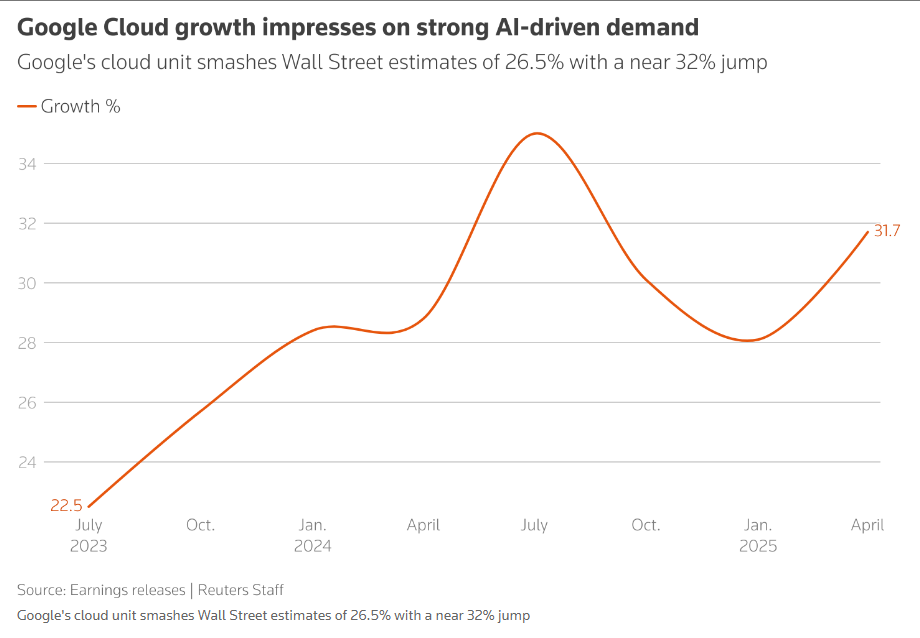
Among them, Google Cloud business sales surged nearly 32% year on year, far exceeding expectations of 26.5% growth, and became the main engine driving revenue growth. “In the face of continued strong demand for cloud products and services, we are increasing capital expenditure investments,” CEO Sundar Pichai emphasized in an earnings statement.
Although the stock price fell for a while after the earnings report was announced, it quickly rebounded after disclosing details of strong demand for the cloud business in an executive conference call. The company's stock price has accumulated a cumulative increase of more than 18% since the release of the previous quarter's earnings report in April.
However, the sharp increase in capital expenditure still surprised the market.
Dave Wagner, portfolio manager at Aptus Capital Advisors, said, “I don't think anyone expected the 2025 capital expenditure guidelines to be adjusted. Google's performance this season has been impressive, easily exceeding expectations, but the $10 billion increase in capital expenditure has offset this joy.”
Forrester analyst Nikhil Lai said, “Faced with competitive pressure from OpenAI, Google had to drastically increase investment in AI infrastructure and applications.”
Chief Financial Officer Anat Ashkenazi revealed during a conference call that capital expenditure will expand further in 2026 in light of market demand and growth opportunities. She added that while server deployments have accelerated, demand for cloud services continues to exceed supply capacity.
Previously, Google promised capital expenditure of about 75 billion US dollars this year. This figure is already higher than the 58.84 billion US dollars expected by Wall Street at the time, but this is only part of the more than 320 billion US dollars that tech giants are expected to invest in building AI capabilities.
Cloud business growth
The rise of AI technology has driven a surge in demand for cloud computing services.
Although Google Cloud still lags behind Amazon (AMZN.US) AWS and Microsoft (MSFT.US) Azure in terms of total sales, it is struggling to catch up by promoting AI solutions including self-developed TPU chips (which compete with NVDA.US) GPUs). Pichai revealed that the number of customers in the business increased 28% month-on-month in the quarter.
He said, “The comprehensive nature of our AI product portfolio, the breadth of our service range, and the provision of GPUs and TPU-based models to our customers are all really driving demand growth.”
In June of this year, it was reported that ChatGPT developer OpenAI had added Google Cloud to its list of cloud computing vendors, which was a major victory for Google — an unexpected partnership between direct rivals in the AI field, and also marked OpenAI's latest move to reduce its dependence on Microsoft, its main supporter. However, Jesse Cohen, a senior analyst at Investing.com, pointed out that the surge in capital expenditure has raised market concerns about the impact of Google's profit pace and short-term profits.
Faced with fierce competition from Chinese competitors and investors' dissatisfaction with slow returns, Google and other tech giants are still insisting on investing heavily in AI, saying this is a necessary step to drive growth and product upgrades.
AI contests
In terms of search business, new features such as AI Overviews (AI Overviews) and AI mode are helping Google increase user engagement and cope with competition from popular chatbots such as ChatGPT.
Pichai revealed that only two months after the full promotion of the AI model was announced at the annual developer conference, the number of monthly active users has surpassed 100 million; while Google's self-developed ChatGPT competitor Gemini has more than 450 million monthly users. As Google's flagship AI product, the Gemini model is being rapidly integrated into all products and promoted to enterprise customers. Although the new version released at the beginning of the year was well received by AI experts, most assessments suggest that its user adoption still lags behind OpenAI's ChatGPT.
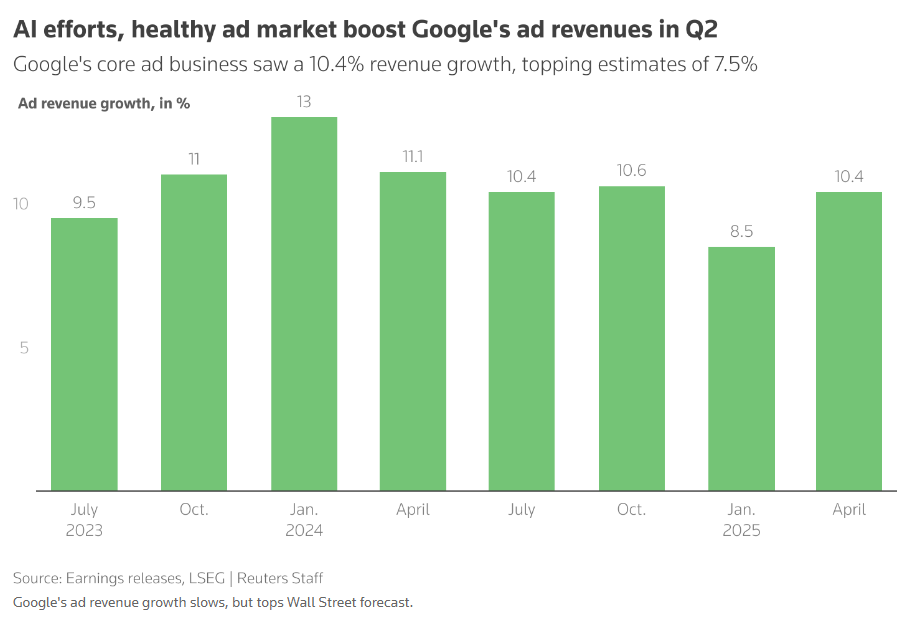
According to the data, the second-quarter revenue of the advertising business, which accounts for three-quarters of the company's total revenue, increased 10.4% to US$71.34 billion, higher than the forecast of US$69.47 billion.
Dan Morgan, senior portfolio manager at Synovus Trust, said: “This is expected to ease the concerns of the investment community — they have been worried that products such as OpenAI/ChatGPT could erode the growth of Google search queries.”
In the battle for AI talent, Google is also facing fierce competition. Meta (META.US) is offering sky-high salaries to recruit super-smart lab researchers, driving up talent costs throughout Silicon Valley. Earlier this month, Google spent about $2.4 billion to acquire the core team and technical licenses of AI programming startup Windsurf. Ashkenazi said Google would “ensure reasonable investment to bring together the best talent in the industry.”
Furthermore, Google's main business is also at risk of spin-off — a federal court ruled that it constituted an illegal monopoly in search and part of advertising technology. Although Google said it would appeal, the presiding judge Amit Mehta is expected to enact specific measures to resume competition in search engines next month.
On the other business side, the video platform YouTube had ad revenue of 9.8 billion US dollars this season, exceeding analysts' expectations of 9.56 billion US dollars. With its dominant position in the living room streaming sector and heavy investment in the podcast business, this platform, which uses advertising as its main source of revenue, continues to perform well.
The innovative business “Other Bets”, which includes the autonomous driving project Waymo, had revenue of 373 million US dollars this quarter, which is lower than the forecast of 429.1 million US dollars. Waymo more than doubled its Austin service area this month and announced the launch of New York City data collection to obtain testing permits, but its commercialization process still seems to have fallen short of investors' expectations. Meanwhile, other innovative business units are under pressure to spin off and operate independently.