
The market quietly staged a style change! The Russell 2000 Index is approaching a “gold cross”
While investors are fervently pursuing the concept of large technology stocks and artificial intelligence, the market is quietly undergoing a style shift, and small-cap stocks and cyclical stocks are “counterattacking”. Since its inception in the second half of 2025, economically sensitive sectors that had been overlooked have re-emerged, setting off a strong rebound, aided by multiple factors such as technological breakthroughs, a recovery in market risk appetite, and the withdrawal of capital from popular AI transactions.
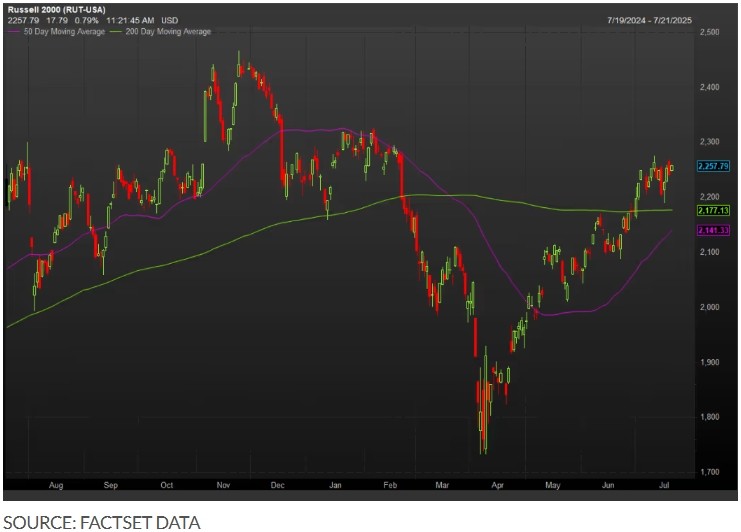
The Zhitong Finance App learned that since July, small-cap stocks have performed the most impressive against the backdrop of the overall rise in US stocks. Up to now, the small-cap index Russell 2000 has risen about 3.5% this month, outperforming the S&P 500 Index (+1.7%) and the Dow Jones Industrial Index (+0.9%).
More notably, the Russell 2000 Index is approaching the “golden cross” in technical analysis. When the 50-day moving average breaks through the 200-day EMA, it is generally seen as a sign that the market is entering a new upward trend. This will be the first time since January 2, 2024, that Russell 2000 has seen a gold crossover.
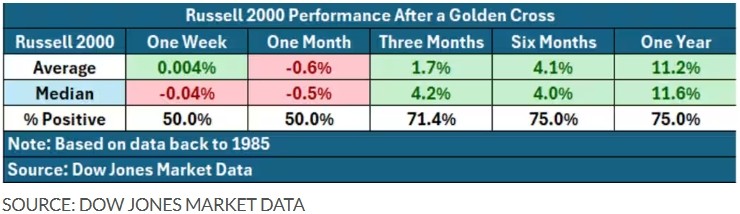
According to Dow Jones market data, since 1985, the Golden Cross has often indicated an upward trend in small-cap stocks for the next 3 months, 6 months, and even 1 year.
Despite positive signals from the technical side, the fundamentals are still weak. Some market participants have expressed doubts about the sustainability of this wave of small-cap stock rebound.
Nanette Abuhoff Jacobson, a global investment strategist at Hartford Funds, pointed out that the rise in small-cap stocks “appears to be temporary” because large-cap stocks are more stable in the current economic cycle, especially under pressure from inflation, tariffs, and slowing economic growth.
She said, “Large-cap stocks have better quality and profitability, so they can better absorb the impact of rising costs and tariffs. The rebound in small-cap stocks is often brief, and investors need to be wary of this.”
Since the beginning of the year, the market generally anticipated that Trump's return to the White House might create a friendly environment for businesses, such as cutting taxes, easing financial regulations, and reviving local manufacturing and supply chains. This expectation has boosted the recovery of small-cap stocks. However, the tariff policy introduced by the Trump administration has put pressure on small-cap stocks once again.
Faced with the high cost of imported goods and potentially higher inflation, small businesses are under even greater pressure. Furthermore, high inflation has also left the Federal Reserve in a dilemma, unable to easily cut interest rates to stimulate the economy. Russell's cumulative increase in 2000 was still less than 1%, far lower than the 7.3% of the S&P 500 and the 8.2% of the NASDAQ.
Jim Worden, Chief Investment Officer of Wealth Consulting Group, confessed: “We thought small-cap stocks would perform better this year and the second half of last year, but we didn't expect this round of tariff turmoil to be so intense, plus interest rates did not drop as much as we expected.”
According to data from the CME FedWatch tool, as of this Tuesday, the market only estimates that the probability that the Fed will cut interest rates twice a year (25 basis points each) is 43%. Even if implemented, interest rates will only fall to the 3.75%-4% range. In response, Abuhoff Jacobson pointed out that the “impact” of one or two interest rate cuts is “limited” because the current interest rate level is still significantly higher than in the past few years.
Cyclical stocks also go hand in hand with small-cap stocks. With the launch in July, investors have also begun to withdraw some of their capital from large, highly valued technology stocks and shift to economically sensitive materials, industries, and optional consumer sectors.
In the S&P 500 index, the materials sector has risen 3.9% since July, optional consumption has risen 3.7%, and the industrial sector has risen 2.3%, all outperforming the market.
Although cyclical stocks generally have a higher market value than small-cap stocks and are less vulnerable, they are still more vulnerable to rising interest rates and economic slowing. For example, consumer choices are highly dependent on consumer confidence and spending, while the industrial and materials sector is directly linked to commercial investment, construction, and manufacturing.
“The good performance of cyclical stocks is due more to the fact that current consumer and business sentiment remains resilient,” Worden said. “In many areas, demand has not clearly weakened.”