
Continuously falling, “buying” more than once: energy stocks become Wall Street's “stubborn choice”
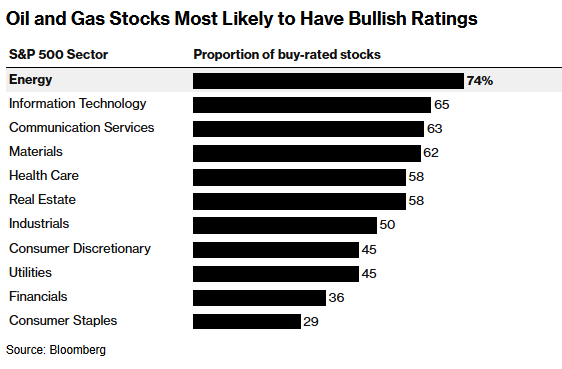
The Zhitong Finance App learned that Wall Street analysts are very encouraged by their high expectations for oil and gas stocks, lower valuations, and Trump's strong support for the troubled energy industry. Among the 11 industries covered by the S&P 500 index, the energy sector accounts for the highest share of stocks with a “buy” rating. According to data compiled by Bloomberg, about three-quarters of the sector's constituent stocks received “buy” recommendations, compared to about half of the overall market. Furthermore, sell-side analysts expect energy stocks to rise by about 16% over the next 12 months, second only to the healthcare sector, and about double the expected increase in the overall index.
Energy stocks are one of the three falling sectors in the S&P 500 index this year, but there still seems to be room for growth. Measured by price-earnings ratio, it is the cheapest sector in the S&P 500, and Trump is the “cheerleader” of the industry, calling for companies to “drill, baby, drill hard (drill, baby, drill).”
Leo Mariani (Leo Mariani), an analyst at Roth Capital Partners (Roth Capital Partners), said in an interview: “Some people think that the current price-earnings ratio and valuation (of energy stocks) are very, very low.”
Looking ahead to the longer term, the sector is expected to achieve the highest profit growth in 2026, according to Bloomberg Intelligence.
The challenge ahead
Of course, investors are understandably skeptical about Wall Street's optimism. Affected by Trump's trade war, combined with the Organization of Petroleum Exporting Countries and its allies (OPEC+) to restore previously limited supply, US crude oil prices have fallen by about 7% this year. Furthermore, the sector lacked much upward momentum. In the past five quarters, energy stocks underperformed the market in four quarters.
Phillip Jungwirth (Phillip Jungwirth), an analyst at Bank of Montreal Capital Markets (BMO Capital Markets), said that the bank expects US energy producers' second-quarter profits to drop 30% compared to the first three months of this year, and cash flow will also drop 15% during the same period due to weakening crude oil prices.
Mariani of Ross Capital said, “In the next 12 months, are there any catalysts that can drastically change this situation and reverse the decline? I'm not sure what factors are particularly clear.” He also added that institutional investors are less likely to feel about this sector. His target price for stocks in this sector is generally lower than many of his Wall Street peers.
Still, there are reasons to consider investing in these stocks. On the one hand, energy stocks have historically played a role in protecting investors when inflation accelerates. When US consumer prices soared in 2022, the energy sector was the best performing sector. At the risk that Trump's tariffs may push up prices in the coming months, this hedging effect may once again work.
Furthermore, Trump's spending bill removed subsidies for renewable energy, giving oil and gas producers some benefits, even if this did not immediately drive energy stocks to a sharp rise.
Michael Casper (Michael Casper), a senior stock strategist at Bloomberg Intelligence, said Wall Street analysts may be waiting for further action from the White House. In an interview, he said, “Trump was seen as someone who would help American energy producers.”