
- PREMIUM
- LIVE QUOTES
- INSTITUTIONS
 Index Options


 State Street
 CME Group
 Nasdaq
 Cboe
Cboe TradingView
 Wall Street Journal
UBS: Stablecoins will drive up net demand for short-term US bonds, and short-term bond supply still has room to absorb
The Zhitong Finance App learned that UBS previously anticipated that the rapid expansion phase of short-term US bonds as a share of negotiable debt has passed. However, the GENIUS Act could bring about a new round of growth.
According to the Act, stablecoin issuers must maintain 100% reserve support with short-term, highly liquid, and high-quality assets. Approved reserve assets include US dollar notes, short-term US Treasury bonds, depositary institution deposits, and short-term treasury bond repurchase agreements.
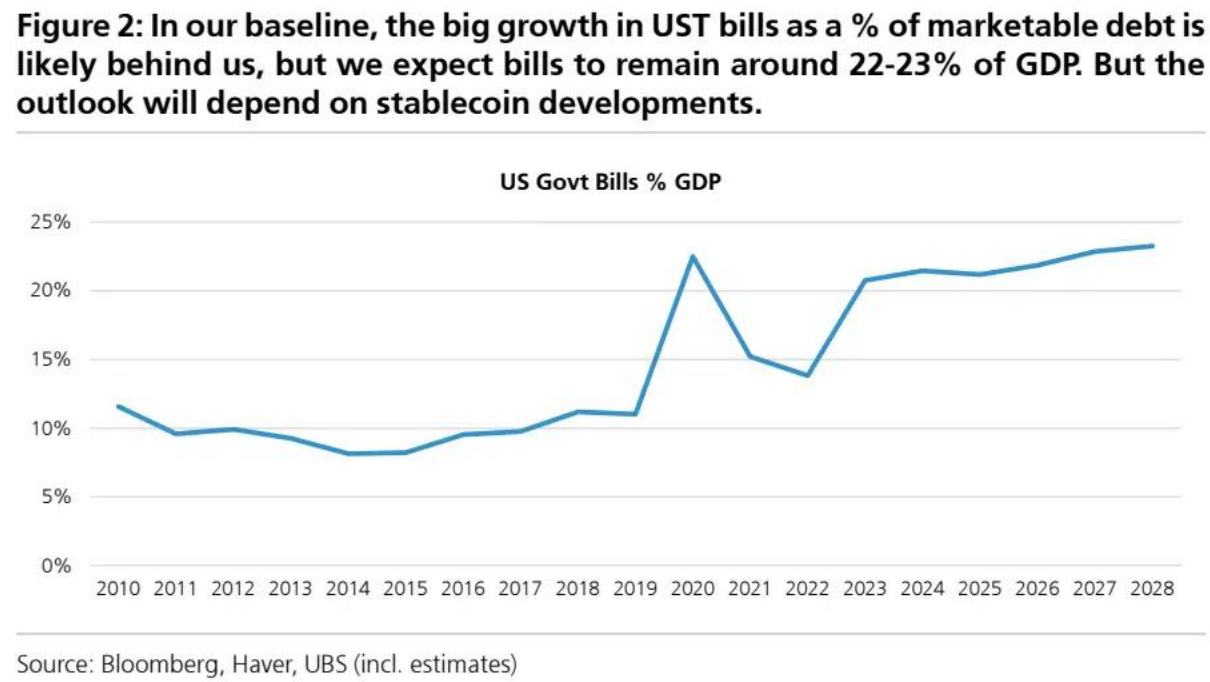
The Bank for International Settlements (BIS) estimates that stablecoins have purchased about 40 billion US dollars of short-term US treasury bonds, which is comparable in size to the largest US government money market fund, and exceeds the holdings of most countries. After the debt ceiling issue was resolved and government money market funds were greatly expanded, the short-term US bond market still has sufficient absorption capacity.
If the GENIUS Act stimulates demand for more short-term treasury bonds, the US Treasury can slightly delay the time to expand the issuance of interest-bearing treasury bonds, and there is also more room to buy back old bonds with poor liquidity. In any case, UBS expects the Treasury to continue to maintain a stable relative ratio between short-term treasury bonds and interest-bearing treasury bonds.
The ever-expanding stablecoin landscape
The key is how much of the demand brought about by stablecoins is a “net increase” in cash demand. Since 2019, the net assets of US government money market funds have doubled to $7 trillion, while the total market value of stablecoins is only about $240 billion.
US Treasury Secretary Bessent believes that $2 trillion is a reasonable size for a US dollar stablecoin, and there is an upward risk. The Treasury Borrowing Advisory Committee (TBAC) discussed a scenario where the market value will reach $2 trillion by 2028, corresponding to a seven-fold increase in overall transaction volume, no change in the speed of currency circulation, and a 10% increase in the share of stablecoin transactions in foreign exchange spot transactions.
Tokenized money market funds have become an alternative because they can provide returns like funds, while stablecoins usually have no returns. The growth of the stablecoin industry will also depend on the scope of international use.
Bezent anticipates that the legislation will “further expand the global use of the dollar through stablecoins.”
Capital flow and rate of return
Growth, inflation, and central bank policies have historically dominated yields, but institutional changes are just as important. BIS researchers pointed out that the strong inflow of dollar stablecoins is related to the decline in 3-month short-term Treasury yields, and even had some impact on 10-year US Treasury yields after about 15 days.
In a previous report, UBS pointed out that during the period when the US escaped its fiscal surplus in the late 90s, the supply of short-term treasury bonds grew faster than the traditional investor base, making them relatively cheap. However, any deviation between short-term treasury interest rates and effective federal funds rates remains limited.
