
Bank of America Securities: Rising Defense Spending Exploits Metal “Military Dividend” Demand for Aluminum and Copper Faces Strong Structural Growth
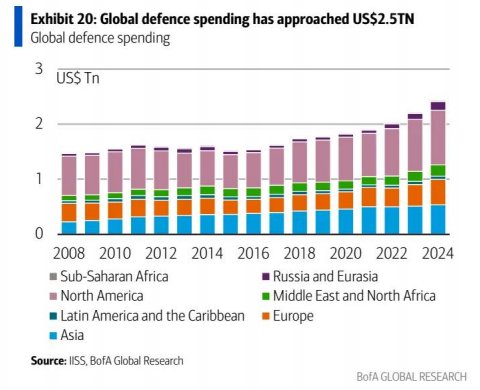
The Zhitong Finance App learned that Bank of America Securities released a research report stating that as the world becomes more multi-polarized, defense spending and its drive on metal demand are receiving more attention. Defense spending is rising, as highlighted by NATO's latest commitment to spend 5% of GDP on defense. If spending is more focused on equipment and infrastructure than people (as currently appears), minerals will benefit disproportionately.
Structural growth in demand for defense metals
Estimating defense metal demand faces challenges: countries rarely publish detailed expenditure details, and the metal content of equipment is difficult to accurately quantify. However, the escalation of NATO spending targets is a key driver. In 2024, NATO countries (excluding the US) will spend 507 billion US dollars on core defense; if they reach the 3.5% GDP target, they will spend an additional 371 billion US dollars.
Germany, for example, plans to increase its defense budget from 62.4 billion euros in 2024 to 154 billion euros in 2029, with equipment procurement accounting for 40%, driving up demand for metals.
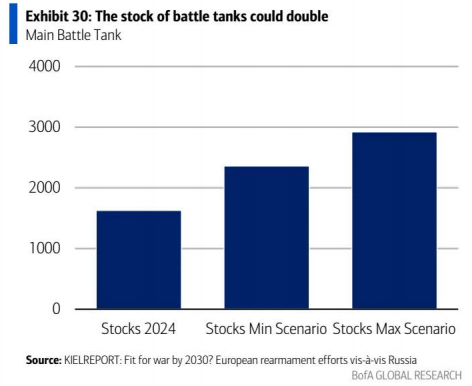
According to a 2009 audit by the US Department of Defense, the annual demand for aluminum and copper is 275,000 tons and 106,000 tons, respectively; Bank of America Securities is expected to increase to 1.6 million tons and 553,000 tons in 2030, mainly dominated by equipment expenses. For example, infrastructure investment consumes 3 tons of aluminum and 4 tons of copper per million US dollars, which is in line with NATO's infrastructure target (1.5% of GDP).
Ukraine's post-war reconstruction was singled out as a “second battleground” for metal demand. The World Bank and other agencies estimate that direct damage has increased to 170 billion US dollars, and the total cost of reconstruction is 543-123 billion US dollars.
The Bank of America uses two methods of “installed metal volume” and damage rate. If rebuilt over 10 years, 200,000 tons of copper (accounting for 0.65% of the world), 750,000 tons of aluminum (1.1%), and 17.6 million tons (1%) of steel are required; if it is based on the 14-year, 1 trillion US dollar reconstruction limit, copper demand can reach 1.8 million tons (6.8% of the annual market), 720,000 tons (1%) of aluminum, and 16 million tons (1.8%) of steel. Although the ratio seems moderate, against the backdrop of an annual growth rate of only 2% of global copper production, the additional increase of several dozen basis points is enough to make the already tight market even more tight.
Summarize
Bank of America Securities said that the modernization of national defense and post-war reconstruction will jointly boost demand for metals. The demand curve for copper, aluminum, and steel will be steeper, and strategic small metals such as rare earths, gallium, and germanium will become bottlenecks. Spending efficiency, technology routes (lightweight, intelligent, unmanned), and geopolitical games will determine the final intensity of metal consumption.