
The bull market is ringing, can the Hong Kong stock brokerage sector still rise?
The brokerage sector launched an all-out upward trajectory. In just three weeks, the Hong Kong stock securities and brokerage sector rose by more than 30%, and A-shares rose simultaneously, driving a phased bull market dominated by the securities sector.
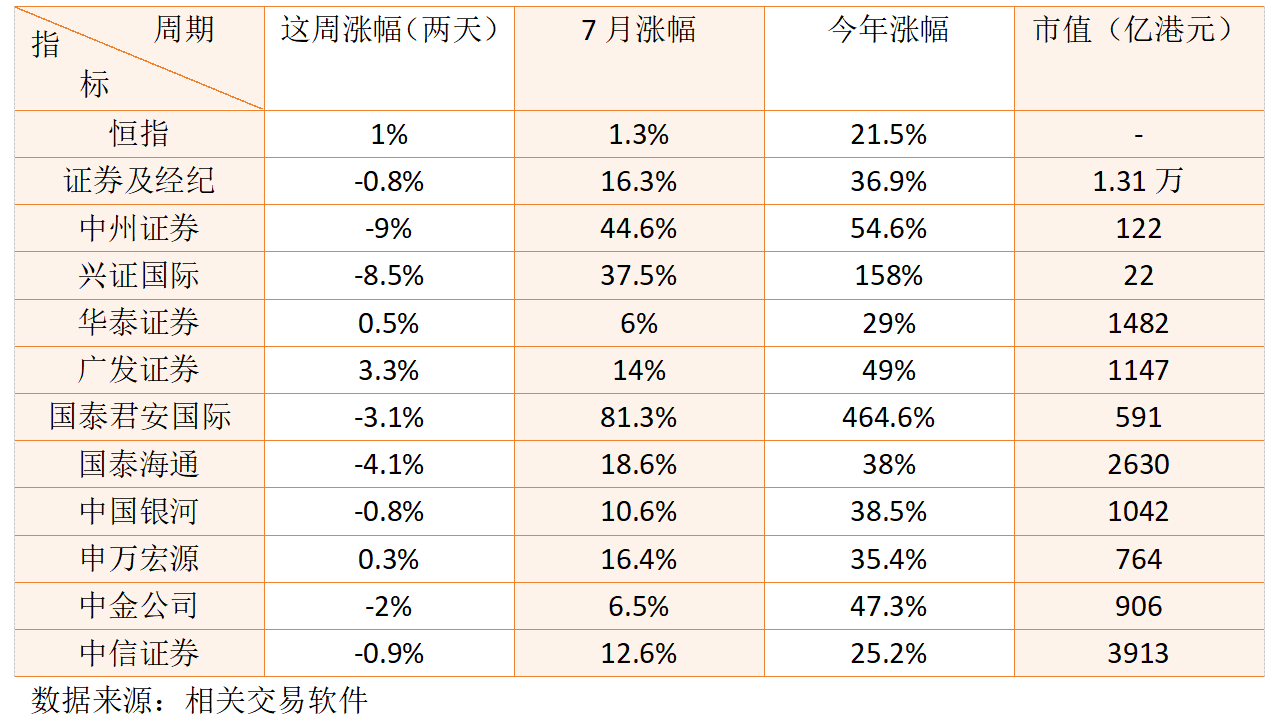
The Zhitong Finance App learned that the securities and brokerage sector has broken out of a local bull market. Since Trump launched the tariff war on April 7, the Hong Kong stock securities and brokerage sector have continued to rise. Since July, they have been driven by various factors such as policies, undervaluation, and sector rotation, and the rise has accelerated. The securities and brokerage sector has risen 36.9% since this year, driving the Hang Seng Index up 21.5%. China Taijunan International (01788) led the way, and the market value doubled 4.6 times.
Individual stocks in the sector were mixed. Weighted stocks with larger markets rose less this year, but the average was over 30%, such as Cathay Pacific Haitong and GF Securities, which rose 38% and 49% respectively, and CITIC Securities, which ranked first in market capitalization, also rose by more than 25%. This wave of phased bullish markets has brought more investment appeal to the Hong Kong stock market.
So, what is the logic of this phased bull market for Hong Kong stocks, and can they rise again?
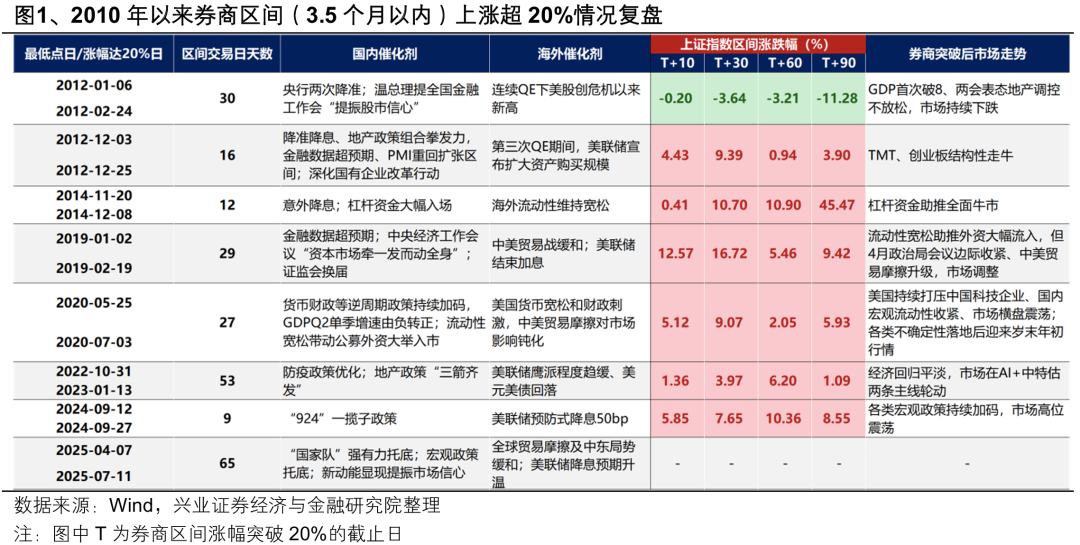
First, let's look at the investment bank's view. According to the Societe Generale Securities Research Report, if the time range is limited to 3.5 months, the brokerage range has risen more than 20% 7 times since 2010, including the beginning of 2012, the end of 2014, the beginning of 2019, the middle of 2020, the end of 2022, and “924” in 2024. The main catalytic factors for the review of the rise: “domestic macroeconomic policy relaxation+boosting the stock market, easing overseas liquidity + mitigating risk events.”
This is also the case in this round, including strong support from the “national team” under the impact of tariffs and the rapid implementation of the “5.7 package policy”, etc., to establish a firm bottom line mentality for the market. Moreover, brokerage firms have led the rise in the market, and the main line has shown a certain degree of continuity. Since the bottom of April 7, the industries that have performed well have mainly focused on growing industries represented by TMT, military industry, and innovative pharmaceuticals, as well as high-price resource products represented by non-ferrous metals and chemicals. It is still expected that market consensus will be forged in the future.
According to the Zhitong Finance App, the securities and brokerage sector still has strong upward momentum. It is mainly driven by three factors: policy driven, undervaluation driven, and performance driven.
From a policy perspective, since September of last year, the country has been supporting capital market development, increasing capital market liquidity through a package of incremental fiscal policies and innovative monetary policy tools. For example, in October 2024, the Securities, Fund, and Insurance Company Exchange Facility (SFISF) commenced operation, and stock repurchase and refinancing was officially established. Up to now, both policy instruments have injected more than 100 billion yuan of capital into the market.
At the end of June 2025, six departments including the Central Bank issued the “Guiding Opinions on Financial Support to Boost Consumption” to provide liquidity support and expected improvements to the market. The central bank proposed combining 500 billion yuan in exchange facilities for securities, funds, and insurance companies and a 300 billion yuan reloan amount for stock repurchases and additional loans of 300 billion yuan, for a total amount of 800 billion yuan. At the same time, the “A+H” listing boom continues to heat up, and there is a wave of Hong Kong Stock Connect fund issuance. Additionally, June 10 documents show that Guangdong-Hong Kong-Macao Greater Bay Area companies listed on the Hong Kong Stock Exchange are allowed to be listed on the Shenzhen Stock Exchange in accordance with regulations, and AH drives incremental capital into the market.
Meanwhile, supply-side reforms in the securities industry continue to optimize supply quality. On July 11, the China Securities Association issued the “Implementation Opinions of the China Securities Association on Strengthening Self-Regulatory Management and Promoting High-Quality Development of the Securities Industry”, which contains a total of 28 measures. Under the policy direction of supervision, support and limitation of advantages and disadvantages, the supply-side structural reform process of brokerage firms will be accelerated, and the advantages of high-quality leading brokerage firms in terms of steady management and professional ability will be further highlighted.
Under policy guidance, Hong Kong Stock Connect became the largest inflow of capital to the brokerage sector. According to Futu Niu Niu data, the net purchases of Cathay Pacific Junan International, Zhongzhou Securities, GF Securities, and CICC, which had the highest gains this year, were 760 million shares, 23.33 million shares, 31.41 million shares, and 48.75 million shares, respectively.
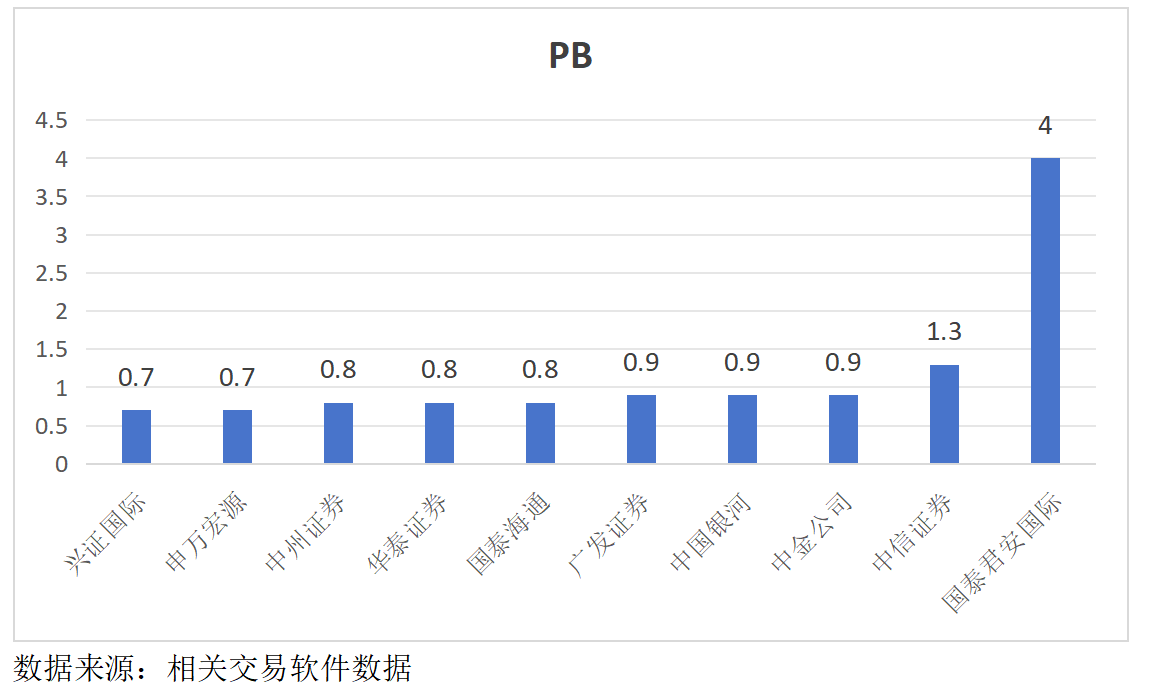
In terms of valuation, the PB value of individual stock assets is basically less than 1 times. Excluding Cathay Pacific Junan International, the average value is 0.86 times. Among them, the two small-cap stocks of Xingzheng International and Zhongzhou Securities, which have had good recent increases, are 0.7 times and 0.8 times, respectively. In terms of PE value with profit attributes, high-quality large-cap brokerage stocks are generally below 10 times. For example, Huatai Securities, GF Securities, and China Galaxy are 8.2 times, 10 times, and 8.4 times, respectively.
The policy has injected a large amount of liquidity into the capital market, but the current investment environment is clearly challenging, including Trump's tariff war still fluctuating, and the geographical conflict is still unstable. However, for the brokerage sector, general undervaluation has brought sufficient margin of safety to the rise in the sector.
More importantly, the securities sector has performance support. Recently, listed companies in the securities industry have released performance forecasts for 2025, all of which have achieved high performance increases. For example, Zhongtai Securities had an advance increase of 80.09%, Fangzheng Securities had an advance increase of 70%-80%, CITIC Construction Investment had an advance increase of 55-60%, and CICC had an advance increase of 55%-78%. In addition, there was also a number of target profits that doubled. For example, Changjiang Securities had an advance increase of 110%-130% and Cathay Pacific Junan International's advance increase of 161%-202%.
The brokerage industry's performance in 2025 was mainly due to a sharp increase in capital market trading activity supported by national policies, which brought considerable benefits to the brokerage business and investment business of the industry. However, as a valuation anchor, up to now, the Hong Kong stock securities and brokerage sector have risen 37% this year, far below the average level of performance growth. It will bring opportunities for valuation repair to the brokerage sector, especially weighted stocks with undervalued performance.
Overall, this wave of phased bullish markets led by brokerage firms is far from over, but it still shows a structural trend. Under the influence of multiple factors (such as policies, geopolitics, etc.), capital may continue to rebound in AI and end-side applications (intelligent driving and humanoid robots, etc.), innovative drugs, military industry, and new consumption, which is expected to drive the Hang Seng Index to rise step-wise. Based on a higher margin of safety, investors can pay attention to high-quality weighted brokerage firms with undervalued values.