
Eleven have been licensed, and 8 are applying. Are brokerage institutions reshaping valuations under the “wave” of stablecoins?
Recently, another brokerage agency officially announced “happy news” or a virtual trading platform license.
On the evening of July 14, CMB International was officially approved by the Hong Kong Securities and Futures Commission, becoming the first Chinese bank brokerage firm in Hong Kong to obtain licenses related to virtual asset trading services.
The agency currently holds licenses No. 1 and 4 from the Hong Kong Securities Regulatory Commission. This time, it has successfully obtained licenses related to virtual assets, marking that the company's business field will officially expand into the digital finance market, further opening up space for cross-sector integration. At the same time, CMB International also said it would explore incorporating virtual assets into diversified investment portfolios and develop innovative strategies by studying the correlation between virtual assets and the stock market. In the future, investors can participate in virtual asset transactions, including cryptocurrencies, in compliance on the CMB International platform.
It is worth mentioning that previously, when Guotai Junan obtained a license, brokerage stocks took turns to rise sharply, but this time, CMB International's results have also driven stablecoin concept stocks to rise strongly.
According to Zhitong Finance, on the evening of June 24, Guotai Junan International was approved by the Hong Kong Securities and Futures Commission (“Hong Kong Securities Regulatory Commission”) to upgrade its existing securities trading license (commonly known as No. 1 trading license) to provide virtual asset trading services and services. This news quickly set off the market. On June 25, Cathay Pacific Junan International (01788) surged nearly 200%, driving the Hong Kong Chinese Brokerage Index to soar 11.75% in a single day. Many brokerage stocks such as A-share Tianfeng Securities rose to a standstill, while Oriental Wealth increased by more than 10%.
Today (July 15), China Merchants Securities H shares (06099) rose by nearly 15% to HK$17.5. At the close of trading, CMB H shares rose more than 4.43% to HK$15.88 due to favorable news that CMB International obtained a license. On the same day, the stablecoin concept ranked among the highest gains in all sectors with an increase of 5.18%.
Stablecoins are becoming increasingly popular. How many relevant institutions can take advantage of this trend?
The approval of virtual trading licenses has been accelerated, 11 have been granted licenses, and 8 are applying
As stablecoins accelerate their “exit”, brokerage institutions are also speeding up “grabbing” licenses.
According to reports, Hong Kong uses a “dual-track” licensing system, which differentiates supervision according to virtual asset types (securities/non-securities) and business models.
First, the virtual asset trading platform (VATP) license covers platforms that provide securities and non-securities token trading services. It is necessary to simultaneously apply for a 1/7 license under SFO and a VASP license under AMLO.
Second, traditional brokerage firms upgrade their license, that is, license upgrade No. 1, such as Hafu Securities and Tianfeng International, which are approved to provide virtual asset trading services through integrated accounts to directly connect with licensed exchanges; and license upgrade No. 4 (institutions can provide virtual asset investment advice) and license upgrade No. 9 (asset management institutions can manage funds that account for more than 10% of virtual assets).
Third, a stablecoin issuance license. Specifically, the HKMA implements “high thresholds and strict standards” for entry. It is initially anticipated that only a few licenses will be issued, requiring issuers to prove the actual application value of stablecoins in scenarios such as cross-border payments and supply chain finance.
In addition to this, other relevant qualifications include anti-money laundering compliance; all participants are required to comply with the Anti-Money Laundering and Terrorist Financing Regulations to carry out customer due diligence; and escrow and liquidation: institutions involved in custodian services are required to hold a Class 7 license (automated transaction service). Platforms such as OSLExchange have obtained this license.
As the licensing system becomes more clear, more and more institutions hold licenses.
As of July 2025, there are 11 VATP licensed trading platforms in Hong Kong, including OSL, Hashkey, HKVAX, HKBiteX, Accumulus, DFXLabs, EX.IO, PantherTrade (owned by Futu Securities), YAX (under Tiger Securities), Bullish, EX.IO, and BGE. Among them, OSL is the first licensed virtual asset trading platform, and the other three have internet brokerage backgrounds.
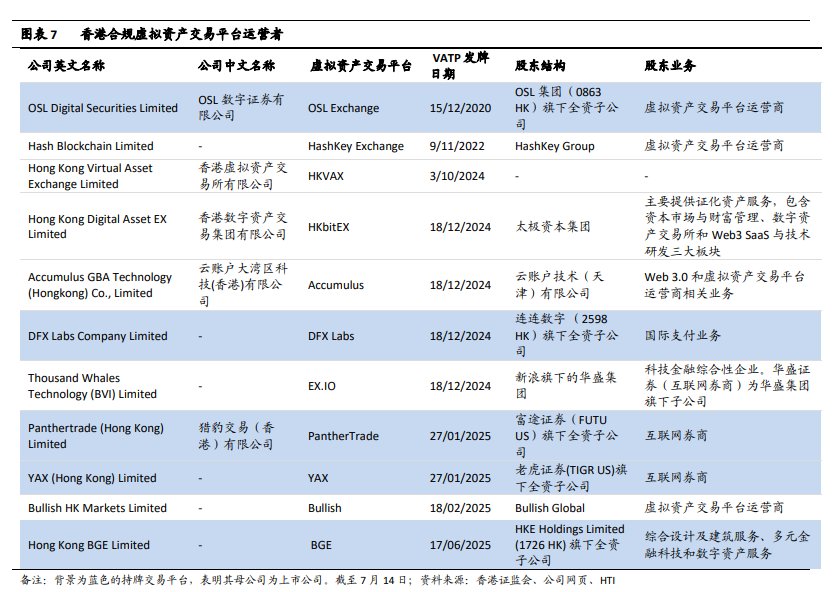
(Image source: Haitong Securities)
Additionally, 8 VATP applicants are still applying, including VDX, Bixin.com, BiTV, Crypto.com, Whalefin, MatrixPorthK, NebulasExchange, Bybit, and BitMart.

(Image source: Haitong Securities)
Meanwhile, according to incomplete statistics, as of July 2025, a total of 42 brokerage firms have been approved to provide virtual asset trading services through integrated accounts, completing the No. 1 license upgrade, directly targeting licensed exchanges such as Hafu Securities, Tianfeng International, Futu Securities, Tiger Securities, etc.; 37 institutions have upgraded their No. 4 license to provide virtual asset investment advice, such as Ping An Securities Hong Kong and Zhongtai International Securities; 40 asset management institutions have upgraded the No. 9 license to manage funds accounting for more than 10% of virtual assets, such as HashKey, by upgrading the 9 license.
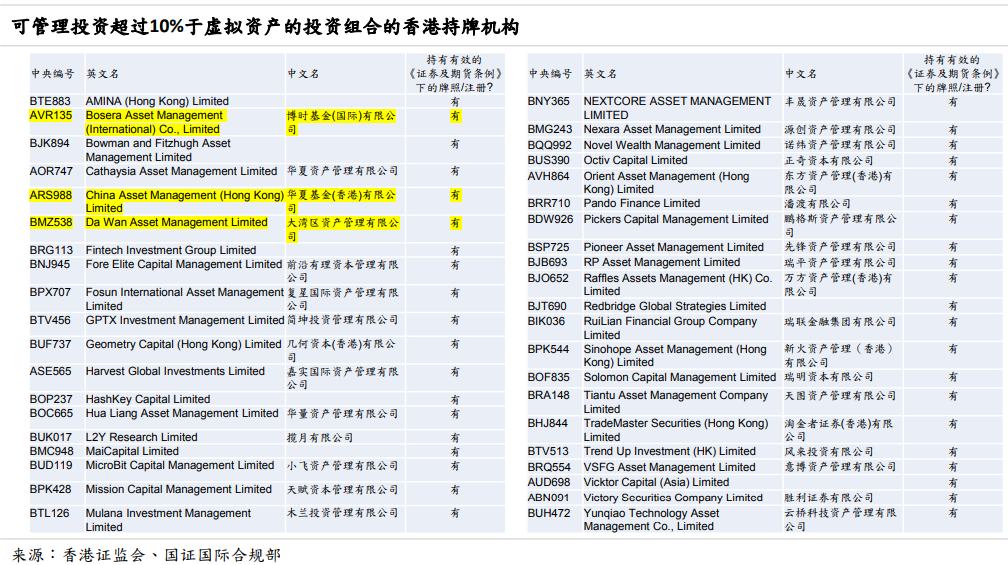
(Image source: China Securities)
According to Tian Lihui, a finance professor at Nankai University, brokerage firms can focus on the four major strategies of underwriting, trading, products, and investment and research when deploying stablecoin asset businesses. First, brokerage firms can assist enterprises to issue tokenized bonds and provide asset custody services based on compliance licenses. Second, it is necessary to promote the construction of a secondary market using stablecoins as settlement units and improve liquidity through algorithmic market making. Third, it is necessary to design structured products based on stablecoin yield to lower the investment threshold for retail investors. Furthermore, it is necessary to provide investment research and compliance consulting services in response to regulatory differences between countries.
As can be seen, as more and more financial institutions in Hong Kong speed up the deployment of virtual asset businesses, the path of financial innovation is slowly being revealed.
The total market volume of RWA has reached 24.4 billion US dollars, and giants from many fields compete
More than just brokerage institutions, as Hong Kong's stablecoin policy continues to be implemented, the overall RWA market volume has grown rapidly, and giants in many fields have also begun to compete for the stablecoin market.
On June 26, 2025, Hong Kong, China officially released the second “Hong Kong Virtual Asset Policy Declaration”. This is a major update following the first declaration in October 2022, further clarifying Hong Kong's roadmap for building an international virtual asset center.
Policy Statement 2.0 proposes the “LEAP Framework”, which once again confirms the goal of making Hong Kong a global digital asset innovation center. Among them, the “LEAP framework” mainly covers the following four aspects:
1) Optimize laws and regulations: Establish a unified and comprehensive regulatory framework for digital asset service providers, covering digital asset trading platforms, stablecoin issuers, digital asset trading service providers and digital asset custodian service providers. 2) Expanding the range of tokenized products: Promoting the tokenization of a wider range of assets and financial instruments. 3) Promote application scenarios and cross-sector cooperation: Encourage the development of digital asset infrastructure. Cyberport will also launch a blockchain and digital asset pilot funding scheme to fund applications with future application potential, iconic and market influence. 4) Talent and partner development: Invest in professional talent training and infrastructure construction.
Hong Kong's stablecoin policy has been implemented at an accelerated pace, and many giants have begun to participate in the Hong Kong stablecoin competition.
The mainland's Internet capital was shortlisted for the first batch of sandbox tests, Ant Group (09618), which has clearly stated its intention to apply; there is also Yuancoin Innovation, which was shortlisted for the first batch of sandbox tests; the fourth party comes from mainland Hong Kong, such as Standard Chartered Hong Kong and Web3 Enterprise Security Group, and Hong Kong Telecom (06823), a subsidiary of “Little Superman” Lee Chak-kai.
For example, JD has responded that it expects to obtain a license early in the fourth quarter of this year and launch the JD stablecoin at the same time. Currently, several partners in the JD Coin Chain have surfaced. In terms of reserve custody, the Hong Kong virtual bank Airstar Bank (Airstar Bank) announced that it is cooperating with the JD Coin Chain to establish a transparent and secure reserve asset custody system; behind this bank is Xiaomi (holding 50.3% of the shares) and Futu Holdings (holding 44.1% of shares) linked to Tencent, which has been watching the financial market for a long time. In addition, JD Technology also held 23.74% of Hong Kong's virtual bank Livi Bank (Livi Bank) through its wholly-owned subsidiary.
According to statistics from the RWA research platform RWA.xyz, as of June 30, 2025, the total RWA market volume has reached about 24.4 billion US dollars, an increase of 5.7% over 30 days ago, and the scale is expanding extremely fast.
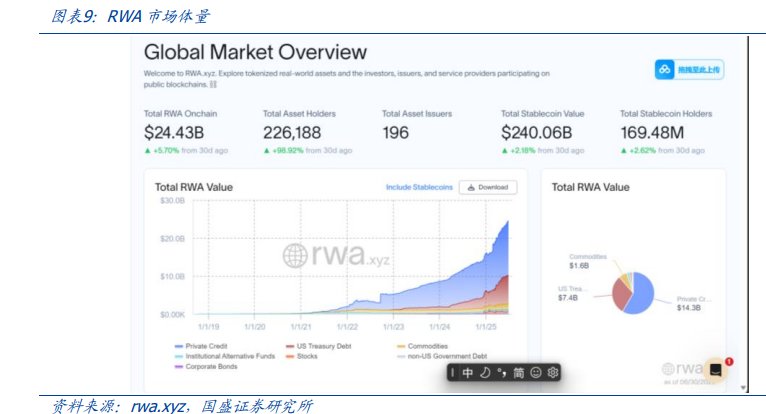
(Image source: Guosheng Securities)
As can be seen, the wave of virtual asset compliance is activating and reshaping the entire non-bank financial industry chain, and a collaborative ecosystem around the issuance, circulation, management and application of digital assets is being accelerated.
epilogue
As the “key” to restructuring the financial order, the accelerated implementation of virtual asset licenses has not only reshaped the brokerage valuation system and opened up high-value-added revenue sources for the industry, but also promoted the deep participation of brokerage firms in cutting-edge fields such as stablecoins and real-world asset (RWA) tokenization, driving business model innovation, expanding a wider space for growth, and thus providing more development opportunities for relevant “entrants”.
Regarding the continuation of this “wave,” Huachuang Securities pointed out that the first half of the current stablecoin market was policy catalysis+event catalytic market. There is no need to worry about fundamental verification. It mainly tracks progress in two areas: the first is the construction process of Hong Kong's web 3.0 and the pace of policy introduction, such as “Policy Declaration 2.0.” Second, important financial institutions will continue to enter the market to further improve the “circle of friends” and “ecosystem” of digital asset trading in Hong Kong. In the short term, brokerage firms and futures companies that will conduct business in Hong Kong may be the main force, continuing to track the progress of the 1/4/7/9 license upgrade of financial institutions.
According to the opinions of many brokerage agencies, this wave of sharp rise in brokerage stocks is mainly due to the approval of virtual asset trading licenses and currently popular stablecoin-themed investment opportunities. As the market service ecosystem is further improved, Chinese brokerage firms with an earlier layout and internet brokerage firms that are good at virtual currency operations may clearly benefit.