
- PREMIUM
- LIVE QUOTES
- INSTITUTIONS
 Index Options


 State Street
 CME Group
 Nasdaq
 Cboe
Cboe TradingView
 Wall Street Journal
5 Analysts Assess Carlyle Group: What You Need To Know
Carlyle Group (NASDAQ:CG) underwent analysis by 5 analysts in the last quarter, revealing a spectrum of viewpoints from bullish to bearish.
Summarizing their recent assessments, the table below illustrates the evolving sentiments in the past 30 days and compares them to the preceding months.
| Bullish | Somewhat Bullish | Indifferent | Somewhat Bearish | Bearish | |
|---|---|---|---|---|---|
| Total Ratings | 1 | 1 | 3 | 0 | 0 |
| Last 30D | 1 | 0 | 0 | 0 | 0 |
| 1M Ago | 0 | 0 | 0 | 0 | 0 |
| 2M Ago | 0 | 0 | 2 | 0 | 0 |
| 3M Ago | 0 | 1 | 1 | 0 | 0 |
Analysts have recently evaluated Carlyle Group and provided 12-month price targets. The average target is $50.4, accompanied by a high estimate of $65.00 and a low estimate of $44.00. Observing a 8.62% increase, the current average has risen from the previous average price target of $46.40.
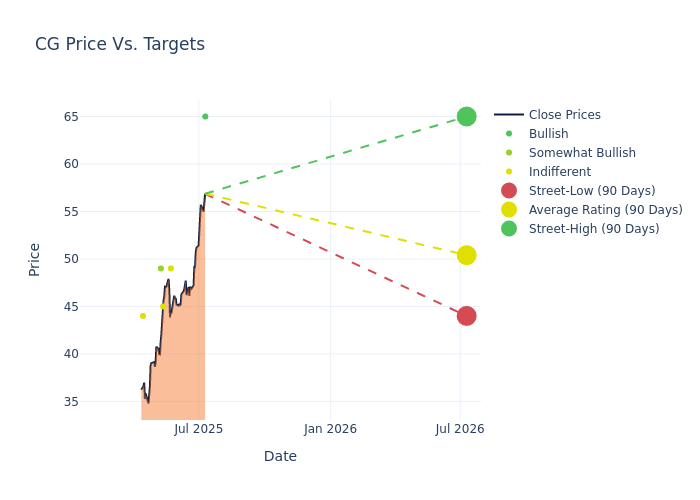
Deciphering Analyst Ratings: An In-Depth Analysis
The standing of Carlyle Group among financial experts is revealed through an in-depth exploration of recent analyst actions. The summary below outlines key analysts, their recent evaluations, and adjustments to ratings and price targets.
| Analyst | Analyst Firm | Action Taken | Rating | Current Price Target | Prior Price Target |
|---|---|---|---|---|---|
| Christopher Allen | Citigroup | Raises | Buy | $65.00 | $44.00 |
| Michael Brown | Wells Fargo | Raises | Equal-Weight | $49.00 | $45.00 |
| Kyle Voigt | Keefe, Bruyette & Woods | Raises | Market Perform | $45.00 | $43.00 |
| Benjamin Budish | Barclays | Raises | Overweight | $49.00 | $43.00 |
| Michael Cyprys | Morgan Stanley | Lowers | Equal-Weight | $44.00 | $57.00 |
Key Insights:
- Action Taken: Analysts frequently update their recommendations based on evolving market conditions and company performance. Whether they 'Maintain', 'Raise' or 'Lower' their stance, it reflects their reaction to recent developments related to Carlyle Group. This information provides a snapshot of how analysts perceive the current state of the company.
- Rating: Offering insights into predictions, analysts assign qualitative values, from 'Outperform' to 'Underperform'. These ratings convey expectations for the relative performance of Carlyle Group compared to the broader market.
- Price Targets: Analysts gauge the dynamics of price targets, providing estimates for the future value of Carlyle Group's stock. This comparison reveals trends in analysts' expectations over time.
Assessing these analyst evaluations alongside crucial financial indicators can provide a comprehensive overview of Carlyle Group's market position. Stay informed and make well-judged decisions with the assistance of our Ratings Table.
Stay up to date on Carlyle Group analyst ratings.
All You Need to Know About Carlyle Group
Carlyle Group is one of the world's largest alternative-asset managers, with $453 billion in total AUM, including $314 billion in fee-earning AUM, at the end of March 2025. The company has three core business segments: global private equity, which includes its private equity, real estate, infrastructure, and natural resources offerings (with $164 billion in total AUM and $99 billion in fee-earning AUM), global credit ($199 billion/$161 billion), and investment/fund solutions, known as Carlyle AlphInvest ($89 billion/$54 billion). The firm primarily serves institutional investors and high-net-worth individuals. Carlyle operates through 29 offices across five continents, serving more than 3,100 active carry fund investors from 87 countries.
Financial Insights: Carlyle Group
Market Capitalization Perspectives: The company's market capitalization falls below industry averages, signaling a relatively smaller size compared to peers. This positioning may be influenced by factors such as perceived growth potential or operational scale.
Revenue Growth: Carlyle Group's remarkable performance in 3M is evident. As of 31 March, 2025, the company achieved an impressive revenue growth rate of 11.31%. This signifies a substantial increase in the company's top-line earnings. When compared to others in the Financials sector, the company excelled with a growth rate higher than the average among peers.
Net Margin: Carlyle Group's net margin lags behind industry averages, suggesting challenges in maintaining strong profitability. With a net margin of 19.5%, the company may face hurdles in effective cost management.
Return on Equity (ROE): Carlyle Group's ROE lags behind industry averages, suggesting challenges in maximizing returns on equity capital. With an ROE of 2.32%, the company may face hurdles in achieving optimal financial performance.
Return on Assets (ROA): Carlyle Group's ROA is below industry averages, indicating potential challenges in efficiently utilizing assets. With an ROA of 0.55%, the company may face hurdles in achieving optimal financial returns.
Debt Management: With a high debt-to-equity ratio of 1.88, Carlyle Group faces challenges in effectively managing its debt levels, indicating potential financial strain.
The Basics of Analyst Ratings
Analysts work in banking and financial systems and typically specialize in reporting for stocks or defined sectors. Analysts may attend company conference calls and meetings, research company financial statements, and communicate with insiders to publish "analyst ratings" for stocks. Analysts typically rate each stock once per quarter.
Beyond their standard evaluations, some analysts contribute predictions for metrics like growth estimates, earnings, and revenue, furnishing investors with additional guidance. Users of analyst ratings should be mindful that this specialized advice is shaped by human perspectives and may be subject to variability.
Which Stocks Are Analysts Recommending Now?
Benzinga Edge gives you instant access to all major analyst upgrades, downgrades, and price targets. Sort by accuracy, upside potential, and more. Click here to stay ahead of the market.
This article was generated by Benzinga's automated content engine and reviewed by an editor.