
IPO outlook | Backed by Zijin Mining and holding 8 “Jinshan”, how did Zijin Gold International go public in Hong Kong?
The gold sector of the Hong Kong stock market may add “titans”.
On June 30, Zijin Gold International Co., Ltd. (hereinafter referred to as “Zijin Gold International”) submitted a prospectus for listing on the Hong Kong Main Board. The co-sponsors are Morgan Stanley and CITIC Securities.
According to reports, the company is a gold mining company spun off by Zijin Mining (02899) and listed separately. Until the IPO, Zijin Mining held 100% of Zijin Gold International's shares. The company was founded in 2000 and is a leading global gold mining company integrating all of Zijin Mining's gold mines (except China). It inherits Zijin Mining's competitive advantage in the management of exploration, development and operation of low-grade and difficult resources, and is mainly engaged in gold exploration, mining, beneficiation, smelting, refining and sales.
Meanwhile, Zijin Mining, the controlling shareholder of the company, is a world-leading mining company focusing on mineral exploration and development. By the end of 2024, Zijin Mining had more than 30 large-scale mining projects in 17 countries around the world, covering metals such as gold, copper, lithium, and zinc. Zijin Mining's resource reserves and production, operating income and profit, total asset value and market value have all entered the top five global mining companies.
Backed by a “big tree”, how did Zijin Gold International mainly go public in Hong Kong? What is the investment value of the company?
Holding 8 “Golden Mountains”, the return on equity reached 21.4%
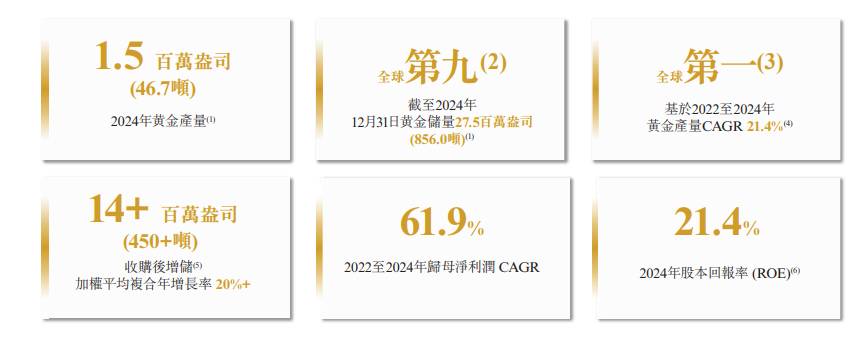
According to Zhitong Finance, Zijin Gold International is one of the fastest growing companies in the global gold mining industry.
According to Frost & Sullivan, the company's gold reserves as of December 31, 2024 and gold production in 2024 ranked 9th and 11th respectively in the world. From 2022 to 2024, the compound annual growth rate of gold production reached 21.4%, and net profit to mother grew at a compound annual rate of 61.9%.
At the same time, Zijin Gold International is also a mining company leading in the growth, operational efficiency and profitability of the global gold mining industry.
From 2022 to 2024, out of the six mines operated by the company, the mining costs per ton of mined ore were US$38.6, US$31.0 and US$33.3, while the beneficiation costs per ton of grinding ore during the same period were US$20.6, US$17.8 and US$19.3, respectively. Furthermore, the company maintained a high return on capital in 2024, with a return on equity of 21.4%.
As of the last practical date, Zijin Gold International holds interests in 8 gold mines in gold resource-rich regions such as Central Asia, South America, Oceania and Africa, namely the Gilau/Taro gold mine in Tajikistan, the left bank gold mine in Kyrgyzstan, the Norton gold field gold mine in Australia, the Aurora gold mine in Guyana, the Buritika gold mine in Colombia, the Rosebel gold mine in Suriname, the Akim gold mine in Ghana, and the Bogra gold mine in Papua New Guinea.
With eight “gold mountains”, the vast majority of Zijin Gold International's revenue unquestionably comes from gold sales — in 2022, 2023 and 2024, revenue from gold sales was 94.8%, 95.8%, and 94.0%, respectively. Fluctuations in gold prices can be described as directly affecting the company's operating performance.
In recent years, due to factors such as increased geopolitical uncertainty and more frequent global monetary easing cycles, the price of gold is a so-called safe-haven asset, and the price of gold has soared. This has undoubtedly had a great positive effect on Zijin Gold's international performance.
From 2022 to 2024, the company achieved revenue of 1,818 billion yuan, 2.62 billion yuan and 2.99 billion yuan respectively, with a compound annual growth rate of 28.2%; realized net profit to mother was 188 million yuan, 230 million yuan, and 481 million yuan respectively, with a compound annual growth rate of 61.9%.
In addition, the company's profitability also increased significantly in 2024. From 2022 to 2024, Zijin Gold International's gross margins were about 34.13%, 26.20%, and 37.94%, respectively. Among them, gross margin increased 11.74 percentage points year-on-year in 2024.
According to the prospectus, Zijin Gold International plans to use the capital raised during the Hong Kong listing to repay the transition loan to acquire the Raygorodok gold mine in Kazakhstan, for upgrading and construction projects for existing mines within the next five years, and for general working capital.
However, the reason why the company went public in Hong Kong in the context of high performance may be that the company did not have much “living money” in its hands.
According to reports, the company's total maintenance cost (AISC) in 2024 was 1,458 US dollars per ounce, which means that mining 1 ounce of gold required 1,458 US dollars, while the average selling price of gold in 2024 was 2,288 US dollars/ounce, which means that more than 60% of the gold price profit will be “consumed” during the mining process. As of December 31, 2024, Zijin Gold International held approximately US$235 million in cash and cash equivalents.
Therefore, if Zijin Gold International wants to further “expand its territory”, it must also seek “blood supplementation channels” from the outside world.
Driven by multiple favorable factors, gold has entered a long-term upward channel
According to Frost & Sullivan, global demand for gold grew at a CAGR of 5.8% from 2020 to 2024, reaching 148.1 million ounces (4,606.1 tons) in 2024. Compared with 2023, global demand for gold rose in 2024, and global gold investment showed an upward trend. Total global gold investment increased to 38.0 million ounces (1,181.7 tons).
From 2024 to 2030, global gold demand is expected to grow steadily at a compound annual growth rate of 3.2%, mainly due to increased demand for gold by central banks to preserve value and spread risk in the current context of geopolitical uncertainty, and increased demand for investment gold.
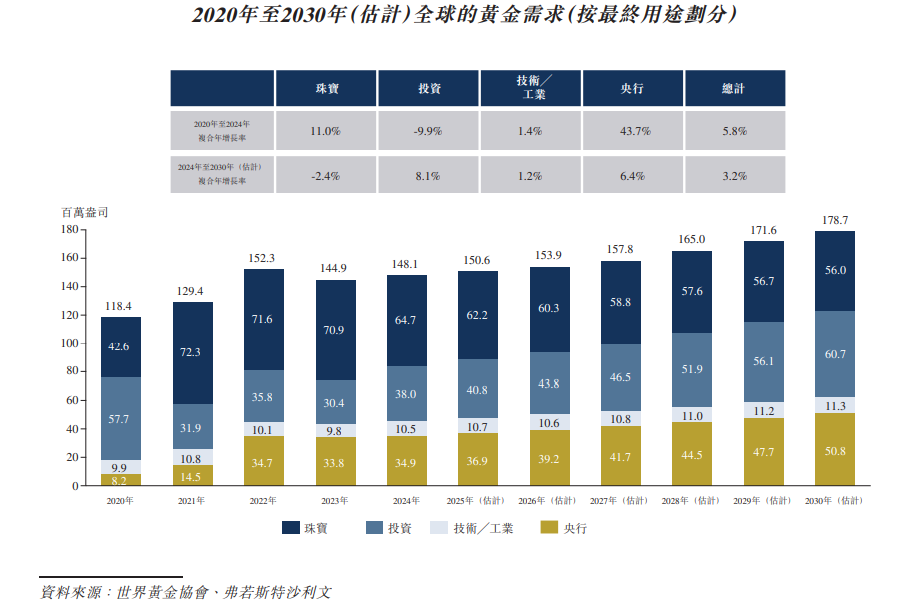
Continued gold purchases by central banks around the world, particularly large purchases by central banks in emerging markets, provide strong support for gold prices. At the same time, uncertainty in the global economy, including anticipated changes in interest rate policies and fiscal dynamics, particularly around the US budget process, further enhances the appeal of gold as a safe-haven asset.
According to the London Bullion Market Association (LBMA) gold prices, the global average annual gold price showed an overall fluctuating upward trend between 2010 and 2024, reaching $2,386.4 per ounce in 2024. According to the London Bullion Market Association (LBMA) gold prices, in the context of de-dollarization, emerging market central banks may further increase their gold reserves, driving the average annual gold price to continue to rise during the forecast period and reach $3,387.7 per ounce in 2026.
In recent years, the gold mining industry has become increasingly concentrated. This trend is largely due to mergers and resource consolidation among leading gold producers — that is, major gold mining companies are now leading the industry due to their efficient operations, global operations, financial strength, and other competitive advantages. These large gold mining companies achieve economies of scale through integration, which can optimize production processes and reduce unit costs.
So in a nutshell, the key success factors in the gold mining industry mainly include operational efficiency, cost management, and strategic mergers and acquisitions.
According to Frost & Sullivan data, in 2024, the world's top 15 gold producers will contribute about 30.5% of global gold mining production. Among these leading companies, Zijin Gold International ranked 11th in the world in 2024, and its seven mines produced a total of 1.5 million ounces (45.3 tons) of gold. Furthermore, among these producers, the compound annual growth rate from 2022 to 2024 was 21.4%, ranking first in production growth. As can be seen, although the company's production growth rate is high, total gold production still needs to be increased. Therefore, as the industry enters an upward channel, Zijin Gold still needs to improve the company's competitiveness in all aspects, starting from the above three factors.
In summary, it is easy to see that with the company's multiple advantages such as resource reserves, cost control, technical barriers, and global operations, the international investment value of Zijin Gold is self-evident. Currently, the industry is on a long-term upward path of “tight balance between supply and demand+strengthening of financial attributes”. It was clearly to be expected that the company chose to go public in Hong Kong to enhance the company's competitive strength.